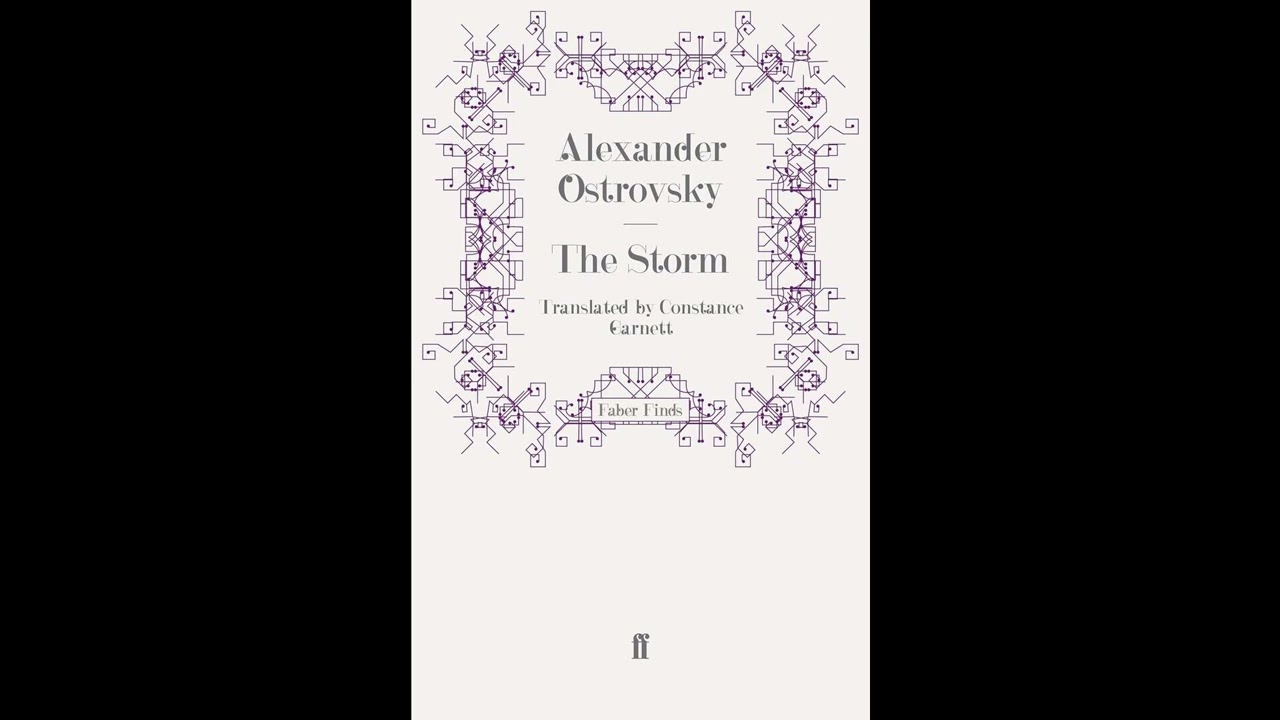
The Storm
Alexander Ostrovsky's "The Storm" stands as a monumental work of Russian drama, a searing portrayal of human spirit clashing with rigid, suffocating tradition. First staged in 1859, this play casts a stark light on the "dark kingdom" of provincial life, a world where piety often masks cruelty, and individual yearning is crushed under the weight of an unyielding social order. It resonates powerfully today as a timeless examination of oppression, hypocrisy, and the desperate search for freedom, speaking to anyone who has felt constrained by expectation or yearned for an existence beyond the confines of their immediate world. The play’s central struggle, between a sensitive soul and an unpitying environment, remains as poignant and relevant now as it was when it first shocked and captivated audiences. The story unfolds in the fictional town of Katerinovsk, a stagnant, sleepy settlement on the banks of the mighty Volga River, a place where time seems to stand still and archaic customs hold sway. Here, we meet Katerina, a young woman of gentle nature and poetic spirit, married to Tikhon Kabanov. Tikhon, though not unkind, is weak-willed and utterly dominated by his tyrannical mother, Marfa Ignat'evna Kabanova, known to all as Kabanikha. Kabanikha is the embodiment of the old order: a fervent believer in strict, traditional morality and outward piety, whose stern gaze and constant criticism stifle any joy or independent thought within her household. Katerina finds herself trapped in this joyless home, her artistic inclinations and desire for genuine affection constantly thwarted. Her only allies are Tikhon's sister, Varvara, a pragmatic and somewhat rebellious young woman who finds her own ways to circumvent Kabanikha's rules, and Kuligin, a self-taught mechanic and philosopher who dreams of progress for his backward town. But Katerina's heart truly stirs when she encounters Boris Grigor'evich, Kabanikha's nephew, a well-educated but equally weak man dependent on his formidable aunt. When Tikhon is forced to leave for a journey, Katerina, overwhelmed by her lonely existence and Boris’s timid overtures, succumbs to her passions. This illicit affair, born of desperation and a longing for connection, sets in motion a chain of events that will lead to agonizing internal conflict and devastating public exposure within a society that offers no mercy for perceived transgressions. Alexander Ostrovsky, born in Moscow in 1823, carved out an unparalleled career as the most significant Russian playwright of the 19th century. Coming from a well-to-do merchant family, he initially studied law at Moscow University and later worked in various government offices, including a court. This early exposure to the intricacies of legal disputes and the everyday lives of ordinary citizens, particularly the merchant class, provided him with a rich reservoir of material and a keen understanding of Russian society. His first published play, "The Bankrupt" (later renamed "It's a Family Affair – We'll Settle It Ourselves"), caused a scandal with its unvarnished portrayal of a corrupt merchant, leading to government censorship. Undeterred, Ostrovsky continued to write, producing nearly fifty plays that meticulously depicted the social mores, linguistic quirks, and moral failings of various strata of Russian society, from the merchant class to the lesser nobility and civil servants. He is often credited with founding the modern Russian national theatre, providing a repertoire of realistic plays that reflected the lives and concerns of contemporary Russians. Other notable works include "Poverty Is No Vice," a comedic critique of traditional values, and "The Forest," a brilliant satire on provincial hypocrisy and the struggle of artists. Ostrovsky's dedication to realism and his ability to craft memorable, psychologically complex characters earned him immense popularity and a lasting place in the literary canon, influencing generations of playwrights and actors. He passed away in 1886, leaving behind a body of work that continues to be performed and studied worldwide. The Storm lays bare several profound themes, chief among them the stark contrast between oppression and the human yearning for freedom. Katerina, confined by Kabanikha's suffocating rules and the locked gates of her garden, frequently expresses a longing to fly, to be like the birds she watches outside her window. This simple, recurring image underscores her spiritual imprisonment and her innate, almost visceral need for liberation, which ultimately drives her actions, however tragic their consequences. Another central theme is the widespread hypocrisy and moral decay within the provincial society. Kabanikha, a devout churchgoer who meticulously observes all outward forms of religious observance, is simultaneously a cruel tormentor of her family, her piety serving as a shield for her authoritarian nature. Similarly, Savel Prokof'ich Dikoy, a wealthy merchant, loudly abuses his dependents while clinging to an outdated social hierarchy, his public shows of faith belied by his tyrannical behavior. The play also serves as a potent commentary on the individual's struggle against an unyielding society. Katerina's internal turmoil and eventual public confession are not merely personal failures but a direct outcome of a community that offers no space for compromise, forgiveness, or individual expression. The rigid expectations and the absence of compassion force her into an impossible choice, highlighting how the collective weight of tradition can crush even the most vibrant spirits. Furthermore, Ostrovsky subtly foregrounds the tension between an antiquated way of life and the stirrings of modernity. Kuligin, with his dreams of perpetual motion machines and lightning rods, represents a nascent scientific and progressive spirit, constantly clashing with the entrenched superstitions and resistance to change embodied by Kabanikha and Dikoy, hinting at the vast societal shifts brewing beneath the surface of Russian life. "The Storm" was written and published in 1859, a pivotal moment in Russian history, on the cusp of the Great Reforms. Emperor Alexander II had just ascended to the throne, ushering in a period of intense intellectual debate and social change that would culminate in the emancipation of the serfs in 1861. The play emerged from a cultural landscape grappling with the legacy of serfdom, the patriarchal structure of society, and the burgeoning calls for progress and modernization. Ostrovsky's work, particularly "The Storm," served as a powerful critique of the "dark kingdom" – a term coined by the critic Nikolay Dobrolyubov in his influential essay on the play – referring to the ignorance, superstition, and oppression prevalent in the Russian provinces. It reflected the deep anxieties and hopes of a society teetering between its feudal past and an uncertain, modern future, giving voice to the frustrations of those trapped by archaic customs and authoritarian figures. Listening to "The Storm" as an audiobook offers a uniquely immersive experience, allowing the theatrical power of Ostrovsky's dialogue to truly shine. The several hours of runtime become a window into Katerinovsk, with distinct voices bringing to life Kabanikha's relentless, cutting pronouncements, Katerina's lyrical laments and desperate pleas, and Dikoy's blustering tirades. The pacing of the narration is critical, building the suffocating atmosphere of the Kabanov household and gradually ratcheting up the tension as Katerina's internal conflict grows. Listen for the subtle inflections that betray character, the moments of dramatic stillness followed by explosive emotional outbursts, and the underlying current of the Volga's presence, a symbol of both escape and tragic finality, woven into the sonic landscape of the story.
Enjoyed The Storm? A few ways to support us
Audible & Amazon links are affiliate; we may earn a small commission at no extra cost.
About this production
Human narration by a volunteer reader from LibriVox.org, the public-domain audiobook project. LibriVox volunteers record literary works whose copyright has expired in the United States, releasing the resulting recordings into the public domain.
The Storm by Alexander Ostrovsky. The underlying text is in the U.S. public domain. We do not republish any modern copyrighted edition, translation, or commentary.
The 4K cinematic visuals accompanying this audiobook are generated by an AI image model from prompts derived from the source text. No copyrighted photos, paintings, or stock footage are used. AI generation is disclosed on every video on our YouTube channel as required by YouTube's altered/synthetic content policy.
English subtitles are transcribed from the LibriVox recording with OpenAI Whisper. Translations into the 11 other supported languages are produced by Meta's NLLB-200 neural translation model. No human translator's copyrighted translation is used.
Questions about sourcing or rights? See our DMCA & Sourcing policy or contact us.
Enjoyed this audiobook?
If you'd like to own a copy of The Storm or hear a professionally produced edition, the links below help support free audiobook production at no extra cost to you.
As an Amazon Associate we earn from qualifying purchases. Audible / print links are affiliate.