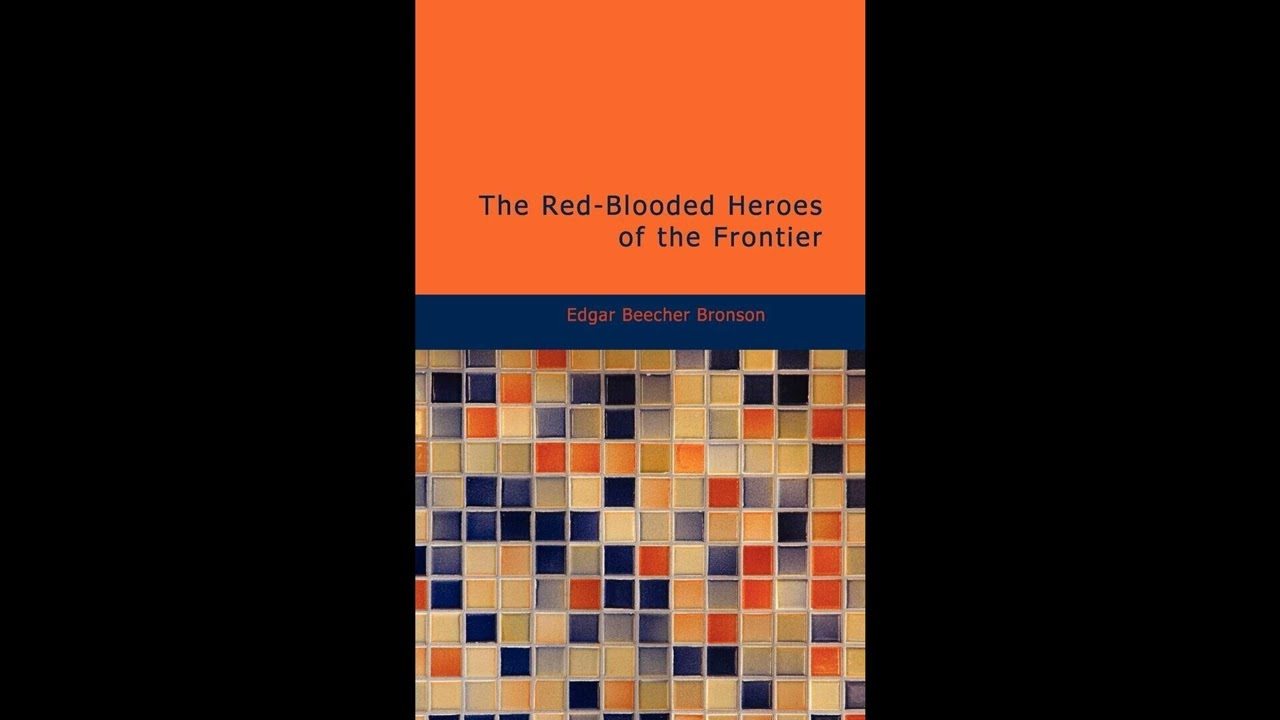
The Red-Blooded Heroes of the Frontier
The American West—a place synonymous with untamed wilderness, boundless opportunity, and the crucible of a distinct national character. Edgar Beecher Bronson's The Red-Blooded Heroes of the Frontier brings to vivid life a pivotal era, offering a direct window into the experiences that forged the myths and realities of that grand expanse. More than a collection of historical anecdotes, this book serves as an essential testament to the spirit of rugged individualism and communal resilience that defined the frontier. For today’s listener, it provides not only a thrilling narrative of daring deeds and stark survival, but also a crucial context for understanding the enduring legends and complex legacy of America’s westward expansion, reminding us what it meant to face an unyielding world with courage and resourcefulness. Bronson’s narrative transports listeners to the late nineteenth and early twentieth centuries, painting an expansive tableau of the American West. Here, the vast, unbroken plains meet jagged mountain ranges, and nascent settlements cling precariously to the edges of a still-wild continent. The story unfolds not around a single protagonist, but through a gallery of unforgettable figures—the quintessential frontiersmen, stoic cowboys, resolute prospectors, cunning Native American leaders, and courageous women who carved lives out of the wilderness. These are men and women whose names may not always grace history books, but whose daily struggles and triumphs shaped the very fabric of a nation. The central conflict of these interwoven tales is humanity’s relentless encounter with the raw forces of nature and the volatile interactions between diverse cultures vying for a foothold. Listeners witness the relentless battle against blizzards that sweep across the prairie, the scarcity of water in arid lands, and the constant threat posed by dangerous wildlife. Beyond the elements, the narrative also chronicles the intense human dramas: the pursuit of justice against outlaws, the fragile peace and sudden conflicts with various indigenous tribes, and the sheer grit required to establish a home in an unforgiving landscape. Each chapter offers a fresh perspective on the daily heroism—and occasional tragedy—that defined life on the frontier, capturing the arc of struggle and eventual, if often bittersweet, triumph that characterized the era. Edgar Beecher Bronson, born in 1853 in Wyoming County, New York, was uniquely positioned to chronicle the American West. Unlike many who wrote from a distance, Bronson lived the life he described. After a brief period at Yale, he felt the pull of the frontier, heading west in his youth to become a working cowboy, a miner in the Dakotas, and even a lawyer in Wyoming. His firsthand experiences as a ranchman, a hunter, and a participant in the unfolding drama of the West provided an authenticity that set his writing apart. Later, he turned to journalism and writing, leveraging his intimate knowledge to craft narratives that resonated with a public eager for genuine accounts of the disappearing frontier. Bronson was part of a tradition of writers who sought to capture the authentic spirit of the American West, often standing in contrast to the more sensationalized dime novels of his time. He penned several notable works, including Reminiscences of a Ranchman (1908) and In Closed Territory (1906), solidifying his reputation as a keen observer and an engaging storyteller. His work falls within a broader literary movement that valued realism and regionalism, striving to present an unvarnished view of life in specific American settings. Bronson's contribution lies in his ability to bridge the gap between historical fact and compelling narrative, ensuring that the true grit and glory of the frontier were not lost to legend or embellishment before his passing in 1917. The book powerfully enacts several core themes central to understanding the American experience. One prominent theme is undoubtedly courage and heroism, as the title suggests. Bronson illustrates this through countless examples, such as the stoic resilience of a lone scout facing down a band of cattle rustlers against impossible odds, or the unwavering resolve of a pioneer woman protecting her children during a sudden blizzard. These aren't abstract concepts; they are embodied in the moment-to-moment decisions of individuals under immense pressure, highlighting a courage born not of bravado, but of necessity. Another significant theme is survival against overwhelming odds, both natural and man-made. The accounts depict characters constantly adapting to a brutal environment, whether by tracking game across vast distances to stave off hunger, or by constructing shelters from whatever sparse materials the land offered. Furthermore, the book candidly addresses the clash of cultures between white settlers and Native American tribes. Bronson presents glimpses into the complex relationships, moments of profound misunderstanding, and the often tragic consequences of expansion, challenging listeners to consider the human cost of westward progress from multiple perspectives, and not shying away from the harsh realities of frontier justice and conflict. Published in 1910, The Red-Blooded Heroes of the Frontier emerged during a period of intense reflection on America's identity and history. The frontier, famously declared "closed" by the U.S. Census Bureau in 1890, was already receding into the realm of memory and myth. This era saw a surge of nostalgia for the "Wild West," even as the nation was rapidly industrializing and urbanizing. Writers like Bronson felt a pressing need to document the lives and experiences of those who had shaped this unique chapter of American history before they vanished entirely. Culturally and politically, America was grappling with its own coming-of-age. The Progressive Era was in full swing, advocating for social reforms and a more regulated society, yet simultaneously, there was a deep-seated reverence for the rugged individualist spirit that the frontier represented. Bronson's work speaks to this dual consciousness, offering authentic accounts that served both as a tribute to a vanishing way of life and as a reminder of the foundational values—independence, self-reliance, and perseverance—that many believed defined the American character. His narratives provided a vital bridge between a romanticized past and an ever-changing present. Listening to The Red-Blooded Heroes of the Frontier as an audiobook offers a uniquely immersive experience, perfectly suited to the episodic nature of these tales. A skilled narrator brings the vastness of the landscape and the gravitas of its inhabitants directly to your ears, their voice painting images of sweeping plains and towering mountains. You can fully appreciate the unhurried descriptions that set the scene, followed by sudden, heart-pounding bursts of action. The narration’s pacing allows you to absorb the authentic-sounding dialogue, which captures the distinct cadences and expressions of frontiersmen, settlers, and Native American figures, lending a sense of direct witness to the events. The atmosphere created through voice and delivery — the crackle of a campfire under an immense sky, the tension of a standoff, the quiet determination of a long trek — envelops the listener, making the hours spent with this audiobook feel like time traveling to a foundational period in American history.
Enjoyed The Red-Blooded Heroes of the Frontier? A few ways to support us
Audible & Amazon links are affiliate; we may earn a small commission at no extra cost.
About this production
Human narration by a volunteer reader from LibriVox.org, the public-domain audiobook project. LibriVox volunteers record literary works whose copyright has expired in the United States, releasing the resulting recordings into the public domain.
The Red-Blooded Heroes of the Frontier by Edgar Beecher Bronson. The underlying text is in the U.S. public domain. We do not republish any modern copyrighted edition, translation, or commentary.
The 4K cinematic visuals accompanying this audiobook are generated by an AI image model from prompts derived from the source text. No copyrighted photos, paintings, or stock footage are used. AI generation is disclosed on every video on our YouTube channel as required by YouTube's altered/synthetic content policy.
English subtitles are transcribed from the LibriVox recording with OpenAI Whisper. Translations into the 11 other supported languages are produced by Meta's NLLB-200 neural translation model. No human translator's copyrighted translation is used.
Questions about sourcing or rights? See our DMCA & Sourcing policy or contact us.
Enjoyed this audiobook?
If you'd like to own a copy of The Red-Blooded Heroes of the Frontier or hear a professionally produced edition, the links below help support free audiobook production at no extra cost to you.
As an Amazon Associate we earn from qualifying purchases. Audible / print links are affiliate.