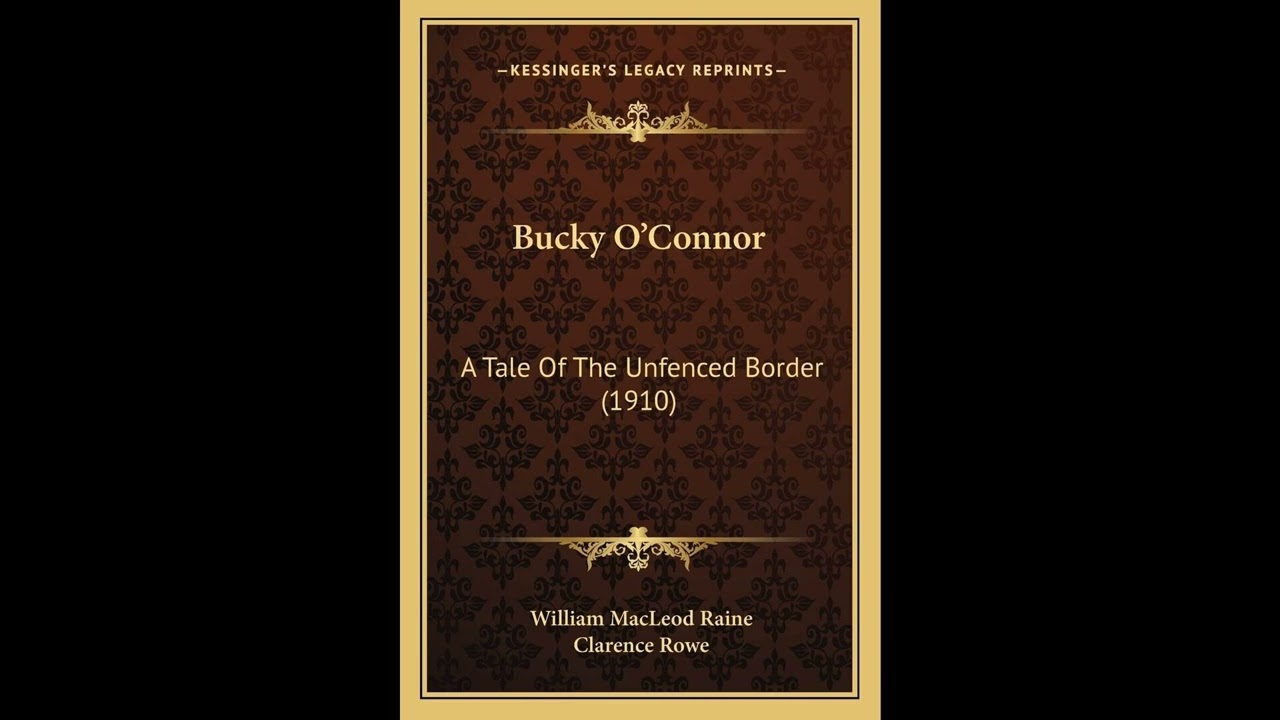
Bucky O'Connor: A Tale Of The Unfenced Border (1910)
"Bucky O'Connor: A Tale Of The Unfenced Border" isn't merely a century-old story; it's a foundational cornerstone of the American Western, plunging listeners into the untamed heart of the early 20th-century frontier. William MacLeod Raine's 1910 novel captures the raw spirit of an era defined by rugged individualism, stark landscapes, and the eternal clash between order and anarchy. It offers more than simple escapism; it presents a vivid, unvarnished look at the myth-making process of the West, showcasing the courage, moral dilemmas, and surprising humor of men and women who forged their own destinies. This gripping narrative resonates with anyone who has ever faced an uncertain path, making the legendary figures of the old border feel as immediate and vital as ever. Our tale unfolds amidst the dusty, sun-baked expanses of the Arizona-New Mexico border, a region where the land itself seems to breed both beauty and brutality. This is a country of sprawling ranches, isolated settlements, and treacherous canyons, where human law often takes a backseat to the quick draw of a six-shooter. At the center of this world stands Bucky O'Connor, a young man who arrives under a cloud of suspicion, haunted by a past that hints at previous missteps. He’s a drifter, an outsider, yet possesses an innate sense of justice and a determination to make his own way, earning his stripes where trust is hard-won. Bucky quickly finds himself entangled in local politics and personal feuds, particularly concerning the powerful Bransford ranch, overseen by the formidable Judith Bransford. Judith, a woman of unusual strength, battles to protect her family’s legacy against a relentless tide of rustlers and unscrupulous rivals. Bucky, drawn into her orbit, must navigate this dangerous landscape, proving his worth not just as a skilled horseman and marksman, but as a man of integrity capable of standing against overwhelming odds. The narrative arc follows Bucky’s arduous path toward redemption and respect, as he confronts the lawlessness that pervades the unfenced border and grapples with burgeoning feelings for Judith, all while the specter of his prior troubles looms. William MacLeod Raine, born in London, England, in 1871, became one of the most prolific authors of the American Western. His family immigrated to the United States when he was ten, settling in the Midwest, where he developed an early affinity for frontier stories. Raine pursued an education and eventually a career in journalism, working for newspapers in places like Denver. It was in the American West that Raine found his true calling. Beginning his fiction career in the late 1890s, Raine quickly found success with his authentic depictions of cowboy life, mining camps, and the challenges of establishing law. His debut novel, A Daughter of the Dons, was published in 1903, marking the beginning of an extraordinarily productive period. Over the next five decades, Raine penned more than eighty novels, including popular titles such as The Yukon Trail and Brand Blotters. He established himself as a master of the genre, known for his fast-paced plots, clear prose, and believable characters. Raine's works helped to codify many of the tropes and archetypes synonymous with the Western, offering millions of readers a window into a rugged world until his passing in 1954. "Bucky O'Connor" powerfully renders several enduring themes that define the Western. One prominent idea is the struggle between law and lawlessness. The narrative depicts a nascent society where formal legal structures are weak, and justice often falls to individuals willing to enforce it. Bucky’s arrival in a town dominated by outlaws and the Bransford ranch’s constant battle against cattle rustlers serve as concrete examples. The story asks how order can be established when the "unfenced border" truly means a border without rules. Another central theme is the nature of reputation and redemption. Bucky O'Connor arrives with a shadowed past, and much of the story concerns his efforts to overcome preconceived notions and prove his character through his actions. He earns his standing through courage, loyalty, and a willingness to put himself at risk for others. This plays out in subtle interactions where locals eye him warily, and in overt challenges where he must face down accusations. Coupled with this is the theme of individual strength and self-reliance, common in frontier narratives. Both Bucky and Judith are figures who stand firm against adversity, relying on their wits and resolve in a world that offers little outside support. When "Bucky O'Connor" was published in 1910, America was undergoing a significant cultural shift. The "closing of the frontier" had been declared two decades prior, creating a profound sense of nostalgia and a burgeoning public appetite for stories romanticizing the vanishing Old West. Authors like Raine provided an essential service, capturing the excitement and danger of a bygone era for a nation rapidly industrializing and urbanizing. The early 20th century also saw the popularization of mass-market literature. Dime novels and serialized stories paved the way for full-length Western novels to reach a wide audience. These stories shaped America's self-image, reinforcing ideas of rugged independence, moral fortitude, and the pioneering spirit. Raine’s work emerged at a moment when the frontier narrative was solidifying into a powerful national myth, offering readers a clear vision of American heroism and the foundational struggles that forged the nation. Experiencing "Bucky O'Connor" as an audiobook brings the arid plains, the tense standoffs, and the spirited dialogue to life. The narrator's performance is paramount in conveying the vastness of the unfenced border, the dusty atmosphere of a frontier town, and the crackle of tension in a saloon confrontation. With several hours of listening ahead, the pacing perfectly suits the ebb and flow of Western drama—moments of quiet reflection under an immense sky punctuated by sudden, explosive action. A skilled voice artist will distinguish Bucky’s quiet determination from Judith’s unwavering resolve, and give each colorful character and menacing villain their own distinct inflections. Listen for the subtle nuances, the way dialogue sharpens under pressure, and how the narrative captures the distinct patois of the turn-of-the-century West. It's an auditory adventure, immersing you fully in the sounds and emotions of a legendary period.
Enjoyed Bucky O'Connor: A Tale Of The Unfenced Border (1910)? A few ways to support us
Audible & Amazon links are affiliate; we may earn a small commission at no extra cost.
About this production
Human narration by a volunteer reader from LibriVox.org, the public-domain audiobook project. LibriVox volunteers record literary works whose copyright has expired in the United States, releasing the resulting recordings into the public domain.
Bucky O'Connor: A Tale Of The Unfenced Border (1910) by William MacLeod Raine. The underlying text is in the U.S. public domain. We do not republish any modern copyrighted edition, translation, or commentary.
The 4K cinematic visuals accompanying this audiobook are generated by an AI image model from prompts derived from the source text. No copyrighted photos, paintings, or stock footage are used. AI generation is disclosed on every video on our YouTube channel as required by YouTube's altered/synthetic content policy.
English subtitles are transcribed from the LibriVox recording with OpenAI Whisper. Translations into the 11 other supported languages are produced by Meta's NLLB-200 neural translation model. No human translator's copyrighted translation is used.
Questions about sourcing or rights? See our DMCA & Sourcing policy or contact us.
Enjoyed this audiobook?
If you'd like to own a copy of Bucky O'Connor: A Tale Of The Unfenced Border (1910) or hear a professionally produced edition, the links below help support free audiobook production at no extra cost to you.
As an Amazon Associate we earn from qualifying purchases. Audible / print links are affiliate.