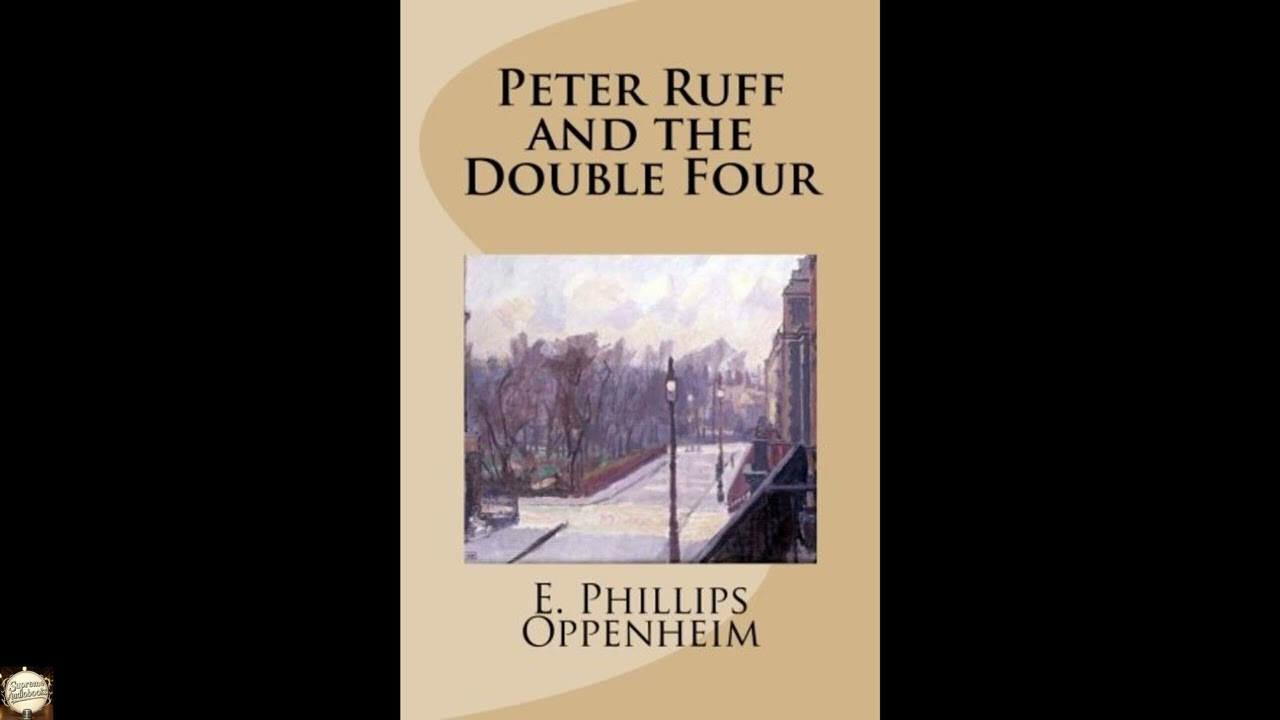
Peter Ruff and the Double Four
Step into a world shrouded in secrets and propelled by the silent gears of international intrigue with E. Phillips Oppenheim’s Peter Ruff and the Double Four. This classic thriller, a foundational text in the realm of espionage fiction, introduces listeners to a unique protagonist operating on the razor's edge between crime and justice. Before the super-spies and the high-tech gadgets, there was Peter Ruff—a man of profound intellect and an enigmatic past, whose quiet presence masks a formidable capacity for observation and deduction. For anyone fascinated by the origins of the spy genre, by stories where the battle of wits takes precedence over brute force, or by narratives that reflect the very real anxieties of a pre-war Europe, this audiobook offers a compelling, suspenseful experience that remains relevant for its intricate plotting and psychological depth. The story plunges us into the shadowy depths of Edwardian London, a city outwardly serene but secretly a hotbed of clandestine activities and whispers of continental unrest. Our protagonist, Peter Ruff, initially presents himself as a man of modest means, perhaps even a figure on the fringes of society, but beneath this unassuming exterior lies a mind sharper than any blade. He becomes unwittingly entangled with the Double Four, a terrifying and elusive criminal syndicate whose influence stretches across national borders and whose operatives seem to appear and vanish like phantoms. Their sinister agenda involves nothing less than widespread destabilization, threatening the very fabric of European peace and order through cunning schemes and a network of highly skilled, ruthless agents. As Ruff is drawn deeper into the conflict, he finds himself in a desperate, high-stakes game of cat and mouse. The Double Four is no ordinary gang; they are organized with chilling precision, their members masters of disguise, deception, and the art of vanishing without a trace. Ruff must employ every trick in his own considerable arsenal—his uncanny ability to read people, his talent for disguise, his strategic thinking—to anticipate their moves, unravel their plots, and prevent catastrophic events. Each confrontation is less about physical might and more about psychological warfare, a test of intellect and nerve as Ruff endeavors to outmaneuver an opponent that seems to hold all the cards and whose motives remain darkly opaque until the very end. The narrative consistently builds tension, presenting a relentless series of challenges that Peter Ruff must overcome to protect a world teetering on the brink. E. Phillips Oppenheim, born Edward Phillips Oppenheim in 1866, was an English novelist whose prolific output defined an era of popular fiction. Raised in Leicester, he initially followed his father into the leather business but soon found his true calling in storytelling. He began writing early, publishing his first novel in 1896, and over his long career, he penned more than 150 novels and countless short stories, earning him the unofficial title of "the Prince of Storytellers." His immense popularity spanned decades, cementing his reputation as a master of the thriller, espionage, and crime genres. Oppenheim enjoyed a life of considerable comfort, spending much of his later years on the French Riviera, testament to the success of his work. His books, often serialized in magazines before appearing in print, captivated a wide readership with their intricate plots, international settings, and dashing heroes. Oppenheim was a pioneer in developing the modern spy novel, paving the way for countless writers who followed. Works like The Great Impersonation and The Man Who Made London Laugh exemplify his talent for creating suspenseful narratives populated by clever protagonists, shadowy villains, and high-stakes intrigue. He was adept at reflecting the political anxieties and social changes of his time within highly readable and entertaining tales, making him a significant, if often overlooked, figure in the history of popular literature. Peter Ruff and the Double Four effectively showcases several recurring themes prominent in Oppenheim's work and in the broader genre it helped shape. One central theme is the nature of identity and disguise, where characters frequently adopt false personas to achieve their aims. Peter Ruff himself is a master of blending into the background, altering his appearance or demeanor to gather information or evade capture. For instance, Ruff might appear as a shabby clerk in one scene, only to reveal himself as the sharpest mind in the room in the next, demonstrating how outward appearances are constantly manipulated to conceal true intentions or capabilities by both heroes and villains. Another powerful theme is moral ambiguity, where the line between lawful conduct and expedient action becomes blurred. Ruff often operates outside conventional legal frameworks, using his knowledge of the criminal underworld or bending rules to defeat an even greater evil. There are moments where his methods might be questionable, but they are consistently justified by the dire consequences of inaction against such a formidable foe as the Double Four. The presence of secret societies and conspiracies forms the bedrock of the narrative, tapping into a pervasive societal fear of unseen forces controlling events. The Double Four represents this fear made manifest – a powerful, anonymous group pulling strings from the shadows, their reach seemingly limitless. The novel dramatizes the psychological toll of fighting an enemy without a clear face or defined boundaries, fostering a sense of paranoia that mirrors real-world anxieties about espionage and hidden agendas. Finally, the story champions deduction and intellect over brute force. Peter Ruff’s victories are almost always achieved through his superior mental faculties—his ability to piece together fragments of information, to predict an opponent's move, or to devise a clever trap. A scene might feature him escaping a physical threat not through combat, but by outsmarting his pursuers with a cunning diversion or a meticulously planned escape, highlighting the power of the mind in an age of growing global complexity. The early 20th century, the period during which Oppenheim was writing and Peter Ruff and the Double Four likely emerged, was a crucible of profound change and escalating tensions. Culturally, Europe was basking in the twilight of the Edwardian era, a time of relative peace and prosperity, yet underneath, anxieties simmered. Politically, the continent was a powder keg, with competing empires, the rise of nationalism, and an escalating arms race creating an atmosphere of deep unease and suspicion. The public was fascinated by stories of international espionage, secret agents, and clandestine operations, reflecting a very real awareness of the "Great Game" played out by intelligence services across borders. This environment was ripe for the emergence of the spy thriller. Oppenheim, along with contemporaries like William Le Queux and John Buchan, tapped directly into these collective fears and fascinations. His works provided thrilling escapism while simultaneously offering a lens through which to process the complex geopolitical landscape. Peter Ruff and the Double Four perfectly captures this zeitgeist, presenting a narrative where the security of nations hinges on the actions of extraordinary individuals battling unseen enemies, resonating deeply with a public grappling with the shifting tides of power and the looming shadow of war. Listening to Peter Ruff and the Double Four as an audiobook offers a uniquely immersive experience, perfectly suited to the novel’s atmosphere of suspense and intrigue. The narrator’s voice becomes the conduit for Oppenheim’s meticulously crafted plotting, allowing the listener to truly sink into the period setting and the escalating tension. With its runtime of several hours, this makes for an ideal companion during commutes, long walks, or evenings spent unwinding. Pay close attention to the pacing, which often begins with a deceptive calm before accelerating into a breathless pursuit of information or a desperate evasion. The subtle shifts in voice for different characters, particularly for Peter Ruff himself – his calm resolve versus the menace of his antagonists – enhance the psychological depth of the story. The dialogue, crisp and often formal yet full of concealed meaning, truly shines when spoken, bringing to life the witty exchanges and veiled threats that define Ruff’s encounters with the Double Four. The atmospheric details of Edwardian London and the chilling undertones of international conspiracy are amplified, drawing the listener fully into the world of secrets and shadows.
Enjoyed Peter Ruff and the Double Four? A few ways to support us
Audible & Amazon links are affiliate; we may earn a small commission at no extra cost.
About this production
Human narration by a volunteer reader from LibriVox.org, the public-domain audiobook project. LibriVox volunteers record literary works whose copyright has expired in the United States, releasing the resulting recordings into the public domain.
Peter Ruff and the Double Four by E. Phillips Oppenheim. The underlying text is in the U.S. public domain. We do not republish any modern copyrighted edition, translation, or commentary.
The 4K cinematic visuals accompanying this audiobook are generated by an AI image model from prompts derived from the source text. No copyrighted photos, paintings, or stock footage are used. AI generation is disclosed on every video on our YouTube channel as required by YouTube's altered/synthetic content policy.
English subtitles are transcribed from the LibriVox recording with OpenAI Whisper. Translations into the 11 other supported languages are produced by Meta's NLLB-200 neural translation model. No human translator's copyrighted translation is used.
Questions about sourcing or rights? See our DMCA & Sourcing policy or contact us.
Enjoyed this audiobook?
If you'd like to own a copy of Peter Ruff and the Double Four or hear a professionally produced edition, the links below help support free audiobook production at no extra cost to you.
As an Amazon Associate we earn from qualifying purchases. Audible / print links are affiliate.