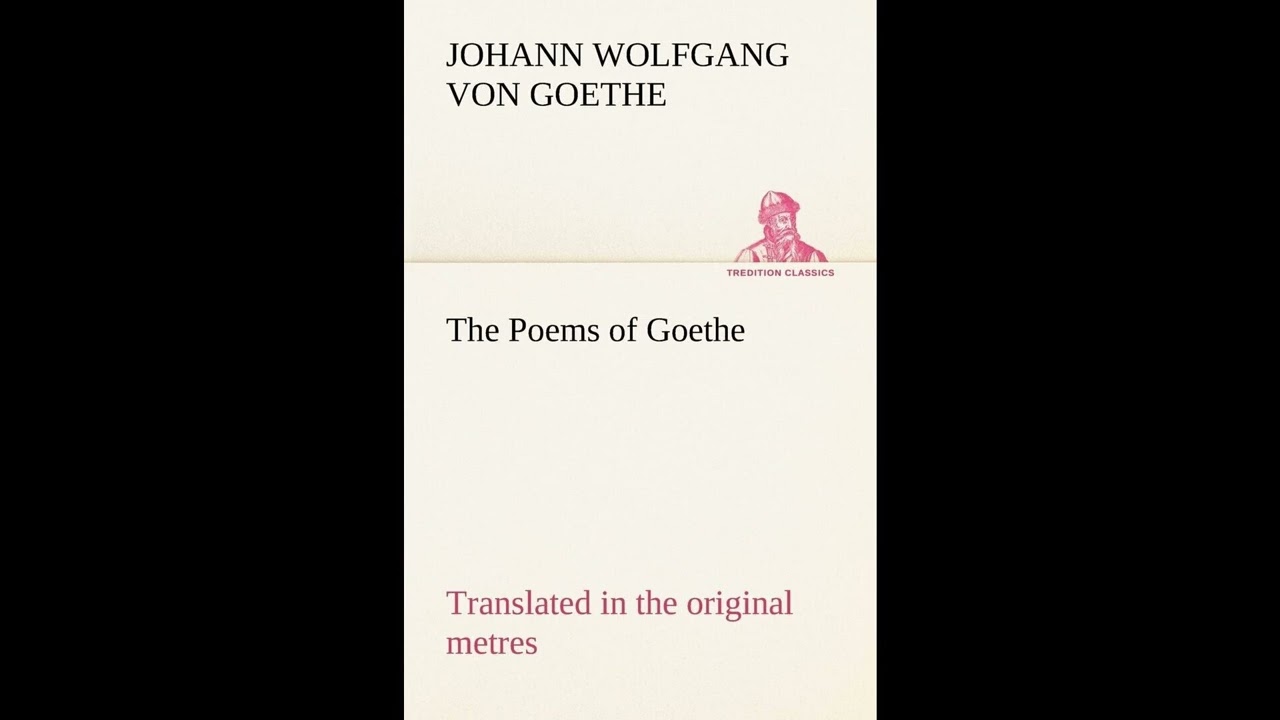
The Poems of Goethe Translated in the original metres
Goethe's poetry stands as a monumental pillar in Western literature, a testament to language's power to distill the human spirit's joys and sorrows. This collection presents Johann Wolfgang von Goethe's lyrical output, meticulously rendered into English, preserving original metres and rhythmic integrity. These poems are portals to a world where nature speaks, love burns, and wisdom is sought. Listening offers a rare opportunity to connect directly with the musicality and emotional nuance that made Goethe the preeminent voice of his age, a voice resonating with clarity and relevance today. Within these verses, the listener finds no single narrative, but a grand drama of consciousness across human experience. From youthful passion to elder contemplations, Goethe's poetry embodies a spectrum of emotional states. We encounter figures consumed by romantic ardor, lamenting lost loves, or celebrating a spring day. Settings shift from garden paths and moonlit forests to classical antiquity and rugged Alps. The "characters" are often personifications of universal feelings – the yearning heart, the questioning mind – or mythical figures brought to vivid life. The central "conflict" of these poems is often internal: the tension between aspiration and limitation, between individual spirit's impulses and societal demands. We witness the poet-speaker grappling with nature's forces, seeking solace or revelation, or questioning humanity's place. An arc moves from the tempestuous "Sturm und Drang" outpourings of his younger years towards the more measured, harmonically balanced expressions of his later "Weimar Classicism." This progression reflects personal and intellectual growth, an ongoing negotiation with the self and the world. Johann Wolfgang von Goethe, born in Frankfurt am Main in 1749, lived a life of extraordinary breadth and influence, a universal genius. His early education was extensive, steeped in languages, art, and law. A pivotal moment arrived with The Sorrows of Young Werther in 1774, an epistolary novel that became an overnight sensation. This made him a celebrity and leader of the nascent Sturm und Drang movement, championing individual emotion, natural genius, and passionate rebellion against Enlightenment rationalism, establishing a new literary direction. In 1775, invited by Duke Carl August, Goethe moved to Weimar, transforming the small duchy. His interests broadened, encompassing scientific studies and ducal administration. This era marked a transition towards Weimar Classicism, seeking a synthesis of passion and form, beauty and intellect, inspired by ancient Greek and Roman models. His dramatic poem Faust, completed shortly before his death in 1832, is considered his crowning achievement, a philosophical epic examining human striving. Other notable works include Wilhelm Meister's Apprenticeship and West-Eastern Divan. Goethe's immense impact solidified his place as a foundational figure of modernity. Goethe's poems illuminate human concerns. One prominent theme is humanity's profound connection with nature. His verses frequently depict the natural world not merely as a backdrop, but as a living entity mirroring human emotions and offering lessons. In "To the Moon" (An den Mond), the tranquil night sky or a flowing river becomes a confidant for the solitary soul, reflecting melancholy or offering peace. Another pervasive theme is the ceaseless yearning for ideal beauty and knowledge. Through scientific understanding or classical art contemplation, Goethe's speakers often strive beyond the mundane, seeking a higher order or deeper truth. The complexities of love and human relationships form another core element. From the intoxicating flush of first attraction to the bittersweet ache of separation, Goethe renders romantic sentiment with honesty and elegance. His poems capture joy, pain, and folly inherent in desire, often with poignant awareness of life's transience. Furthermore, the tension between individual freedom and societal constraint, or between passion and reason, often drives the poetic voice. Many verses express the struggle against conventional norms, or finding harmony between inner desires and the external world. These recurring motifs ground his poetry in universal human experience. Goethe's long and productive life spanned a period of great upheaval in Europe. Born into the tail end of the Enlightenment, a movement emphasizing reason, individualism, and scientific inquiry, he initially responded to its limitations with the emotional intensity of Sturm und Drang. This literary and artistic movement, which prefigured Romanticism, arose in Germany in the late 18th century as a reaction against perceived cold rationality. It championed subjective experience, powerful emotions, and reverence for untamed nature, making it a distinctly German phenomenon. Goethe's early poetry and Werther perfectly embodied this spirit. As the French Revolution and Napoleonic Wars reshaped Europe, Goethe’s aesthetic evolved. He transitioned from youthful rebellion of Sturm und Drang towards Weimar Classicism, a movement he co-founded with Friedrich Schiller. This shift was partly a response to the age's chaotic violence, seeking refuge and order in the ideals of ancient Greece and Rome – balance, harmony, and ethical perfection. His later works reflect a desire to synthesize the intense emotion of his youth with a more disciplined, universal form, creating art that could endure beyond political storms. His long career thus mirrored and shaped his time's intellectual and artistic currents, moving from revolutionary individualism to a more measured humanism. To truly appreciate Goethe's poetic artistry, listening to it read aloud, especially in translations honoring original metres, offers an unparalleled experience. The cadence, rhythm, and precise musicality of his language are brought to the forefront when spoken by a skilled narrator. You will hear subtle shifts in tone, intentional pauses, and emotional inflections often overlooked when reading text. The spoken word breathes life into the intricate structures and lyrical beauty, allowing the listener to absorb the intended impact of each line and stanza. This collection invites sustained immersion into the profound world Goethe created, allowing his wisdom, passion, and artistic precision to speak directly to the soul.
Enjoyed The Poems of Goethe Translated in the original metres? A few ways to support us
Audible & Amazon links are affiliate; we may earn a small commission at no extra cost.
About this production
Human narration by a volunteer reader from LibriVox.org, the public-domain audiobook project. LibriVox volunteers record literary works whose copyright has expired in the United States, releasing the resulting recordings into the public domain.
The Poems of Goethe Translated in the original metres by Johann Wolfgang Von Goethe. The underlying text is in the U.S. public domain. We do not republish any modern copyrighted edition, translation, or commentary.
The 4K cinematic visuals accompanying this audiobook are generated by an AI image model from prompts derived from the source text. No copyrighted photos, paintings, or stock footage are used. AI generation is disclosed on every video on our YouTube channel as required by YouTube's altered/synthetic content policy.
English subtitles are transcribed from the LibriVox recording with OpenAI Whisper. Translations into the 11 other supported languages are produced by Meta's NLLB-200 neural translation model. No human translator's copyrighted translation is used.
Questions about sourcing or rights? See our DMCA & Sourcing policy or contact us.
Enjoyed this audiobook?
If you'd like to own a copy of The Poems of Goethe Translated in the original metres or hear a professionally produced edition, the links below help support free audiobook production at no extra cost to you.
As an Amazon Associate we earn from qualifying purchases. Audible / print links are affiliate.