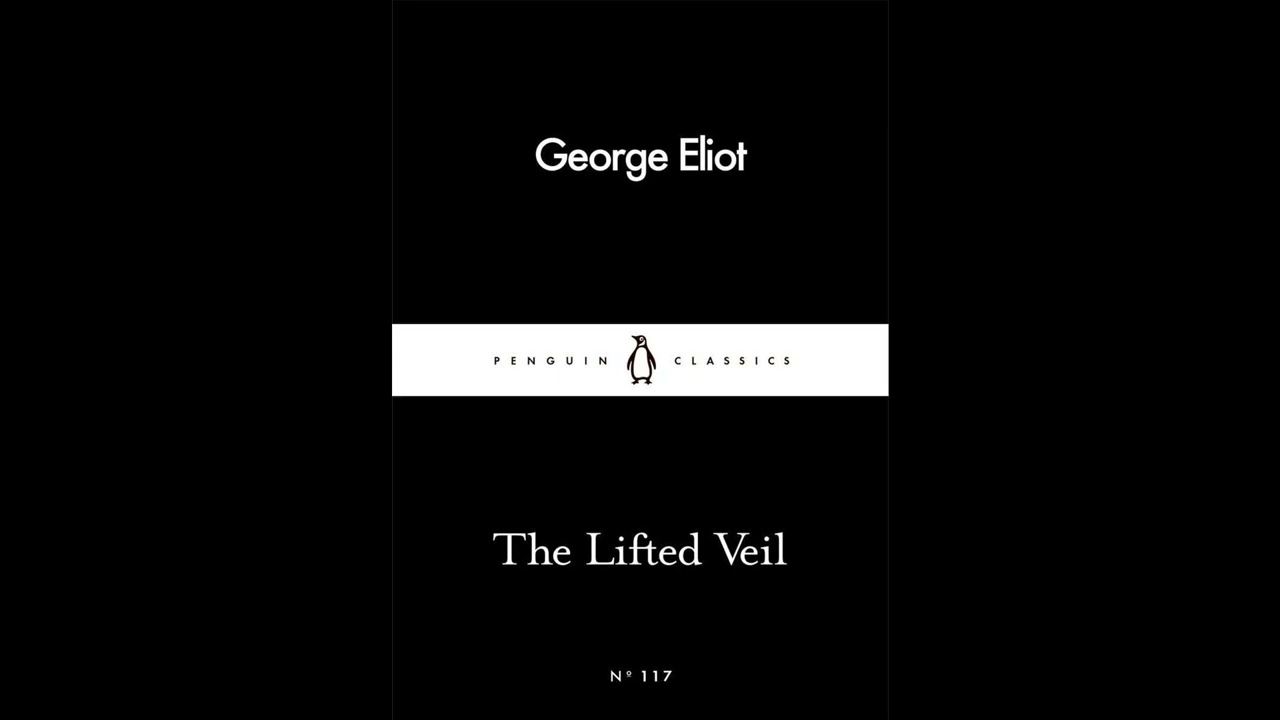
The Lifted Veil
George Eliot’s The Lifted Veil stands as a haunting and singular departure from her sprawling, socially grounded novels. It is a psychological novella, a gothic experiment, and a chilling venture into the uncanny that lays bare the profound and often terrifying consequences of unwanted knowledge. This compact yet powerful story asks a disquieting question that resonates acutely today: what if you knew too much, saw too clearly into the future, and could not alter your predetermined fate? It’s a prescient examination of isolation, the burden of prescience, and the tragic disconnect between inner truth and outward presentation, inviting the listener to confront the unsettling possibilities of an unshielded mind. The story unfolds across mid-nineteenth century Europe, moving from the refined drawing rooms of England to the dramatic backdrops of Geneva and Prague. We meet Latimer, a sensitive, artistic young man who feels an early sense of alienation. He is overshadowed by his conventionally successful elder brother and misunderstood by his pragmatic father. Latimer’s true affliction, however, is far more profound: a gift – or curse – of prescience and clairvoyance. He sees the future, particularly visions of death, and hears the unexpressed thoughts of others, often their most base or cruel intentions. This "lifted veil" isolates him completely, making genuine human connection fraught with pain and impossibility. Latimer’s life takes a dramatic turn when he becomes infatuated with Bertha Grant, his brother’s fiancée. Latimer's unbidden visions reveal Bertha’s shallow, cold, and calculating inner world, a stark contrast to her outwardly charming and beautiful facade. Yet, despite this chilling foreknowledge, he finds himself inexplicably drawn to her. After a tragic accident, Latimer and Bertha marry. The narrative then chronicles their profoundly unhappy union, made unbearable for Latimer by his constant, unbidden access to Bertha’s true thoughts and simmering malevolence. The arrival of a new servant, Mrs. Archer, in their household further escalates the pervasive tension, propelling the story towards a climactic and unsettling revelation that tests the very limits of Latimer’s perception and sanity, leaving the listener with the heavy weight of his extraordinary and terrible life. The author behind this compelling tale was Mary Ann Evans, though she is universally celebrated by her pen name, George Eliot. Born in Warwickshire in 1819, Evans was a woman of prodigious intellect and insatiable curiosity, truly ahead of her time. Her early life was marked by extensive self-education, as she devoured books and languages, distinguishing herself from many women of her era. She later moved to London, where she associated with leading radical thinkers and served as assistant editor for The Westminster Review, a prominent intellectual journal. This period significantly broadened her mind and immersed her in the key philosophical and scientific debates of the day. Her personal life, particularly her long, unconventional relationship with the philosopher and literary critic George Henry Lewes, was a source of social scandal. To ensure her serious fiction received a fair hearing, unburdened by societal judgment, she adopted the male pseudonym George Eliot, publishing her groundbreaking first novel, Adam Bede, in 1859. This success was followed by classics like The Mill on the Floss, Silas Marner, and her crowning achievement, Middlemarch. By the time of her death in 1880, she was widely recognized as a literary giant. Eliot’s contributions redefined the English novel, pushing the boundaries of realism, psychological depth, and moral inquiry. She meticulously depicted the inner lives of ordinary people, their struggles with conscience, community, and the subtle forces shaping human destiny, securing her place among the most profound and influential voices in the literary canon. The Lifted Veil functions as a chilling meditation on the peril of prescience and the profound burden of knowledge. Latimer’s clairvoyance, initially seeming like a unique faculty, quickly devolves into a source of immense suffering. He experiences the future not as a changeable path but as an inescapable script, and he hears the unspoken thoughts of others, stripping away the necessary illusions of social interaction. For example, his early visions of Bertha Grant reveal her cruel and calculating nature even as she presents a charming facade to the world. This foreknowledge prevents him from enjoying the natural unfolding of life, turning every interaction into an agonizing anticipation of pain or deceit. Furthermore, Latimer’s unusual abilities render him profoundly isolated. He cannot share his inner reality with anyone, as doing so would be either unbelievable or terrifying. This separation from common human experience denies him genuine empathy and connection. His awareness of others’ hidden thoughts makes sincere communication impossible, cementing his solitary existence within a crowd. The novella also keenly examines the duality of perception and reality, particularly through Bertha Grant, who is outwardly beautiful and charming but inwardly malicious—a truth Latimer perceives but cannot articulate or escape. Published in 1859, The Lifted Veil emerged from a period of intense intellectual and social flux in Victorian England. This was the same year Charles Darwin’s On the Origin of Species shattered conventional views of creation, ushering in an era of scientific skepticism and a questioning of established religious doctrines. Amidst this intellectual upheaval, there was also a widespread, though often controversial, interest in spiritualism, mesmerism, and the occult—phenomena that sought to explain experiences beyond rational understanding. Eliot herself, a profound intellectual deeply engaged with contemporary philosophy and science, undoubtedly wrestled with these debates. Her exploration of Latimer’s prescience can be seen as a sophisticated engagement with the era’s fascination with unseen forces and the limits of human perception, perhaps even a critique of the idea that such powers could bring happiness or clarity. While her major works championed realism, The Lifted Veil suggests an acknowledgment of the period’s lingering gothic sensibilities and the psychological mysteries that science alone could not fully explain, making it a unique product of its time. This novella is an ideal candidate for audio, its power residing in the intense first-person introspection of its tormented protagonist. A skilled narrator can bring Latimer’s singular, melancholic voice to life, allowing the listener to truly inhabit his burdened consciousness. The story’s psychological tension builds through his internal monologues and his chilling insights into the minds of those around him. Listening allows the subtle shifts in atmosphere, the creeping dread, and the moments of profound revelation to unfold with immediacy. The pacing, often slow and deliberate as Latimer grapples with his visions, benefits from an attentive listen, letting the full weight of his prophetic insights settle. A sensitive voice performance can amplify the tragic beauty of Eliot’s prose and fully realize the haunting, dreamlike quality of this extraordinary tale, making it a truly immersive experience for anyone seeking a powerful psychological narrative.
Enjoyed The Lifted Veil? A few ways to support us
Audible & Amazon links are affiliate; we may earn a small commission at no extra cost.
About this production
Human narration by a volunteer reader from LibriVox.org, the public-domain audiobook project. LibriVox volunteers record literary works whose copyright has expired in the United States, releasing the resulting recordings into the public domain.
The Lifted Veil by George Eliot. The underlying text is in the U.S. public domain. We do not republish any modern copyrighted edition, translation, or commentary.
The 4K cinematic visuals accompanying this audiobook are generated by an AI image model from prompts derived from the source text. No copyrighted photos, paintings, or stock footage are used. AI generation is disclosed on every video on our YouTube channel as required by YouTube's altered/synthetic content policy.
English subtitles are transcribed from the LibriVox recording with OpenAI Whisper. Translations into the 11 other supported languages are produced by Meta's NLLB-200 neural translation model. No human translator's copyrighted translation is used.
Questions about sourcing or rights? See our DMCA & Sourcing policy or contact us.
Enjoyed this audiobook?
If you'd like to own a copy of The Lifted Veil or hear a professionally produced edition, the links below help support free audiobook production at no extra cost to you.
As an Amazon Associate we earn from qualifying purchases. Audible / print links are affiliate.