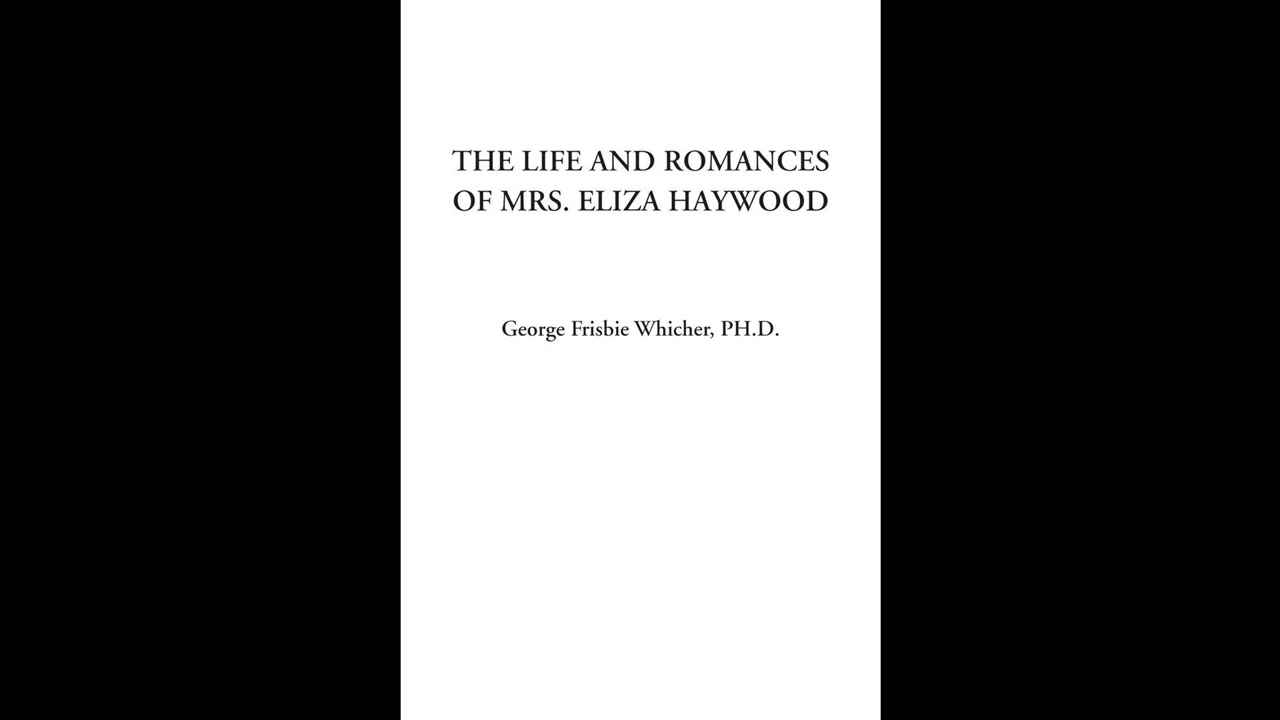
The Life and Romances of Mrs. Eliza Haywood
Before the Bronte sisters, before Jane Austen, even before Mary Wollstonecraft, there was Eliza Haywood – a figure who defied the rigid expectations of her age to become one of Britain's most prolific and controversial writers. George Frisbie Whicher's monumental work, The Life and Romances of Mrs. Eliza Haywood, stands as a vital re-evaluation of this foundational author, whose name was once synonymous with scandalous wit and literary ambition, yet has often been relegated to the footnotes of history. This detailed study resurrects Haywood not merely as an intriguing historical curiosity, but as a critical voice whose novels, plays, and periodicals offered sharp insights into the evolving social landscape of the early eighteenth century, particularly the precarious position of women. For anyone interested in the origins of the novel, the challenges faced by female artists, or the vibrant, often cutthroat world of Georgian literature, Whicher's meticulous account presents an essential lens through which to view a transformative period and one of its most daring participants. Whicher sets his scene in the bustling, frequently morally ambiguous London of the early 1700s, a city where wit could make one's fortune and scandal could ruin a reputation overnight. We are introduced to Eliza Haywood, born Elizabeth Fowler, at the outset of her public life – a woman of respectable, if somewhat obscure, origins who found herself drawn into the burgeoning world of professional letters. The narrative traces her initial ventures into theater, her early marriage and subsequent separation, and the pressing need to support herself and her children in an era that offered few avenues for independent women. Whicher meticulously reconstructs the circumstances that led Haywood to Grub Street, the teeming literary district, where she began to pour forth a prodigious output of novels, translating her lived experiences and keen observations into narratives that gripped the reading public. The story intensifies as Haywood's fame grows, particularly with the publication of sensational "secret histories" and novels of intrigue. She becomes a recognizable, if often maligned, personality in a literary world dominated by figures like Alexander Pope and Jonathan Swift. Whicher paints a picture of a woman navigating professional jealousies, public censure, and private entanglements that frequently spilled into her published work, blurring the lines between fiction and autobiography. Her personal relationships, often illicit in the eyes of society, become fodder for her detractors, who used satire and moral condemnation to attack her character and, by extension, her literary credibility. The central dramatic tension of Whicher's biography resides in Haywood's relentless struggle for artistic freedom and financial stability against the societal pressures designed to silence an outspoken, independent woman. She is shown constantly reinventing herself, adapting her writing to meet changing tastes and fending off attacks, her career arc a testament to her resilience. George Frisbie Whicher, PH.D., was an eminent American literary scholar and academic, recognized for his significant contributions to the study of English and American literature. Active in the early to mid-twentieth century, Whicher’s work exemplifies a rigorous, research-driven approach to literary biography and criticism. His academic career saw him associated with institutions dedicated to serious scholarship, where he cultivated a reputation for meticulous historical inquiry and insightful literary analysis. Whicher’s dedication to unearthing and understanding lesser-known literary figures, particularly those whose stories had been obscured by time or prejudice, marks him as a pioneering intellectual force. Among his other contributions, Whicher's scholarship consistently aimed to provide comprehensive contexts for understanding literary works and their creators. His writing style, evident throughout The Life and Romances of Mrs. Eliza Haywood, combines scholarly precision with engaging narrative skill, making complex historical and literary arguments accessible to a wide readership. This particular volume stands as a testament to his commitment to revising the literary canon, bringing to light the substantial achievements of an author who had long been dismissed or misunderstood. Whicher's careful sifting through sparse archival records, contemporary reviews, and Haywood's voluminous writings allowed him to construct what remains one of the most authoritative accounts of her life and literary career, solidifying his place as a crucial figure in eighteenth-century studies. Whicher's work illuminates several key themes relevant not only to Haywood's specific struggles but to broader literary and social history. Foremost among these is the theme of female authorship and agency in a patriarchal society. Haywood’s career vividly demonstrates the immense difficulties faced by women who dared to pursue a public profession, especially one as opinionated and financially uncertain as writing. Her sheer volume of output, from novels like Love in Excess to the editorship of the periodical The Female Spectator, stands as a powerful counter-narrative to the prevailing belief that women should remain in the private sphere. Whicher shows how Haywood often used her fiction to portray women navigating impossible choices, highlighting societal double standards, as seen in her often-sympathetic depiction of seduced women or those trapped in unhappy marriages. Another significant theme is the power of reputation and scandal in shaping a public figure’s legacy. Haywood was a frequent target of satirists, most notably Alexander Pope, who vilified her in The Dunciad. Whicher carefully dissects these attacks, showing how they often stemmed from misogyny and professional rivalry rather than genuine moral failing. Her perceived "scandalous" personal life became a weapon used to discredit her literary achievements, a tactic that Whicher argues ultimately led to her marginalization in subsequent literary histories. The text also underscores the rise of the novel as a literary form. Haywood was instrumental in popularizing this new genre, moving it beyond the aristocratic romances into more accessible, often sensational, narratives that appealed to a growing middle-class readership. Whicher credits her with significant innovations in plotting, character development, and emotional realism, influencing later novelists in surprising ways. The period during which Eliza Haywood lived and wrote, the early to mid-eighteenth century, was a time of profound cultural and societal transformation in Great Britain. Known often as the Augustan Age, it was characterized by the flourishing of print culture, the emergence of a burgeoning reading public—especially among women—and the rise of the coffee house as a hub for intellectual and literary exchange. Politically, the Hanoverian dynasty had recently been established, bringing with it a period of relative stability but also intense partisan debate, which often spilled into literature. This era saw the beginnings of modern journalism and the novel, moving away from classical forms towards narratives that reflected contemporary life and manners. Haywood's work emerged directly from this ferment: the demand for popular entertainment, the growing literacy rates, and the nascent commercialization of authorship. She was one of the first writers to truly make a living solely by her pen, navigating the often-brutal economics of Grub Street. Her willingness to address controversial subjects—from seduction and social hypocrisy to the complexities of female desire—resonated with a public hungry for stories that mirrored, however distortedly, their own realities and anxieties about changing social conventions. Listening to The Life and Romances of Mrs. Eliza Haywood as an audiobook offers a unique opportunity to immerse oneself in this compelling biography. The narrator's voice becomes the conduit for George Frisbie Whicher's meticulous research and his insightful interpretations of Haywood's world. Listeners will appreciate the measured pacing, which allows the often-dense historical detail and literary analysis to unfold with clarity. A skilled narrator brings Whicher's prose to life, distinguishing between historical fact, contemporary rumor, and critical assessment, ensuring that the listener can follow the complex interplay of Haywood's personal and professional life. The audiobook format allows the listener to fully absorb the dramatic arc of Haywood’s struggles and triumphs, providing an unbroken narrative flow that elevates the scholarly content into a truly engaging and accessible story, perfect for sustained periods of listening and contemplation.
Enjoyed The Life and Romances of Mrs. Eliza Haywood? A few ways to support us
Audible & Amazon links are affiliate; we may earn a small commission at no extra cost.
About this production
Human narration by a volunteer reader from LibriVox.org, the public-domain audiobook project. LibriVox volunteers record literary works whose copyright has expired in the United States, releasing the resulting recordings into the public domain.
The Life and Romances of Mrs. Eliza Haywood by George Frisbie Whicher PH.D. The underlying text is in the U.S. public domain. We do not republish any modern copyrighted edition, translation, or commentary.
The 4K cinematic visuals accompanying this audiobook are generated by an AI image model from prompts derived from the source text. No copyrighted photos, paintings, or stock footage are used. AI generation is disclosed on every video on our YouTube channel as required by YouTube's altered/synthetic content policy.
English subtitles are transcribed from the LibriVox recording with OpenAI Whisper. Translations into the 11 other supported languages are produced by Meta's NLLB-200 neural translation model. No human translator's copyrighted translation is used.
Questions about sourcing or rights? See our DMCA & Sourcing policy or contact us.
Enjoyed this audiobook?
If you'd like to own a copy of The Life and Romances of Mrs. Eliza Haywood or hear a professionally produced edition, the links below help support free audiobook production at no extra cost to you.
As an Amazon Associate we earn from qualifying purchases. Audible / print links are affiliate.