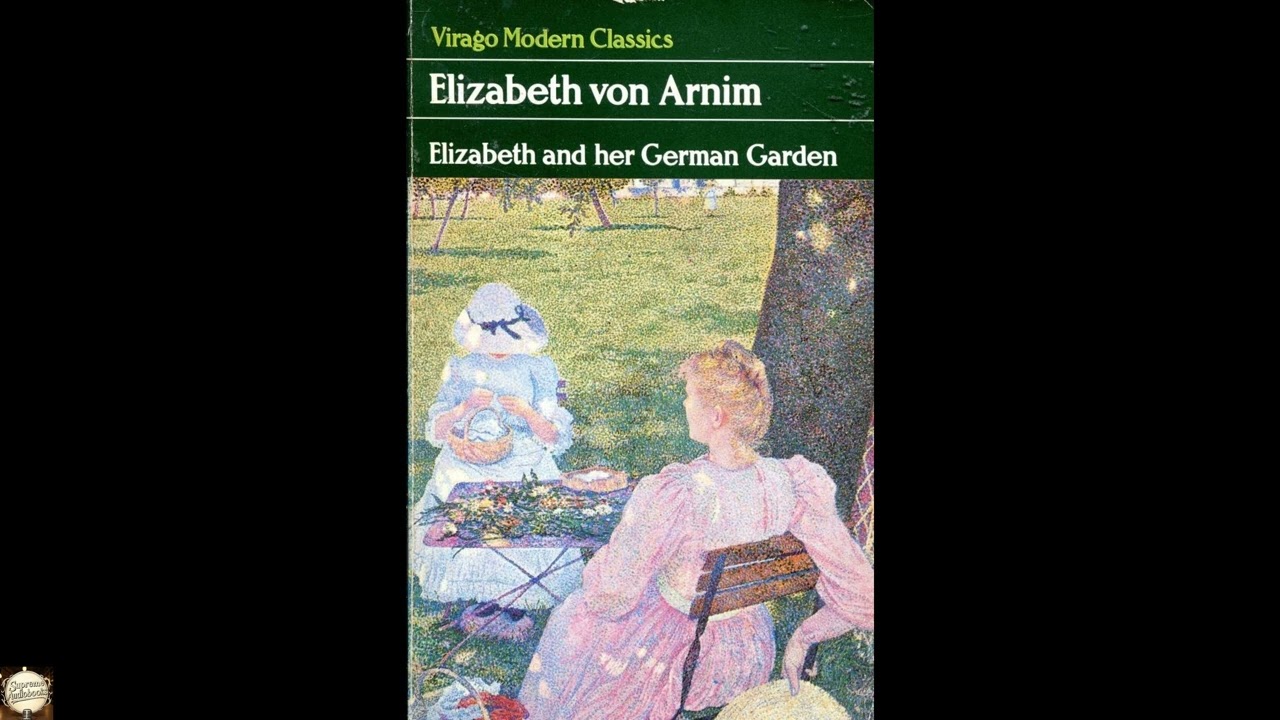
ELIZABETH AND HER GERMAN (Virago Modern Classics)
Step into a world of gentle wit, sun-drenched gardens, and the quiet rebellion of a woman determined to find her own patch of paradise amidst the demands of Edwardian society. Elizabeth Von Arnim’s ELIZABETH AND HER GERMAN introduces listeners to a singular voice—a clever, introspective woman who longs for solitude and the simple joy of nature, even as life conspires to pull her back into its social whirl. This beloved classic, often celebrated for its understated humor and keen observations of human nature, resonates as strongly today as it did when it first charmed readers, speaking to anyone who has ever yearned for a moment of peace, a breath of fresh air, and the freedom to cultivate their own unique happiness. Our story unfolds at an idyllic country estate in Pomerania, a region then part of Imperial Germany. Here resides Elizabeth, an Englishwoman married to a German aristocrat, the “German” of the title. She is a mother of three young daughters—referred to playfully as the April, May, and June babies—and mistress of a large household. Yet, despite her comfortable circumstances, Elizabeth feels a profound yearning for something more personal, something beyond the endless rounds of social calls, the management of servants, and the expectations of her marriage. Her sanctuary is her sprawling garden, a wild, untamed expanse she has lovingly cultivated herself, much to the quiet consternation of her practical husband. It is in this green haven, amidst the roses and the unruly vines, that Elizabeth seeks refuge from the mundane and the merely tolerable. The central conflict of the narrative arises from Elizabeth’s desire for unadulterated solitude and her husband's more conventional perspective, which sees the garden as something to be managed rather than worshipped, and solitude as peculiar rather than restorative. Her German, a man of routine and order, cannot quite comprehend his wife’s deep attachment to the natural world or her need for uninterrupted contemplation. This delicate tension is further complicated by the arrival of three unwelcome guests from England: Elizabeth’s two female friends, Minna and Sally, and her husband's rather imposing cousin, Lena. These intrusions threaten to shatter Elizabeth’s carefully constructed peace, pulling her back into a world of social niceties and superficial conversation, forcing her to choose between her cherished quietude and her duties as a hostess. The narrative gently follows Elizabeth’s attempts to reconcile her inner life with her outer obligations, all while maintaining her wry sense of humor and her profound appreciation for the beauty of her natural surroundings. The author behind this charming and enduring novel was Mary Annette Beauchamp, born in Australia in 1866, who later became Countess von Arnim after her marriage to Count Henning August von Arnim-Schlagenthin. Known primarily by her pen name, Elizabeth Von Arnim—or simply "Elizabeth" to her legions of fans—she cultivated a reputation as a witty and perceptive writer whose experiences living in aristocratic European circles provided fertile ground for her fiction. After the death of her first husband, she maintained relationships with prominent figures like H.G. Wells and E.M. Forster, and later married Frank Russell, Bertrand Russell's brother. Her life was characterized by a certain independence and a sharp intellect, qualities that shine through in her protagonists. Elizabeth Von Arnim carved out a distinct niche in literature with her keen observations of character and her ability to blend humor with deeper social commentary. Her works, including the much-loved The Enchanted April and Vera, often feature women seeking liberation or a personal awakening, frequently set against picturesque, often European, backdrops. She masterfully used satire to poke gentle fun at societal conventions and the foibles of the upper classes, establishing herself as a unique voice in the early twentieth century literary landscape. Her place in the canon is secured by her elegant prose, her psychological insights, and her creation of memorable female characters who, despite their constraints, strive for self-fulfillment. ELIZABETH AND HER GERMAN enacts several enduring themes, most notably the profound solace and restorative power of nature. Elizabeth’s garden is far more than just a plot of land; it is her spiritual refuge, a place where she can shed the burdens of her roles as wife and mother and connect with a deeper sense of self. We see this in her lyrical descriptions of the budding flowers, the changing seasons, and the quiet joy she finds in simply observing the natural world. For instance, when the pressures of her household grow too great, Elizabeth retreats to a specific sun-dappled corner of her garden, finding immediate peace and perspective among her beloved pansies and roses, her spirit refreshed by the rustling leaves and the open sky. Another central theme is the quest for female autonomy and intellectual independence within the confines of conventional marriage and society. Elizabeth, though economically secure, quietly struggles against the expectations placed upon her, desiring a mental and emotional space free from external demands. She cherishes her books and her solitude, often devising clever ways to avoid social obligations or to steal moments of introspection. Her internal monologues reveal a sharp mind constantly processing her experiences and asserting her individuality, even when her outward actions conform to expectations. This silent rebellion highlights the broader societal pressures on women of her era to prioritize domesticity and social graces over personal growth and intellectual pursuits. When Elizabeth Von Arnim's debut novel appeared at the turn of the twentieth century, the world was experiencing rapid social and technological change, yet traditional roles for women, particularly those of Elizabeth’s social standing, remained largely fixed. The Edwardian era, following the long Victorian reign, saw women beginning to push for greater freedoms, but the domestic sphere was still considered their primary domain. Books like ELIZABETH AND HER GERMAN tapped into a burgeoning desire among women for personal expression and a life beyond strictly domestic confines, even if that yearning had to be expressed subtly, through gardening or quiet contemplation. The novel emerged as part of a literary trend that valued psychological depth and domestic realism, moving away from more overtly moralizing narratives towards stories that probed the inner lives of individuals, especially women. Its immediate popularity underscored a widespread resonance with Elizabeth’s gentle struggle for identity amidst the beauty of her surroundings. Listening to ELIZABETH AND HER GERMAN as an audiobook offers a unique and deeply personal experience. The book’s introspective nature, with much of the narrative unfolding within Elizabeth’s own mind, makes it perfectly suited for audio. A skilled narrator can bring Elizabeth’s dry wit, her subtle exasperations, and her moments of profound contentment to vivid life, allowing listeners to fully appreciate the nuances of her character. The measured pacing of the prose, interspersed with delightful descriptions of the natural world, creates an atmosphere of serene reflection that is ideal for unwinding. You can let the story wash over you during a quiet afternoon, a leisurely stroll, or while tending your own garden, allowing the narrator’s voice to transport you directly into Elizabeth’s beloved German sanctuary and her amusingly observant inner world.
Enjoyed ELIZABETH AND HER GERMAN (Virago Modern Classics)? A few ways to support us
Audible & Amazon links are affiliate; we may earn a small commission at no extra cost.
About this production
Human narration by a volunteer reader from LibriVox.org, the public-domain audiobook project. LibriVox volunteers record literary works whose copyright has expired in the United States, releasing the resulting recordings into the public domain.
ELIZABETH AND HER GERMAN (Virago Modern Classics) by Elizabeth Von Arnim. The underlying text is in the U.S. public domain. We do not republish any modern copyrighted edition, translation, or commentary.
The 4K cinematic visuals accompanying this audiobook are generated by an AI image model from prompts derived from the source text. No copyrighted photos, paintings, or stock footage are used. AI generation is disclosed on every video on our YouTube channel as required by YouTube's altered/synthetic content policy.
English subtitles are transcribed from the LibriVox recording with OpenAI Whisper. Translations into the 11 other supported languages are produced by Meta's NLLB-200 neural translation model. No human translator's copyrighted translation is used.
Questions about sourcing or rights? See our DMCA & Sourcing policy or contact us.
Enjoyed this audiobook?
If you'd like to own a copy of ELIZABETH AND HER GERMAN (Virago Modern Classics) or hear a professionally produced edition, the links below help support free audiobook production at no extra cost to you.
As an Amazon Associate we earn from qualifying purchases. Audible / print links are affiliate.