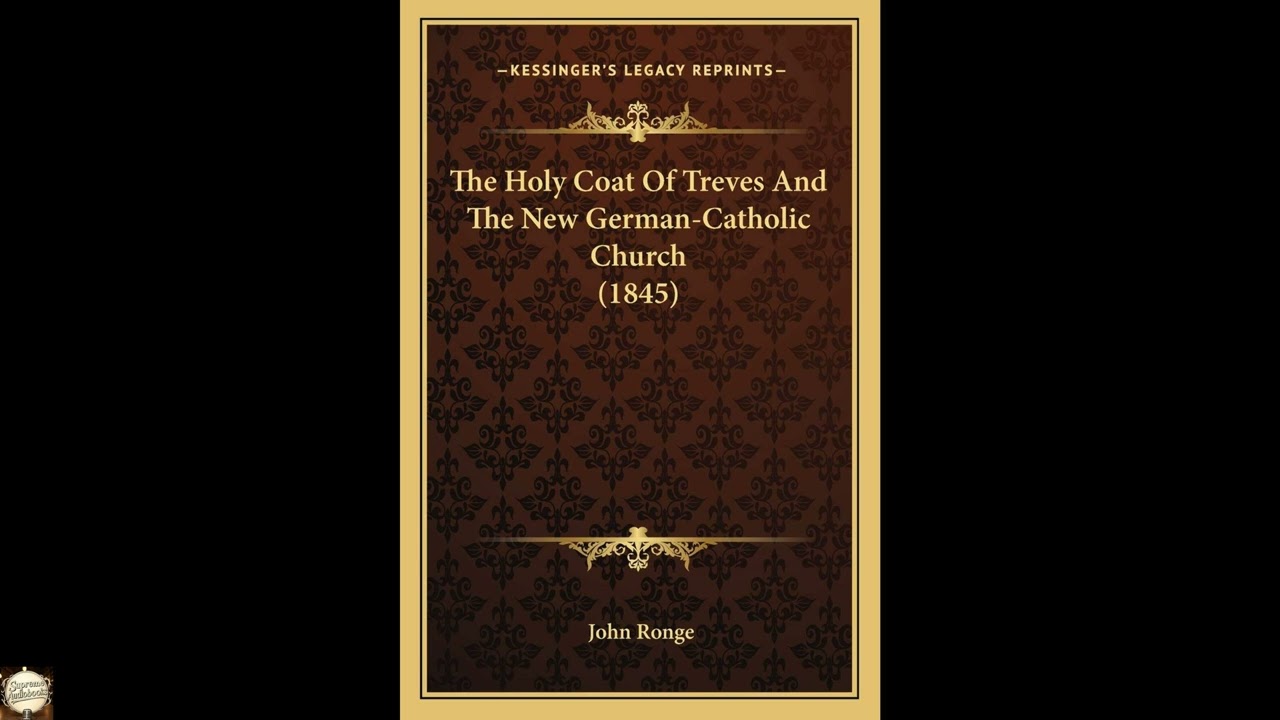
The Holy Coat Of Treves And The New German-Catholic Church
Step into a moment of profound spiritual and social upheaval with John Ronge’s The Holy Coat Of Treves And The New German-Catholic Church. This isn't merely a historical document; it's a living echo of a fierce battle for conscience and autonomy, a resonant voice from 19th-century Germany that dared to challenge entrenched religious authority. Ronge’s powerful declaration, born from a specific controversy, crystallizes universal questions about faith, dogma, and the individual's right to interpret sacred tradition. In an age where institutional power still faces scrutiny, and where the line between genuine veneration and commercial exploitation can blur, Ronge's articulate protest remains startlingly relevant, inviting listeners to reflect on the enduring tension between personal conviction and collective belief. The central “story” of this work unfolds not as a fictional narrative, but as a compelling intellectual and spiritual drama, set against the backdrop of Germany in the mid-1840s. The curtain rises on the city of Trier, where Bishop Arnoldi has announced a grand exhibition of the Holy Coat, a supposed relic of Christ’s seamless garment, promising pilgrims spiritual benefits and drawing massive crowds. This event serves as the igniting spark for Ronge, a former Catholic priest, who steps forward as the primary character – a figure of defiance and principle. His initial open letter, published in October 1844, serves as the book's foundational act, directly confronting Bishop Arnoldi and denouncing the exhibition as a scandalous spectacle, an affront to reason and true Christian piety. From this initial, explosive confrontation, Ronge expands his argument, laying bare the central conflict that underpins the entire book: the clash between what he perceives as the superstition and hierarchical control of the Roman Catholic Church and the aspirations for a more rational, nationally independent, and morally grounded German Christianity. The text systematically outlines his critiques of various Church practices and doctrines, from the veneration of relics and the concept of indulgences to the authority of the Pope and the mandatory celibacy of priests. The arc of the work moves from passionate protest to the deliberate articulation of an alternative, culminating in the detailed exposition of the principles for a “New German-Catholic Church,” one rooted in an enlightened understanding of scripture and a direct relationship between the believer and God, free from external intermediaries and perceived abuses. The voice that gives The Holy Coat Of Treves And The New German-Catholic Church its considerable force belongs to Johannes Ronge, a German priest born in 1815 in the Prussian province of Silesia. After his ordination in 1839, Ronge’s early career as a teacher and chaplain saw him increasingly at odds with the conservative hierarchy of the Roman Catholic Church. His liberal theological views and outspoken critiques of ecclesiastical abuses led to his suspension from priestly duties even before the Trier incident, marking him as a figure already primed for dissent. However, it was the exhibition of the Holy Coat that propelled him onto the national stage, transforming him from a local critic into a figure of international renown. Ronge’s letter against the Holy Coat of Trier, published on October 1, 1844, became an instant sensation, reprinted widely and sparking a wildfire of debate across the German states. This act of profound intellectual courage led swiftly to his excommunication from the Roman Catholic Church, but it also catalyzed the formation of the German Catholic Church movement. Adherents, drawn by Ronge's call for a more independent, rational, and national form of Christianity, elected their own priests and adopted simplified liturgies in the vernacular. Though the movement later waned, Ronge remained a significant figure, becoming involved in the liberal political ferment of the 1848 revolutions, which ultimately forced him into political exile. He spent many years abroad, including a period in London, continuing his advocacy for educational and social reforms before finally returning to Germany. His writings, including this foundational text, stand as vital primary sources for understanding the intellectual and religious currents of 19th-century Germany. At its core, The Holy Coat Of Treves And The New German-Catholic Church enacts several potent themes. Foremost among these is the enduring struggle between religious authority and individual conscience. Ronge’s denunciation of the Holy Coat as a "shameful spectacle" is a direct challenge to the Bishop's command, arguing that true faith resides not in blind obedience to relics or hierarchical pronouncements, but in the believer's own rational and ethical judgment. This defiance underscores his belief that personal integrity and an enlightened understanding of Christian principles must supersede institutional dogma. Another crucial theme is the interplay of nationalism and ecclesiastical independence. Ronge's vision for a "German-Catholic Church" was deeply intertwined with the burgeoning sense of German national identity in the mid-19th century. He articulates a desire for a religious institution free from what he perceived as foreign, Roman control, one that could better serve the spiritual and cultural needs of the German people. This call for an indigenous church reflects broader European movements of the time that sought to align religious practice with national character and political self-determination, portraying the papacy as an external power rather than a universal spiritual guide for Germans. This work emerged during a period of significant cultural, political, and literary ferment in the German states. The 1840s were marked by growing liberal and nationalist sentiments, a hunger for greater political freedoms, constitutional reform, and ultimately, national unity. Ronge’s protest against the Trier exhibition tapped directly into this widespread dissatisfaction with traditional authorities, both secular and religious. The Enlightenment’s emphasis on reason and individual liberty had deeply influenced German intellectual thought, creating an environment ripe for challenges to established dogma. The widespread exhibition of the Holy Coat itself, drawing hundreds of thousands of pilgrims, inadvertently provided the perfect flashpoint for this growing discontent. While many devoutly believed in the relic, others, including both Protestants and liberal Catholics, viewed it with skepticism and even contempt, seeing it as a symbol of outdated superstition and clerical abuse. Ronge’s widely publicized letter thus coalesced disparate voices of dissent into a powerful, unified movement, making The Holy Coat Of Treves And The New German-Catholic Church not just a theological statement, but a significant cultural and political act that anticipated the revolutionary upheavals of 1848. Listening to The Holy Coat Of Treves And The New German-Catholic Church as an audiobook offers a uniquely immersive experience, allowing the listener to truly encounter the urgent, polemical spirit of Ronge's original pronouncement. The spoken word breathes life into Ronge’s arguments, conveying the passion and conviction that ignited a religious movement. With a run length of several hours, this audiobook provides ample opportunity to absorb the nuances of his critique and the blueprint for his proposed alternative. A skilled narrator can emphasize the rhetorical power of Ronge’s prose, making the listener privy to the intellectual force that captured the imagination of a nation. It's an opportunity to hear history unfold, not just read about it, engaging directly with the voice of dissent that helped shape a crucial moment in German and European religious thought.
Enjoyed The Holy Coat Of Treves And The New German-Catholic Church? A few ways to support us
Audible & Amazon links are affiliate; we may earn a small commission at no extra cost.
About this production
Human narration by a volunteer reader from LibriVox.org, the public-domain audiobook project. LibriVox volunteers record literary works whose copyright has expired in the United States, releasing the resulting recordings into the public domain.
The Holy Coat Of Treves And The New German-Catholic Church by John Ronge. The underlying text is in the U.S. public domain. We do not republish any modern copyrighted edition, translation, or commentary.
The 4K cinematic visuals accompanying this audiobook are generated by an AI image model from prompts derived from the source text. No copyrighted photos, paintings, or stock footage are used. AI generation is disclosed on every video on our YouTube channel as required by YouTube's altered/synthetic content policy.
English subtitles are transcribed from the LibriVox recording with OpenAI Whisper. Translations into the 11 other supported languages are produced by Meta's NLLB-200 neural translation model. No human translator's copyrighted translation is used.
Questions about sourcing or rights? See our DMCA & Sourcing policy or contact us.
Enjoyed this audiobook?
If you'd like to own a copy of The Holy Coat Of Treves And The New German-Catholic Church or hear a professionally produced edition, the links below help support free audiobook production at no extra cost to you.
As an Amazon Associate we earn from qualifying purchases. Audible / print links are affiliate.