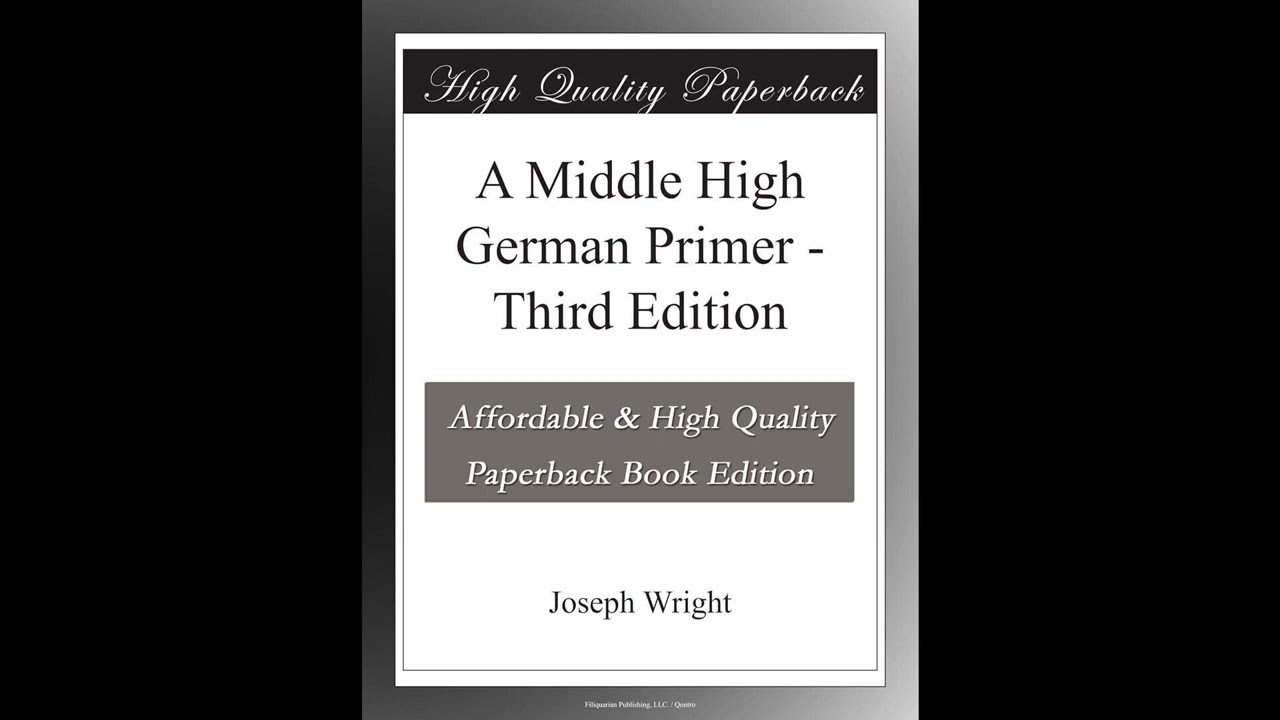
A Middle High German Primer - Third Edition
Step back in time over a millennium, to the spirited heart of medieval Germany, a land of epic heroes, courtly love, and fervent faith. While the modern world moves at a dizzying pace, there exists a profound satisfaction in pausing to reconstruct the linguistic foundations upon which so much of European culture was built. Joseph Wright’s A Middle High German Primer – Third Edition offers precisely this unique opportunity, not as a dry academic exercise, but as a meticulously crafted guide into a language that shaped the very narrative of a civilization. For anyone drawn to the origins of German literature, the roots of its modern tongue, or simply the sheer intellectual reward of unlocking a historical code, this primer is more than a textbook – it is a portal, inviting the listener to hear the resonant echoes of a bygone age. It is a work of enduring scholarship that continues to equip new generations with the tools to connect with the past on its own terms, making the ancient voices sing anew. This primer does not unfold as a conventional story with characters and a linear narrative, but rather as an intellectual progression, guiding the diligent student through the layers of a historically significant language. The setting is the linguistic landscape of medieval Germanic lands, specifically the period roughly from 1050 to 1350, a time ripe with literary creation. The “protagonist” here is the language itself – Middle High German – a dynamic system undergoing the subtle shifts and transformations that characterize all living speech, even as it becomes crystallized in written form. The initial challenge presented is the stark difference between this older form and its modern descendant; words and grammatical structures, once familiar, now appear alien, obscuring the profound literary treasures they once held. The “arc of the story” within this primer traces the student’s increasing comprehension, moving from the foundational elements to sophisticated interpretations. The exposition begins with a thorough introduction to the phonology, detailing the sounds and their written representations – crucial for accurate pronunciation and understanding how the language changed from Old High German. From there, the exposition progresses into the morphology, systematically presenting the declensions of nouns and pronouns, the conjugations of verbs, and the various parts of speech, illustrating how these forms distinguish meaning and function. The primer then moves to syntax, showing how words combine into phrases and clauses, building sentences that convey complex ideas. Each chapter serves as a building block, gradually illuminating the grammatical architecture of Middle High German, until the student can finally engage with authentic texts, moving from simple sentences to excerpts from the great poetic works of the era. Joseph Wright, born in 1855 in Yorkshire, England, embodied a remarkable testament to self-reliance and intellectual drive. His early life was marked by adversity; the son of a quarryman, he began working in a woollen mill at the tender age of six, with minimal formal schooling. Despite these challenging circumstances, Wright possessed an insatiable curiosity and an extraordinary aptitude for languages. He famously taught himself French, German, and Latin while working long shifts in the mill, studying by candlelight and snatching moments whenever he could. This early struggle fostered a deep appreciation for the mechanics of language and an exceptional work ethic that would define his academic career. Wright’s academic ascent was nothing short of meteoric. Through sheer perseverance and brilliant self-education, he eventually earned a place at Heidelberg University, where he delved into philology, the historical and comparative study of language. He later joined the faculty at Oxford University in 1888, becoming a professor of comparative philology in 1901. Beyond his significant contributions to Germanic philology, including this very primer, Wright is perhaps most widely celebrated for his monumental achievement, the English Dialect Dictionary. This six-volume work, published between 1898 and 1905, meticulously documented the regional variations of English spoken across Great Britain, a project of immense scope that required decades of dedicated research and organization, often supported by his own personal funds and tireless efforts. His work firmly established him as a towering figure in the field of linguistic scholarship, one who valued both rigorous analysis and the preservation of spoken heritage. The underlying themes of A Middle High German Primer are not those of human drama or societal conflict, but rather the profound intellectual currents that drive linguistic study itself. One central idea is the preservation of heritage. By providing the keys to understanding Middle High German, the book enables a direct engagement with centuries-old literature—the heroic sagas of the Nibelungenlied, the sophisticated lyric poetry of the Minnesingers, the religious texts and chronicles that illuminate the medieval worldview. Without such tools, these invaluable cultural artifacts would remain locked away, their nuances lost to modern readers. For instance, the primer’s careful explanation of umlaut and vowel gradations is not merely a dry grammatical point; it directly informs how one interprets the emotional register or social status conveyed in a stanza of Walther von der Vogelweide, allowing the words to resonate with their original force. Another significant theme is the bridging of historical divides. Language is a living bridge between generations, and the study of Middle High German highlights how even seemingly "dead" languages continue to inform and shape the present. The Primer’s careful delineation of grammatical shifts—how certain verb endings disappeared, how noun cases simplified, how vocabulary evolved—provides a concrete example of linguistic evolution. This process demonstrates not only how Modern German came to be but also offers insights into the broader patterns of language change across cultures and time. The methodical presentation of strong and weak verb paradigms, for example, illustrates the deep Indo-European roots that connect German to many other European languages, showcasing an underlying unity amidst apparent diversity. Joseph Wright published the first edition of A Middle High German Primer in 1888, a period of intense academic ferment and national self-discovery across Europe. The late 19th century witnessed a burgeoning interest in philology, spurred by the pioneering work of scholars like the Grimm brothers, who not only collected fairy tales but also laid the groundwork for the scientific study of Germanic languages and their historical development. The recently unified German Empire, forged in 1871, fostered a renewed focus on national identity and its historical roots, driving a significant academic push to understand the origins of German language, literature, and culture. Universities across Germany and Europe established and expanded departments dedicated to these studies, creating a demand for rigorous, accessible textbooks. Wright’s primer emerged from this environment, meeting the need for a concise yet comprehensive introduction to a language critical for understanding the medieval foundations of German national character and its literary achievements. It reflected a broader scholarly movement to apply scientific principles to the study of language, moving beyond mere grammar instruction to a deeper historical and comparative analysis. Listening to A Middle High German Primer – Third Edition as an audiobook offers a distinctive and highly beneficial learning experience. The narration provides crucial guidance on pronunciation, which is often the most challenging aspect of engaging with an older language. A clear, authoritative voice articulates the distinctions between various vowel and consonant sounds, demonstrating how the words would have likely been spoken, a dimension often lost when reading only from the page. The pacing is thoughtfully measured, allowing listeners ample time to absorb complex grammatical explanations, to mentally replay examples, and to follow the methodical breakdown of linguistic structures. The speaker’s voice maintains a consistent, calm scholarly tone, creating an atmosphere conducive to focused study rather than hurried consumption. This format transforms the potentially intimidating task of learning a historical language into an accessible, auditory lesson, making the nuances of Middle High German unfold with a clarity that enhances comprehension and fosters a deeper appreciation for the beauty and precision of the language.
Enjoyed A Middle High German Primer - Third Edition? A few ways to support us
Audible & Amazon links are affiliate; we may earn a small commission at no extra cost.
About this production
Human narration by a volunteer reader from LibriVox.org, the public-domain audiobook project. LibriVox volunteers record literary works whose copyright has expired in the United States, releasing the resulting recordings into the public domain.
A Middle High German Primer - Third Edition by Joseph Wright. The underlying text is in the U.S. public domain. We do not republish any modern copyrighted edition, translation, or commentary.
The 4K cinematic visuals accompanying this audiobook are generated by an AI image model from prompts derived from the source text. No copyrighted photos, paintings, or stock footage are used. AI generation is disclosed on every video on our YouTube channel as required by YouTube's altered/synthetic content policy.
English subtitles are transcribed from the LibriVox recording with OpenAI Whisper. Translations into the 11 other supported languages are produced by Meta's NLLB-200 neural translation model. No human translator's copyrighted translation is used.
Questions about sourcing or rights? See our DMCA & Sourcing policy or contact us.
Enjoyed this audiobook?
If you'd like to own a copy of A Middle High German Primer - Third Edition or hear a professionally produced edition, the links below help support free audiobook production at no extra cost to you.
As an Amazon Associate we earn from qualifying purchases. Audible / print links are affiliate.