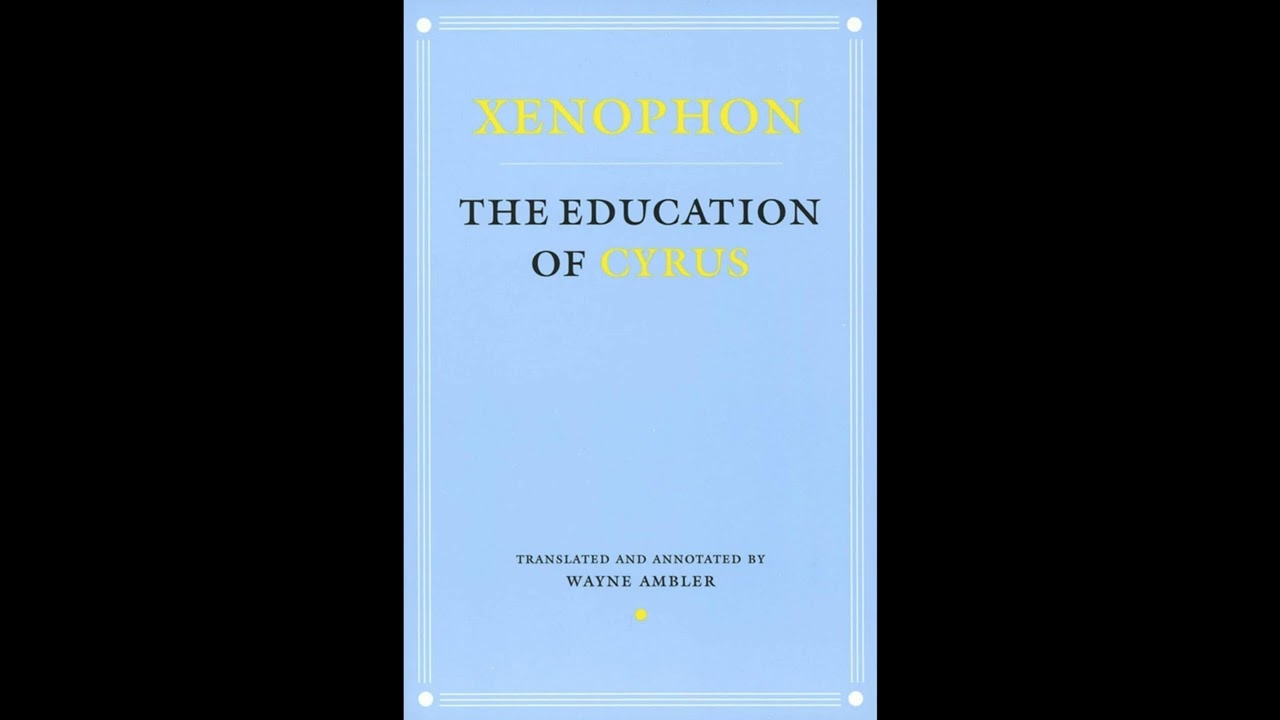
The Education of Cyrus
"The Education of Cyrus," or Cyropaedia in its original Greek, stands as a literary anomaly from the ancient world—a compelling blend of historical biography, philosophical inquiry, and early novelistic storytelling. Penned by the Athenian historian Xenophon, this is much more than a simple account of the legendary Persian king Cyrus the Great; it is a profound examination of leadership, character development, and the nuanced art of governance. Imagine a foundational text that maps out how an individual can be cultivated from boyhood into an ideal ruler, one capable of founding and sustaining a vast empire through intellect, ethical conduct, and military acumen. For anyone seeking to understand the enduring dynamics of power, the immense responsibilities of command, or the qualities that genuinely inspire loyalty and profound respect, Xenophon's detailed narrative offers insights as relevant today as they were millennia ago, serving as an enduring blueprint for effective leadership. Xenophon's narrative begins in ancient Persia, a land renowned for its disciplined civic virtues. Here, we meet Cyrus in his formative years, a young prince raised within a rigorous educational system designed to instill justice, courage, and self-control, rather than in luxury. His early experiences, particularly during a stay at the court of his grandfather, Astyages, King of Media, highlight his precocious judgment and natural capacity for leadership, setting the stage for his future monumental achievements. He quickly demonstrates a remarkable ability to inspire those around him, a trait that would define his ascent. As Cyrus matures, he is called to lead the Persian army in defense of Media against the aggressive Assyrians. This becomes his initial significant test as a military commander, where he distinguishes himself through both strategic brilliance and a genuine concern for his soldiers' welfare. The story charts his transformation of a smaller, disciplined force into a formidable power, capable of confronting and overcoming entrenched empires. Xenophon meticulously details Cyrus's innovative military tactics, his diplomatic skill in uniting disparate nations under a common cause, and the personal charisma that wins over both enemies and allies. The narrative progresses through a series of campaigns and political maneuvers that steadily expand Cyrus's influence and territory, illustrating the meticulous construction of one of the ancient world's most enduring empires. The exceptional mind behind The Education of Cyrus belongs to Xenophon of Athens, a distinguished figure who navigated the tumultuous currents of ancient Greek history, roughly from 430 to 354 BCE. Born into an aristocratic Athenian family, Xenophon was a devoted student and admirer of Socrates, whose philosophical teachings profoundly shaped his intellectual framework. Unlike many of his contemporaries, Xenophon led a life rich in varied experiences, profoundly influencing his written works. His most famous real-life adventure involved joining a mercenary expedition, the "Ten Thousand," to aid Cyrus the Younger in a bid for the Persian throne. After Cyrus the Younger's death, Xenophon played a pivotal role in leading the Greek forces on their epic retreat across hostile territory, an experience he chronicled in his acclaimed Anabasis. This gave him unparalleled insight into military leadership and the Persian Empire. Following his return, Xenophon faced exile from Athens due to his pro-Spartan sympathies, eventually settling to write. His extensive oeuvre includes historical accounts like the Hellenica, Socratic dialogues such as Memorabilia, and treatises on diverse subjects, establishing him as a unique voice bridging history, philosophy, and early biographical writing. A core theme woven throughout The Education of Cyrus is the rigorous development of ideal leadership. Xenophon portrays Cyrus as an embodiment of virtue and competence, demonstrating how a ruler cultivates loyalty through justice, generosity, and unwavering personal example. For instance, Cyrus meticulously arbitrates disputes among his soldiers, ensuring fair hearings for all, and shares spoils equally, practically illustrating how ethical conduct inspires profound devotion and solidifies authority beyond mere force. Another central theme is the transformative power of education and character formation in a ruler's capacity to govern effectively. The early chapters depict Cyrus's upbringing among the Persians, a system designed to instill self-control, truthfulness, and physical resilience through mock trials and demanding hunts. This focus on ethical and practical training from childhood upwards underscores that innate talent requires deliberate shaping by experience and instruction. The work also addresses empire building and cultural assimilation, showcasing how Cyrus integrates diverse peoples by often adopting aspects of their cultures and employing diplomacy and magnanimity to win their allegiance, rather than solely relying on conquest. This significant work emerged from a specific and turbulent period in ancient Greece, likely penned by Xenophon during his years of exile in the mid-to-late 4th century BCE. This era saw widespread disillusionment following the devastating Peloponnesian War, the decline of Athenian democracy, and constant power shifts among Greek city-states. Amidst this backdrop of political instability, Xenophon, having experienced both Greek military endeavors and the Persian court's intricacies, sought to present a contrasting vision. He looked to the seemingly stable Achaemenid Persian Empire to distill principles of effective governance and personal virtue embodied in its legendary founder. The Education of Cyrus thus offered a blueprint for leadership that transcended the often-flawed political realities of the Greek polis. Listening to The Education of Cyrus as an audiobook offers a direct, immersive way to absorb Xenophon's profound insights and engaging narrative. The several hours of content allow you to fully settle into the ancient world, following Cyrus's growth and strategic brilliance at a natural pace. A skilled narrator brings Xenophon's clear, eloquent prose to life, giving voice to the philosophical discussions and diplomatic exchanges that are as vital as the battle descriptions. You will appreciate the deliberate pacing, designed to allow contemplation of the ethical dilemmas and leadership lessons, as the atmosphere of ancient Persian courts and military camps gains an immediate, powerful presence.
Enjoyed The Education of Cyrus? A few ways to support us
Audible & Amazon links are affiliate; we may earn a small commission at no extra cost.
About this production
Human narration by a volunteer reader from LibriVox.org, the public-domain audiobook project. LibriVox volunteers record literary works whose copyright has expired in the United States, releasing the resulting recordings into the public domain.
The Education of Cyrus by Xenophon. The underlying text is in the U.S. public domain. We do not republish any modern copyrighted edition, translation, or commentary.
The 4K cinematic visuals accompanying this audiobook are generated by an AI image model from prompts derived from the source text. No copyrighted photos, paintings, or stock footage are used. AI generation is disclosed on every video on our YouTube channel as required by YouTube's altered/synthetic content policy.
English subtitles are transcribed from the LibriVox recording with OpenAI Whisper. Translations into the 11 other supported languages are produced by Meta's NLLB-200 neural translation model. No human translator's copyrighted translation is used.
Questions about sourcing or rights? See our DMCA & Sourcing policy or contact us.
Enjoyed this audiobook?
If you'd like to own a copy of The Education of Cyrus or hear a professionally produced edition, the links below help support free audiobook production at no extra cost to you.
As an Amazon Associate we earn from qualifying purchases. Audible / print links are affiliate.