Story of Aeneas
Among the foundational myths that continue to echo through the corridors of Western thought and literature, the saga of Aeneas stands as a monumental epic, a tale of destiny forged in fire and exile, the birth of a civilization from the ashes of another. Michael Clarke's Story of Aeneas offers a vital and accessible portal into this ancient narrative, distilling the grandeur and emotional weight of Virgil's original Roman epic into a form that speaks directly to modern audiences. More than just a recount of ancient battles and gods, this saga is a profound meditation on the burdens of leadership, the relentless call of duty, and the enduring human quest for a place to call home—themes that remain remarkably potent in an age marked by displacement, nation-building, and the search for identity amidst widespread change. To listen to Aeneas's trials is to understand the very roots of a cultural heritage, to witness the origins of ideas about fate, sacrifice, and the founding principles of what would become a sprawling empire, offering a lens through which to consider our own narratives of migration and purpose. The story begins in the smoldering ruins of Troy, after the city has fallen to the Greeks. Aeneas, a Trojan prince and son of the goddess Venus, is divinely commanded to flee the devastation, carrying his elderly father, Anchises, on his shoulders and leading his young son, Ascanius, by the hand. He gathers the remaining Trojans, and under the capricious whims of the gods, particularly the wrathful Juno, they set sail on a perilous course across the Mediterranean. Their odyssey is fraught with storms, encounters with mythical beasts, and poignant stops in lands both welcoming and dangerous. They encounter the Harpies, narrowly escape the Cyclops, and visit the underworld where Aeneas receives prophetic visions of Rome's glorious future from his deceased father. A pivotal, yet heartbreaking, episode unfolds when Aeneas and his people land in Carthage, a flourishing city ruled by the formidable Queen Dido. A powerful love affair ignites between them, offering Aeneas a seductive respite from his arduous quest and a potential new home. However, the gods, ever mindful of his ultimate destiny to found a new city in Italy, intervene, reminding Aeneas of his sacred duty. Torn between profound personal desire and the grave responsibilities laid upon him by fate, Aeneas makes the agonizing decision to leave Carthage, a choice that seals Dido's tragic end and lays the groundwork for future enmity between their descendants. His long and arduous journey eventually leads him to the shores of Latium in Italy, where new challenges await in the form of hostile native tribes and the necessity of forging a new future through alliance and conflict. The narrative meticulously sets the stage for the epic struggles and foundational conflicts that will shape the nascent Roman people, driven always by the imperative of destiny. Michael Clarke, an American educator and classicist whose work flourished around the turn of the twentieth century, dedicated a significant portion of his career to making the profound narratives of antiquity accessible to a broader audience, particularly younger readers and students. Born in 1848, Clarke understood the immense cultural value embedded within classical texts like Virgil’s Aeneid and Homer’s epics. His own publishing career, extending into the early 1900s, was characterized by careful scholarship paired with a clear, engaging prose style designed to introduce these stories without sacrificing their inherent power or historical context. Rather than translating the intricate Latin verse directly, Clarke focused on retelling, crafting narratives that maintained the dramatic sweep and thematic depth of the originals while removing linguistic barriers that might otherwise deter general readers. Clarke's approach positioned him as a vital bridge between specialized classical scholarship and public education during a period when the study of Greek and Roman literature was still central to curricula but also undergoing reevaluation for its accessibility. He was part of a broader educational movement that sought to democratize knowledge, ensuring that the wisdom and stories of the past were not solely the domain of a privileged few. His renditions were often adopted in schools, serving as foundational texts that sparked an initial interest in classical literature, paving the way for deeper engagement with the original works later on. Through his patient and thoughtful adaptations, Clarke solidified his place not as an original poet, but as an indispensable interpreter, ensuring the survival and appreciation of the Aeneid’s narrative core for generations eager to grasp its meaning. The Story of Aeneas powerfully enacts several enduring themes, foremost among them the concept of pietas—a uniquely Roman virtue encompassing duty, devotion, and piety towards gods, family, and country. Aeneas consistently exemplifies this virtue, most memorably when he literally carries his infirm father from burning Troy, symbolizing his devotion to ancestral heritage, and later, when he sacrifices his passionate love for Dido in Carthage for the sake of his divinely ordained mission to found Rome. His personal suffering is consistently subordinate to this higher calling, illustrating the Roman ideal of selfless service. Another central theme is the interplay of fate and free will. While Aeneas's destiny to found a great city is immutable, predetermined by the gods, his path is anything but easy or predetermined in its specifics. Characters constantly make choices, face moral dilemmas, and suffer consequences, highlighting the human struggle within a grand cosmic design. For instance, Juno’s relentless opposition to Aeneas shows divine intervention, yet Aeneas's perseverance and tactical decisions are also crucial to his progress, underscoring that destiny often requires human agency to be realized. Furthermore, the narrative explores the profound weight of loss and the construction of national identity from ruin. The constant remembrance of Troy, its fallen heroes, and the spectral presence of the dead (as experienced during Aeneas's descent into the underworld) underscore how the past informs and motivates the future. Aeneas is not merely a refugee seeking a new land; he is a carrier of memory, a progenitor tasked with rebuilding not just a city, but a spirit. His trials in Italy—fighting for a new home, establishing alliances, and laying the groundwork for Roman law and tradition—are concrete manifestations of the arduous process of forging a national identity and purpose from disparate peoples and traumatic origins. The epic thus serves as a powerful foundational myth for Roman civilization, explaining its values, sacrifices, and ambitions. The original Aeneid by Virgil was composed during the Augustan age in Rome, a period following decades of civil war and the subsequent consolidation of power under Emperor Augustus in the late first century BCE. Virgil’s purpose was to provide a national epic for Rome, mirroring Homer's epics for Greece, and to glorify Augustus's reign by linking his lineage and policies to Aeneas, thus providing a mythic justification for Roman imperial ambitions and the Pax Romana. The poem instilled a sense of patriotic pride and cultural identity at a time of significant political transition, positioning Rome as the inheritor of Trojan grandeur and divine favor. Michael Clarke’s retelling, emerging nearly two millennia later in the early 20th century, found its context in an era focused on educational reform and cultural transmission. As societies modernized, there was a growing desire to make classical literature, once the exclusive domain of scholarly elites, accessible to a wider general public and to integrate these foundational stories into a broader educational curriculum. Clarke’s Story of Aeneas served this purpose, bridging the gap between ancient text and contemporary reader, ensuring that the epic's vital lessons and narrative power could continue to inform new generations. Listening to Story of Aeneas as an audiobook offers a uniquely immersive experience, echoing the oral traditions through which epic poetry was originally disseminated. The story, unfolding over several hours, becomes a companion for extended periods, perfect for long drives, focused evening listening, or accompanying routine tasks. A skilled narrator breathes life into Aeneas's struggles and triumphs, allowing the listener to absorb the complex names and epic scope without the visual strain of reading. The vocal performance can highlight the emotional weight of Aeneas's grief for Troy, the fury of Juno's divine interventions, the poignant desperation of Dido, and the clangor of battles, rendering the ancient world immediately present. The subtle nuances of pacing, changes in voice for different characters, and the creation of an enveloping atmosphere transform the listening experience into a direct connection with one of humanity's most enduring narratives, inviting a deeper, more visceral appreciation of its timeless power.
Enjoyed Story of Aeneas? A few ways to support us
Audible & Amazon links are affiliate; we may earn a small commission at no extra cost.
About this production
Human narration by a volunteer reader from LibriVox.org, the public-domain audiobook project. LibriVox volunteers record literary works whose copyright has expired in the United States, releasing the resulting recordings into the public domain.
Story of Aeneas by Michael Clarke. The underlying text is in the U.S. public domain. We do not republish any modern copyrighted edition, translation, or commentary.
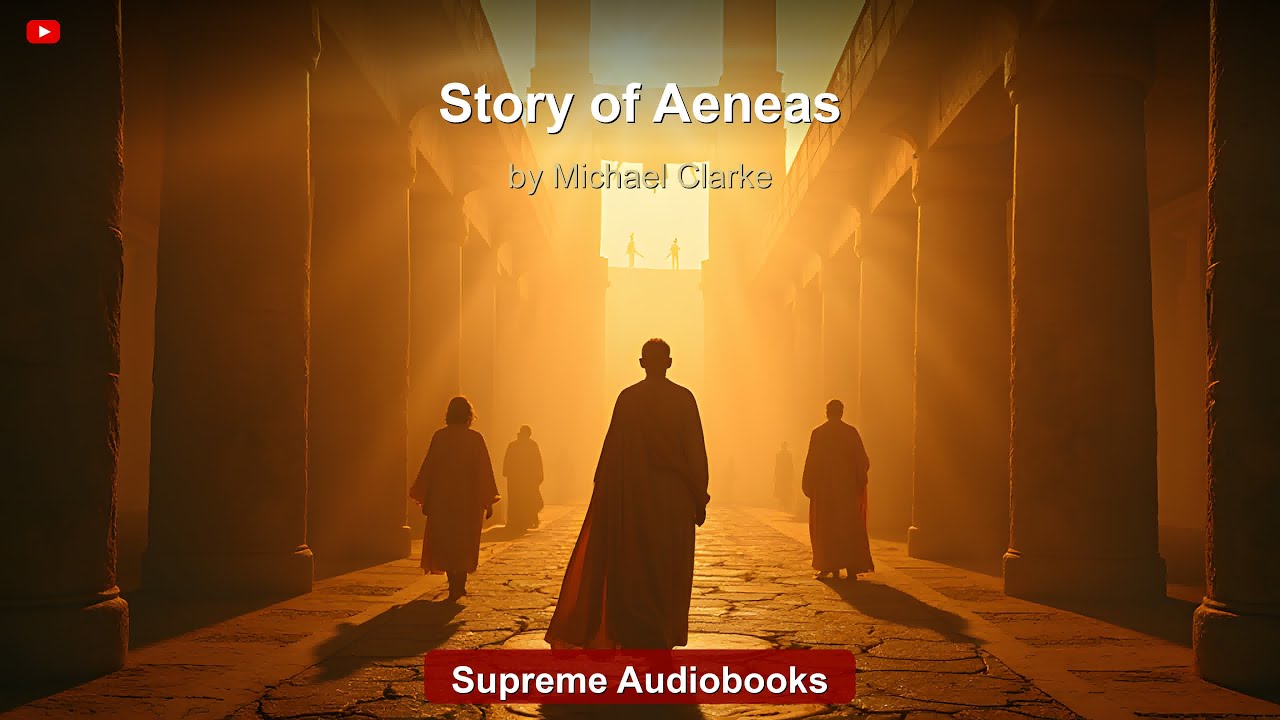
The 4K cinematic visuals accompanying this audiobook are generated by an AI image model from prompts derived from the source text. No copyrighted photos, paintings, or stock footage are used. AI generation is disclosed on every video on our YouTube channel as required by YouTube's altered/synthetic content policy.
English subtitles are transcribed from the LibriVox recording with OpenAI Whisper. Translations into the 11 other supported languages are produced by Meta's NLLB-200 neural translation model. No human translator's copyrighted translation is used.
Questions about sourcing or rights? See our DMCA & Sourcing policy or contact us.
View 10 famous quotes from this book →
Enjoyed this audiobook?
If you'd like to own a copy of Story of Aeneas or hear a professionally produced edition, the links below help support free audiobook production at no extra cost to you.
As an Amazon Associate we earn from qualifying purchases. Audible / print links are affiliate.