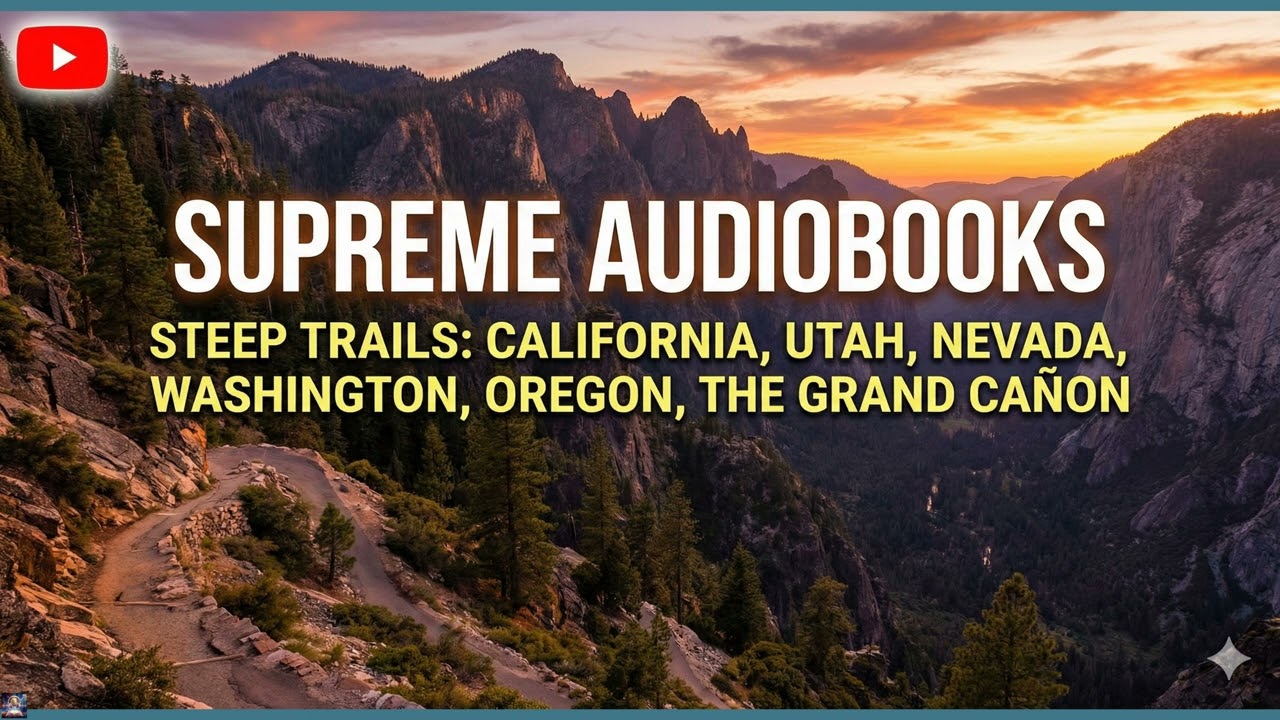
Steep Trails: California, Utah, Nevada, Washington, Oregon, the Grand Cañon
The title alone, "Steep Trails: California, Utah, Nevada, Washington, Oregon, the Grand Cañon," immediately transports the mind to an era when the American West was still being charted, understood, and admired by those who ventured into its vastness. This audiobook offers a singular opportunity to step back in time, to experience these iconic landscapes through the eyes of an astute, perhaps anonymous, observer from a bygone century. It is more than a simple travelogue; it is a meditation on wildness, a direct encounter with some of the continent's most profound natural spectacles, presented with a clarity and immediacy that resonates strongly even today. For anyone who cherishes the untamed corners of the world, or who seeks to understand the historical roots of our appreciation for nature, this collection of observations provides an unparalleled window into a foundational perspective on American wilderness. The core of "Steep Trails" unfolds as a series of meticulously rendered dispatches from the heart of the American West, chronicling the unnamed narrator's sustained passage through the mountains, deserts, and canyons that define this immense region. We are led, often quite literally, along high mountain paths in the Sierra Nevada, where the air is thin and the views stretch to unimaginable horizons. The narrative moves with the observer, describing the arduous climbs and the quiet satisfaction of reaching a summit, offering detailed descriptions of the flora and fauna encountered—the resilient pines clinging to granite, the elusive wildlife glimpsed in twilight. From the sun-drenched, arid expanses of Utah and Nevada, the perspective shifts, revealing the stark beauty of desert landscapes, the unique geological formations, and the immense, silent power of these seemingly barren lands. The observer captures the subtle hues of the desert at dawn and dusk, the surprising resilience of life in extreme conditions, and the profound sense of isolation that these spaces can inspire. The narrative acts as a companion, pointing out details that a less attentive eye might miss—the glint of mica in a rock face, the faint rustle of wind through sagebrush, the distant call of a hawk. The scope broadens further to encompass the verdant forests and rugged coastlines of Washington and Oregon, contrasting sharply with the earlier desert scenes. Here, the focus turns to the majesty of old-growth trees, the ceaseless rhythm of the Pacific surf, and the dramatic interplay between land and sea. And finally, the book culminates in a profound encounter with the Grand Cañon, an experience presented with a reverence and awe that attempts to convey the sheer scale and ancient wisdom of this geological wonder. The text doesn't follow a conventional plot with rising action and resolution, but rather an accumulating series of direct, unfiltered observations, each entry building upon the last to create a cumulative portrait of America's natural heritage. While the name of the individual who penned these remarkable observations remains a mystery to us, "Steep Trails" stands as a testament to a particular spirit of inquiry and connection with the natural world that characterized a significant strand of American letters. This work falls squarely within the tradition of naturalist writing and adventure narratives that flourished in the late nineteenth and early twentieth centuries, a period when the continent's vast wildernesses were being systematically documented, studied, and romanticized. The anonymity of the author, rather than diminishing the work, instead lends it a universal quality, allowing the voice to become less about a singular personality and more about the collective experience of encountering untamed America. One can imagine the author as a seasoned wanderer, perhaps a surveyor, a prospector, or an independent scholar, equipped with a keen eye for detail, a robust intellect, and an almost poetic sensibility. Their method of observation—patient, precise, and deeply respectful of the environment—aligns with the practices of prominent figures like John Muir, Clarence King, and Mary Austin, who similarly devoted their lives to understanding and articulating the wonders of the American West. Although we lack specific biographical details, the quality of the prose, its scientific exactitude tempered by lyrical descriptions, suggests a mind trained in both careful recording and eloquent expression. This collection, then, represents not merely one person's account, but a voice echoing from the past, representing a wider cultural impulse. It speaks to a time before mass tourism, when traversing these regions was an act of genuine courage and physical endurance. The unknown author's dedication to precise geographical and ecological description, combined with a profound sense of wonder, places this work firmly within the esteemed lineage of American nature writing, contributing to the foundational understanding of our continent's geological and ecological splendor. Several powerful themes emerge with clarity from the observations compiled in "Steep Trails," revealing the text's enduring literary significance. Foremost among these is the theme of humanity's place in wild nature. The narrator often describes feeling both dwarfed by the immense landscapes—the towering cliffs of the Cañon, the boundless deserts—and simultaneously deeply connected to them. A passage might detail the quiet humility experienced while camping under a vast, star-strewn sky in the high desert, emphasizing how small human concerns become against the backdrop of geological time and cosmic scale. This isn't a struggle against nature, but rather a seeking of harmony within it, a recognition of belonging rather than conquest. Another significant theme is that of solitude and contemplation. Much of the narrative conveys the quiet intensity of solitary travel, allowing for deep reflection on the natural world. The act of patient observation, whether watching a distant cloud formation shift over a mountain range or studying the delicate structure of a desert flower, becomes a form of spiritual engagement. The book might recount the profound silence of a remote valley, broken only by the sound of wind or water, fostering a sense of inner peace and clarity that is central to the author's experience and, by extension, to the listener's engagement. The meticulous detail in describing the environment suggests a deep, almost meditative focus, revealing how sustained attention to the natural world can yield profound personal insights. The text also powerfully articulates the theme of the sublime and awe. The descriptions of the Grand Cañon, the towering peaks of the Sierras, or the stark, sweeping vistas of the desert evoke a sense of overwhelming beauty and immense power that inspires both reverence and a touch of fear. The author's language often struggles to encompass the sheer scale of these phenomena, using words that convey a sense of the infinite and the eternal. This collection of observations emerged from a critical juncture in American history, likely spanning the final decades of the nineteenth century and the very early years of the twentieth. This was a period defined by the so-called "closing of the frontier," where the vast, largely uncharted territories of the American West were increasingly surveyed, settled, and crisscrossed by railroads. The romantic ideal of Manifest Destiny was giving way to a more pragmatic, often industrial, engagement with the land, leading to significant changes in land use and a growing awareness of the finite nature of natural resources. Culturally, this era saw a burgeoning interest in natural history, fueled by scientific expeditions and the popularization of outdoor pursuits. Travel writing, particularly accounts of the American West, gained immense popularity, offering armchair adventurers a glimpse into the raw beauty and untamed character of these regions. Simultaneously, figures like Theodore Roosevelt and John Muir were beginning to articulate the importance of conservation, leading to the establishment of national parks and a growing public discourse around protecting America's natural heritage. "Steep Trails" can be seen as both a product of this spirit of exploration and documentation, and an early, often subtle, contribution to the emerging conservation ethic, capturing a pristine West just as the forces of modernity were beginning to reshape it. Listening to "Steep Trails" as an audiobook offers an exceptionally immersive and intimate way to experience this unique account. The narrator's voice becomes a direct conduit to the observer's mind, bringing a palpable sense of presence to the detailed descriptions of landscapes, weather, and wildlife. One can almost feel the elevation gain during a mountain climb, sense the dry heat of the desert, or hear the distant roar of the ocean as the words unfold. The pacing of the narration can thoughtfully reflect the slow, deliberate rhythm of wilderness travel, allowing moments of quiet contemplation to linger. Without visual distractions, the listener is invited to form their own mental images, conjuring the vastness of the Grand Cañon or the solitude of a forest trail directly from the spoken word. The act of listening transforms the text into an almost meditative experience, allowing the listener to truly accompany the anonymous chronicler through these iconic American landscapes.
Enjoyed Steep Trails: California, Utah, Nevada, Washington, Oregon, the Grand Cañon? A few ways to support us
Audible & Amazon links are affiliate; we may earn a small commission at no extra cost.
About this production
Human narration by a volunteer reader from LibriVox.org, the public-domain audiobook project. LibriVox volunteers record literary works whose copyright has expired in the United States, releasing the resulting recordings into the public domain.
Steep Trails: California, Utah, Nevada, Washington, Oregon, the Grand Cañon by John Muir. The underlying text is in the U.S. public domain. We do not republish any modern copyrighted edition, translation, or commentary.
The 4K cinematic visuals accompanying this audiobook are generated by an AI image model from prompts derived from the source text. No copyrighted photos, paintings, or stock footage are used. AI generation is disclosed on every video on our YouTube channel as required by YouTube's altered/synthetic content policy.
English subtitles are transcribed from the LibriVox recording with OpenAI Whisper. Translations into the 11 other supported languages are produced by Meta's NLLB-200 neural translation model. No human translator's copyrighted translation is used.
Questions about sourcing or rights? See our DMCA & Sourcing policy or contact us.
View 10 famous quotes from this book →
Enjoyed this audiobook?
If you'd like to own a copy of Steep Trails: California, Utah, Nevada, Washington, Oregon, the Grand Cañon or hear a professionally produced edition, the links below help support free audiobook production at no extra cost to you.
As an Amazon Associate we earn from qualifying purchases. Audible / print links are affiliate.