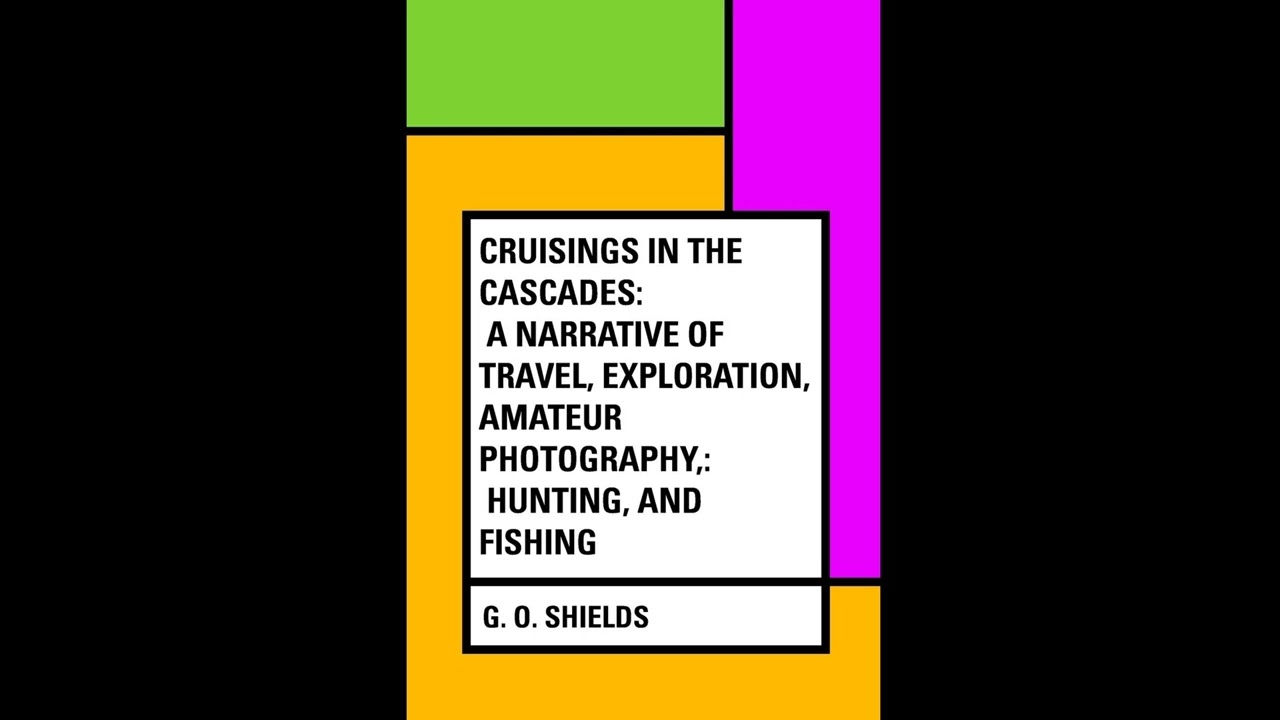
Cruisings in the Cascades: A Narrative of Travel, Exploration, Amateur Photography
Step into a lost landscape, a world both breathtakingly grand and utterly wild, through the pages of Cruisings in the Cascades: A Narrative of Travel, Exploration, Amateur Photography. This remarkable volume, brought to life in audio, stands as a testament to an earlier age of adventure and discovery, offering a direct portal into the untamed beauty of the Pacific Northwest mountains as they existed before widespread settlement. It is more than just a travelogue; it is an intimate encounter with the sublime, an early record of human endeavor against colossal natural forces, and a fascinating glimpse into the nascent days of photography as a tool for documentation and artistic expression. For anyone drawn to the call of the wilderness, the romance of the unknown, or the sheer grit of human perseverance, this book resonates with a spirit that feels as vital and compelling today as it did when first put to paper. The narrative transports listeners deep into the heart of the Cascade Range, a majestic and formidable stretch of mountains that, at the time of this account, remained largely unmapped and unconquered by human presence. Our unnamed protagonist, driven by a keen curiosity and an adventurer's spirit, sets out to traverse these rugged peaks, glacial valleys, and roaring rivers. The story unfolds as a series of encounters with the raw elements: challenging ascents up steep slopes, precarious crossings of rushing streams, and nights spent under an indifferent, star-strewn sky. The central conflict lies not in external antagonists, but in the relentless struggle against the environment itself – the unpredictable weather, the unforgiving terrain, and the profound isolation that comes with venturing into truly untouched territory. Amidst these physical trials, the narrator maintains a sharp eye for observation, meticulously detailing the geological formations, the unique flora and fauna, and the sheer scale of the natural wonders encountered. A particular focus falls on the challenges and triumphs of early photography. Lugging heavy, cumbersome equipment – cameras, tripods, glass plates, and chemical development kits – into such an environment was an extraordinary feat, transforming each successful photograph into a hard-won trophy. The story traces the arc of this ambitious undertaking, from the initial preparations and the eager anticipation of revelation, through the arduous days of travel and documentation, to the profound personal transformation that inevitably accompanies such a profound engagement with nature’s grandeur. It is a tale of pushing physical and technological boundaries, all in the service of capturing and sharing the magnificence of a disappearing frontier. The precise identity of the author of Cruisings in the Cascades remains a fascinating enigma, adding another layer to the book's allure. Many works of travel and exploration from the late nineteenth and early twentieth centuries were published anonymously or pseudonymously, sometimes out of modesty, sometimes to emphasize the objective nature of the observations, and sometimes simply because the focus was intended to be entirely on the subject matter rather than the chronicler. This particular text appears to spring from the tradition of the educated amateur naturalist or the gentleman adventurer, individuals possessed of the means and the intellectual curiosity to undertake expeditions not necessarily for commercial gain or scientific publication, but for personal fulfillment and the public sharing of new knowledge. Such figures often came from a background that afforded them the leisure and resources to pursue their passions, whether it was the mapping of territories, the collection of specimens, or, in this case, the then-novel art of photography in extreme conditions. The text itself serves as the most potent biographical detail, revealing a mind both practical and poetic, capable of enduring hardship while maintaining a profound appreciation for beauty. Two prominent themes resonate throughout the pages of Cruisings in the Cascades. Foremost is the human encounter with the sublime wilderness. The narrator frequently describes landscapes that evoke a sense of awe bordering on terror – towering peaks shrouded in mist, bottomless chasms, and roaring waterfalls that dwarf the human observer. One particularly memorable scene recounts the protagonist standing on a high ridge, gazing at a vast, unbroken expanse of mountains and forests stretching to the horizon, feeling both exhilarated by the view and utterly insignificant in the face of such immensity. This engagement with the sublime is not merely passive observation; it challenges the very limits of human endurance and perception, forcing a re-evaluation of one's place in the natural order. A second significant theme centers on the pioneering spirit of documentation and technological innovation. The constant reference to the photographic process – the careful composition, the painstaking development, the anticipation of the image – highlights how new technologies were transforming our ability to record the world. An illustrative moment might be the detailed description of setting up a bulky plate camera on an uneven rock face, struggling with exposure times under shifting light, all to capture a unique geological feature, underscoring the dedication required to bring visual evidence back from the frontier. This work emerged during a pivotal era in American history, likely in the period following the Civil War and extending into the early decades of the twentieth century. This was a time characterized by rapid industrialization and westward expansion, yet also by a burgeoning appreciation for America's wild spaces. It was the era that saw the establishment of the first national parks, driven by figures like John Muir and the growing conservation movement. There was a widespread public appetite for narratives of exploration and discovery, as the "frontier" was rapidly closing. Scientific expeditions were common, but so too were personal quests into the remaining wilderness by individuals keen to experience and document what was left. Photography itself was evolving from a specialist's craft into a more accessible medium, though still demanding significant skill and effort, especially in the field. This book fits perfectly within this cultural milieu, reflecting a society at once pushing forward into modernity and looking back with a romantic eye at the untamed natural world that was rapidly being altered. It represents a snapshot of a particular moment when technology allowed for a new kind of interaction with, and preservation of, images of the American West. Listening to Cruisings in the Cascades as an audiobook offers a uniquely immersive experience, allowing the listener to truly inhabit the narrator's perspective. The descriptive language, rich with sensory details of the wind, the sound of rushing water, the scent of pine and damp earth, comes alive through skilled narration. A good reading will capture the deliberate, reflective pacing of the original prose, allowing ample space for the listener to visualize the vast landscapes and the physical challenges being described. Listen for the narrator's voice to convey not only the factual reporting of events but also the underlying wonder and occasional trepidation, lending a profound sense of atmosphere. The run length, several hours in total, makes it an ideal companion for long drives, hikes of your own, or quiet evenings spent dreaming of distant peaks. The auditory medium particularly enhances the sense of being a direct companion to the adventurer, sharing in the quiet moments of observation and the arduous steps of progress through a world that, even today, retains a powerful, ancient call.
Enjoyed Cruisings in the Cascades: A Narrative of Travel, Exploration, Amateur Photography? A few ways to support us
Audible & Amazon links are affiliate; we may earn a small commission at no extra cost.
About this production
Human narration by a volunteer reader from LibriVox.org, the public-domain audiobook project. LibriVox volunteers record literary works whose copyright has expired in the United States, releasing the resulting recordings into the public domain.
Cruisings in the Cascades: A Narrative of Travel, Exploration, Amateur Photography by George Mercer Dawson. The underlying text is in the U.S. public domain. We do not republish any modern copyrighted edition, translation, or commentary.
The 4K cinematic visuals accompanying this audiobook are generated by an AI image model from prompts derived from the source text. No copyrighted photos, paintings, or stock footage are used. AI generation is disclosed on every video on our YouTube channel as required by YouTube's altered/synthetic content policy.
English subtitles are transcribed from the LibriVox recording with OpenAI Whisper. Translations into the 11 other supported languages are produced by Meta's NLLB-200 neural translation model. No human translator's copyrighted translation is used.
Questions about sourcing or rights? See our DMCA & Sourcing policy or contact us.
Enjoyed this audiobook?
If you'd like to own a copy of Cruisings in the Cascades: A Narrative of Travel, Exploration, Amateur Photography or hear a professionally produced edition, the links below help support free audiobook production at no extra cost to you.
As an Amazon Associate we earn from qualifying purchases. Audible / print links are affiliate.