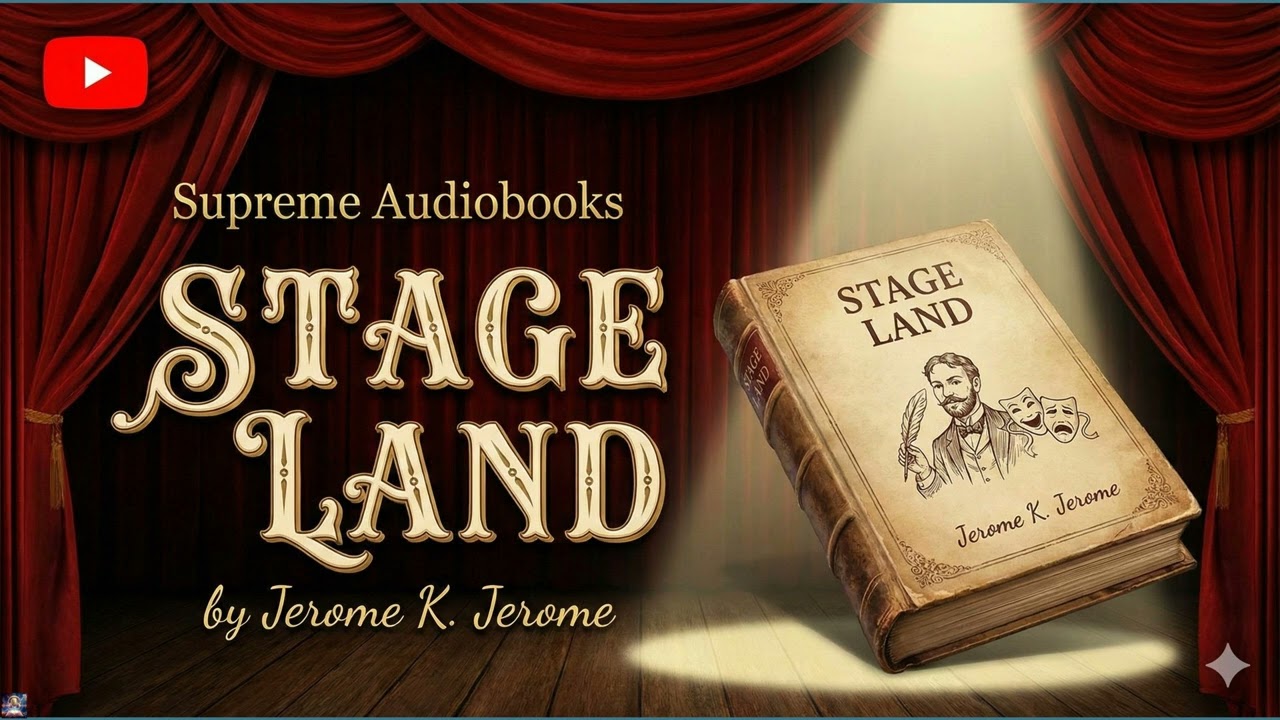
Stage Land
Step into the gaslit glow of the Victorian theatre, where melodrama reigned supreme and character types were as fixed as the set pieces. Jerome K. Jerome's Stage Land, originally published in 1889, offers a brilliant and often hilarious backstage pass to this world, not through a traditional narrative, but through the keen, satirical eyes of an avid theatre-goer. This isn't just a nostalgic look at a bygone era of entertainment; it’s a foundational text for understanding the archetypes that persist in storytelling, from stage to screen, even today. Anyone who has ever rolled their eyes at a predictable villain, a perpetually noble hero, or a suspiciously convenient plot twist will find a kindred spirit in Jerome’s witty observations, discovering how much of what we consume as entertainment is built upon age-old, often absurd, conventions. The setting for Stage Land is, as its title suggests, the theatre itself – specifically, the popular stages of late 19th-century London, though its insights ring true for many theatrical traditions. Our guide is an unnamed narrator, a devoted but discerning member of the audience, who possesses an almost scientific fascination with the recurring patterns of dramatic presentation. Instead of following a single plot, the book presents a series of observational sketches, each dedicated to a distinct theatrical "type." We meet the Stage Hero, a man of unblemished virtue and unwavering purpose, whose dialogue is always noble and whose actions are always above reproach, even when they seem entirely impractical. He is typically wealthy, often an orphan, and unfailingly handsome. Then there is the Stage Villain, a character of pure, unadulterated malevolence, whose motives are often vague but whose dastardly deeds are meticulously planned, usually involving forged documents or secret passages. His laugh is always sardonic, his expression a perpetual sneer. Jerome introduces us to the Stage Ingenue, forever innocent and wide-eyed, often poor but always possessing a mysterious noble lineage, and the Stage Detective, a figure of impossible deductive reasoning who always arrives just in time. The narrator describes these figures with a dry wit, detailing their predictable entrances, their stock phrases, and their inevitable fates, building a cumulative portrait of a stage world governed by strict, often illogical, rules. The central "conflict," if one can call it that, is the narrator's ongoing, gentle struggle against the sheer predictability of it all, his delight in exposing the theatrical machinery that keeps audiences enthralled despite its transparent nature. Jerome K. Jerome, born in Walsall, England, in 1859, was a literary figure whose humor provided a refreshing counterpoint to the more rigid Victorian sensibilities of his time. His early life was marked by considerable hardship; orphaned at a young age, he held various jobs—railway clerk, schoolteacher, actor—before finding his calling as a writer. This early experience in the theatre, no doubt, contributed to the incisive and accurate observations found in Stage Land. Jerome's breakthrough came with Three Men in a Boat (To Say Nothing of the Dog) in 1889, a comedic account of a boating trip on the River Thames, which became an instant sensation and remains his most celebrated work. He also garnered popularity with The Idle Thoughts of an Idle Fellow, published in 1886. Jerome's unique blend of genial wit, philosophical musings, and a keen eye for human foibles placed him firmly within the "New Humour" movement, which offered a lighter, less didactic alternative to the often heavy-handed moralizing found in much Victorian literature. His writing style was characterized by an easygoing conversational tone, a knack for relatable anecdotes, and a satirical edge that, while sharp, rarely turned truly biting. Jerome continued to write plays, essays, and novels throughout his life, becoming a respected editor of several literary magazines, and left a lasting mark on English literature as a master of comic prose before his passing in 1927. Stage Land enacts several key themes with admirable clarity and humor. One primary theme is the satire of theatrical conventions itself. Jerome meticulously dissects the formulaic nature of late Victorian drama, showing how character, plot, and dialogue often served predictable functions rather than reflecting genuine human experience. For instance, he points out the utter lack of individual personality among "stage children," who are always precocious, sweet, and articulate, serving merely as emotional props rather than believable individuals. This highlights the artificiality accepted by the audience of the time. Another significant theme is the distinction, or lack thereof, between performance and reality. Jerome frequently muses on how the extreme behaviors and motivations presented on stage subtly influence or reflect societal expectations. The unwavering moral compass of the "Good Young Man" on stage, who is always ready to forgive and sacrifice, contrasts amusingly with what one might expect in real life, prompting listeners to consider where the line blurs between dramatic ideal and actual behavior. The book also touches upon social commentary through humor, subtly critiquing the moralizing and class divisions often reinforced by popular entertainment. The servant characters, for example, are typically depicted with a simplistic loyalty or a comical incompetence, showcasing the prevailing attitudes towards social strata. Finally, it addresses the theme of audience expectation and complicity, suggesting that audiences are not just passive recipients but active participants in the theatrical illusion, eagerly awaiting the familiar tropes and readily suspending disbelief for the sake of the entertainment. The emergence of Stage Land in 1889 was perfectly timed within the historical and literary landscape of the late Victorian era. This period saw a massive expansion in popular theatre, driven by a growing middle class with more leisure time and disposable income. Melodrama, with its clear-cut heroes and villains, dramatic reversals, and moralizing conclusions, was the dominant form of entertainment. However, concurrently, there was a rising appetite for more sophisticated and self-aware forms of humor. Literary movements were beginning to question the earnestness and sometimes ponderous tone of earlier Victorian writing, paving the way for authors like Jerome who could offer laughter and gentle critique without abandoning accessibility. Jerome's own background as an actor gave him an insider's perspective on the mechanics of the stage, allowing him to critique its conventions with both affection and authority. Stage Land can be seen as part of a broader cultural shift towards analyzing and even deconstructing the forms of popular entertainment, a practice that would only grow more prevalent in the coming decades. It offered audiences not just a laugh, but a chance to reflect on why they found certain dramatic tropes so compelling, and what those tropes revealed about their own society. Listening to Stage Land as an audiobook offers a singular experience that truly enhances Jerome's characteristic wit and observational humor. The dry, understated comedy woven throughout the text blossoms under skilled narration, where the subtle inflections, precise timing, and varied character voices can bring each archetypal stage figure to life with humorous clarity. The descriptions of the Hero's booming pronouncements or the Villain's hissed asides gain an added dimension, allowing you to almost visualize the stage and its exaggerated inhabitants. With a run length of several hours, it's an ideal companion for a morning commute, a leisurely afternoon, or a quiet evening, providing digestible segments of clever insight. Pay attention to the narrator's pacing, which often mirrors Jerome's own thoughtful pauses and sudden bursts of comedic realization, creating an intimate sense of sharing a knowing chuckle with the author himself.
Enjoyed Stage Land? A few ways to support us
Audible & Amazon links are affiliate; we may earn a small commission at no extra cost.
About this production
Human narration by a volunteer reader from LibriVox.org, the public-domain audiobook project. LibriVox volunteers record literary works whose copyright has expired in the United States, releasing the resulting recordings into the public domain.
Stage Land by Jerome K Jerome. The underlying text is in the U.S. public domain. We do not republish any modern copyrighted edition, translation, or commentary.
The 4K cinematic visuals accompanying this audiobook are generated by an AI image model from prompts derived from the source text. No copyrighted photos, paintings, or stock footage are used. AI generation is disclosed on every video on our YouTube channel as required by YouTube's altered/synthetic content policy.
English subtitles are transcribed from the LibriVox recording with OpenAI Whisper. Translations into the 11 other supported languages are produced by Meta's NLLB-200 neural translation model. No human translator's copyrighted translation is used.
Questions about sourcing or rights? See our DMCA & Sourcing policy or contact us.
Enjoyed this audiobook?
If you'd like to own a copy of Stage Land or hear a professionally produced edition, the links below help support free audiobook production at no extra cost to you.
As an Amazon Associate we earn from qualifying purchases. Audible / print links are affiliate.
![MARK TWAIN'S [Date, 1601.] CONVERSATION As It WAS By The SOCIAL FIRESIDE In The TIME- Full Audiobook by Mark Twain — free full audiobook](https://img.youtube.com/vi/IBbX13QIif8/mqdefault.jpg)