Some Experiences of an Irish R.M.
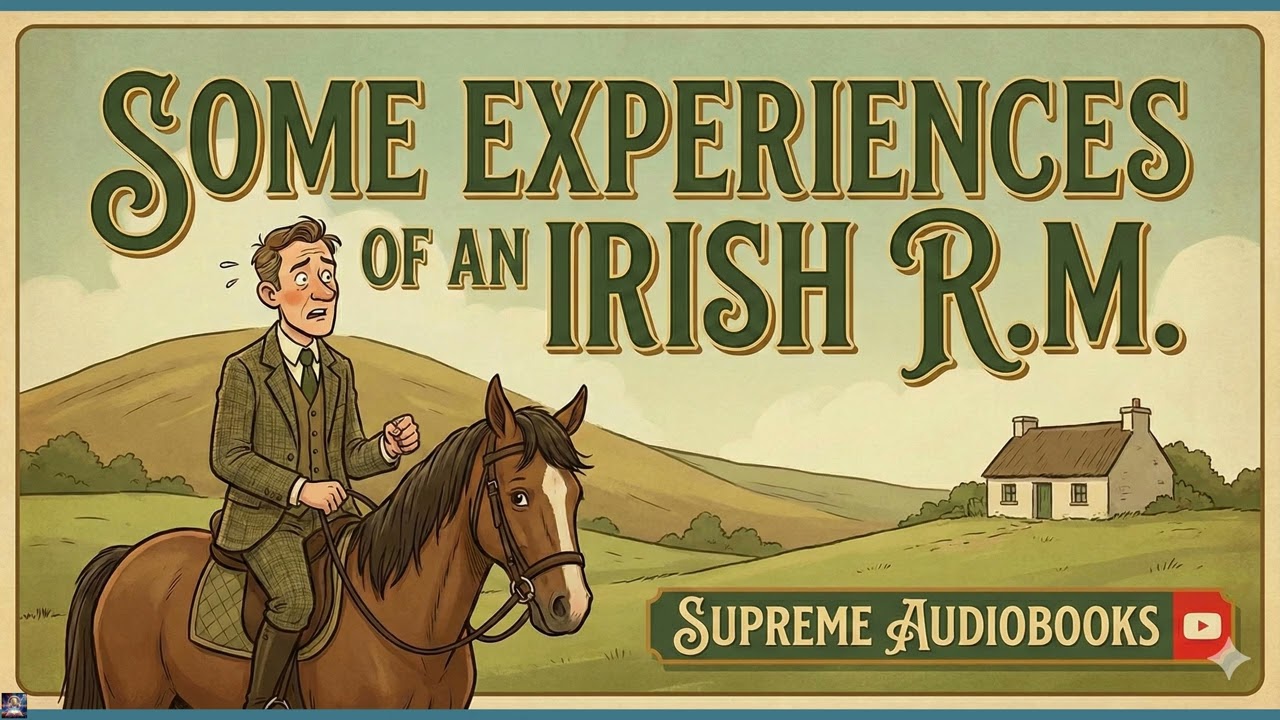
Step into a world where the everyday is a stage for the absurd, where logical English sensibilities collide with the delightful, often baffling, intricacies of rural Irish life. E. O. Somerville’s "Some Experiences of an Irish R.M." stands as a cornerstone of comedic literature, offering listeners a charming and frequently uproarious glimpse into the Anglo-Irish society of the late 19th and early 20th centuries. This collection of episodic tales introduces us to Major Sinclair Yeates, the well-meaning but perpetually outmaneuvered Resident Magistrate, whose attempts to administer justice in West Ireland are met with a colorful cast of characters and circumstances that defy easy explanation. It's a book that resonates today not just for its laugh-out-loud moments, but for its astute observations on cultural differences, the endearing eccentricities of human nature, and the gentle satire of a colonial perspective encountering the indomitable spirit of local tradition. Our story unfolds in the rugged, windswept landscape of County Cork, in the fictional district of Skebawn, where Major Yeates has been appointed to the rather thankless post of Resident Magistrate. He arrives with his wife, Philippa, an English couple determined to bring order and English common sense to what they perceive as a somewhat chaotic corner of the world. From the outset, their intentions are noble, but their understanding of local customs, loyalties, and the ingenious methods employed to circumvent officialdom proves to be profoundly lacking. The central conflict arises from the R.M.’s earnest attempts to apply regulations and legal principles to situations that are invariably dictated by personal ties, ancient grudges, or a logic entirely unique to the Irish countryside. The heart of the book’s comedic genius lies in the character interactions. Major Yeates is a decent man, often exasperated but never malicious, whose attempts at impartiality are constantly undermined by the machinations of the locals. Chief among these is Flurry Knox, a young, cunning, and utterly charming fox-hunter and general mischief-maker, who frequently enlists the R.M. in his schemes—or drags him into trouble without permission. From horse races to local court cases, from hunt meets to domestic squabbles, the R.M. finds himself tangled in a web of misunderstandings and predicaments, often ending up bewildered, poorer, or simply outsmarted. The overarching arc of the narrative sees the Major’s initial optimism gradually tempered by a grudging, humorous acceptance of the fact that he will never truly impose his will on Skebawn. The name E. O. Somerville represents a unique literary collaboration between two remarkable women: Edith Œnone Somerville (1858–1949) and her cousin Violet Florence Martin (1862–1915), who wrote under the pseudonym Martin Ross. Born in Corfu, Edith spent most of her life in County Cork, Ireland, at Drishane House, a quintessential Anglo-Irish estate. Violet, born in Ross House, County Galway, was also steeped in this gentry tradition. Their partnership began in 1886, a truly collaborative effort where they would often write alternate chapters or even sentences, sharing an almost telepathic understanding of character and plot. Their joint output includes several novels and short story collections beyond the R.M. series, most notably the more serious and critically acclaimed novel The Real Charlotte, which offered a sharper, often darker, portrayal of Anglo-Irish society. After Violet's untimely death in 1915, Edith continued to write under their shared pen name, famously claiming to maintain a spiritual connection with Violet, through which their literary work persisted. They are recognized as significant figures in Anglo-Irish literature, capturing a specific social stratum and way of life with unparalleled authenticity and wit, earning them a distinct and enduring place in the canon of Irish letters. One prominent theme running through the R.M. stories is the inevitable cultural clash and misunderstanding between the English R.M. and the Irish locals. Major Yeates arrives with a belief in order and legal precedent, which is repeatedly challenged by the fluid, often contradictory logic of Skebawn. For example, in a local court case, the R.M. might strive for a fair judgment based on evidence, only to find witnesses giving testimony that is more performance than fact, influenced by local alliances or a desire to spin a good yarn. His exasperation is our amusement, highlighting the humorous friction when two distinct worldviews collide. Another pervasive theme is the nature of the Anglo-Irish identity itself, portrayed here with both affection and a touch of melancholy. Somerville and Ross were themselves members of this gentry class, and their observations carry the weight of lived experience. The R.M. represents the earnest, slightly out-of-touch administrator, trying to uphold a system that is increasingly out of step with the emerging Irish national consciousness. The humor often arises from this gentle satire of a class that sees itself as integral to Ireland, yet remains distinct from the majority of its inhabitants, presenting a poignant snapshot of a society in flux. When these tales were published at the turn of the 20th century, Ireland was a country grappling with profound political and cultural shifts. The period saw the rise of Irish nationalism, fervent debates around Home Rule, and a growing sense of distinct Irish identity separate from British influence. Somerville and Ross, however, represented the Anglo-Irish ascendancy—a Protestant, landowning class whose loyalties and cultural affinities often straddled both nations. Their writings emerged from within this specific social stratum, capturing its nuances, its concerns, and its often-idyllic yet precarious existence. Literarily, this was also a vibrant time for Irish letters, with figures like W.B. Yeats, J.M. Synge, and Lady Augusta Gregory forging what would become the Irish Literary Revival. While Somerville and Ross operated with a different tone and focus—more grounded in social comedy and realism than the Revival’s often mythic or dramatic bent—their work is equally vital for its detailed, often affectionate, portrayal of Irish character and landscape. They provided a unique, often humorous, perspective on an Ireland that was both quintessentially itself and inextricably linked to British rule, offering a literary bridge between the two. Listening to "Some Experiences of an Irish R.M." as an audiobook offers a singular pleasure, transforming the printed word into a vivid, immediate experience. The narrator's performance is crucial here, bringing to life the distinct voices of Major Yeates, with his carefully controlled exasperation, and the quick-witted, often brogue-laced responses of the local characters, especially the cunning Flurry Knox. The several hours of listening time allow for a leisurely immersion into this world, perfect for unwinding after a long day or for accompanying a drive through changing landscapes. Pay particular attention to the comedic timing, the subtle shifts in tone that betray the R.M.’s mounting bewilderment, and the lively, authentic dialogue that truly captures the spirit and humor of a bygone Ireland. It’s an auditory delight that allows the wit and charm of Somerville and Ross to shine with renewed brilliance.
Enjoyed Some Experiences of an Irish R.M.? A few ways to support us
Audible & Amazon links are affiliate; we may earn a small commission at no extra cost.
About this production
Human narration by a volunteer reader from LibriVox.org, the public-domain audiobook project. LibriVox volunteers record literary works whose copyright has expired in the United States, releasing the resulting recordings into the public domain.
Some Experiences of an Irish R.M. by E. O. Somerville. The underlying text is in the U.S. public domain. We do not republish any modern copyrighted edition, translation, or commentary.
The 4K cinematic visuals accompanying this audiobook are generated by an AI image model from prompts derived from the source text. No copyrighted photos, paintings, or stock footage are used. AI generation is disclosed on every video on our YouTube channel as required by YouTube's altered/synthetic content policy.
English subtitles are transcribed from the LibriVox recording with OpenAI Whisper. Translations into the 11 other supported languages are produced by Meta's NLLB-200 neural translation model. No human translator's copyrighted translation is used.
Questions about sourcing or rights? See our DMCA & Sourcing policy or contact us.
Enjoyed this audiobook?
If you'd like to own a copy of Some Experiences of an Irish R.M. or hear a professionally produced edition, the links below help support free audiobook production at no extra cost to you.
As an Amazon Associate we earn from qualifying purchases. Audible / print links are affiliate.