Deutsche Liebe.
A quiet intensity, a profound yearning, and a love that transcends the ordinary — these are the currents that run through F. Max Mller's unique literary creation, Deutsche Liebe. This isn't a romance of grand gestures or breathless passions, but rather a tender, philosophical novella that invites listeners into a world of deep introspection and spiritual connection. Originally published in 1857, this work stands as a poignant outlier in the career of a renowned scholar, offering a glimpse into the emotional and intellectual landscape of 19th-century German idealism. Why listen today? Because in an age of fleeting digital interactions, Deutsche Liebe reminds us of the enduring power of intellectual intimacy, the search for meaning in suffering, and the quiet dignity of a love that seeks understanding above all else. Its gentle pace and contemplative spirit offer a respite, a chance to pause and reflect on the very nature of human connection and the mysteries that bind us. The story unfolds through the reflective lens of an unnamed narrator, a young man of scholarly inclination, who recounts his profound and transformative relationship with a mysterious and ethereal Princess. Their initial meeting, perhaps in the refined circles of academic or aristocratic life, quickly blossoms into an extraordinary intellectual and emotional bond. The setting feels less like a specific place and more like an inner landscape, a world of hushed libraries, quiet gardens, and intimate conversations. The Princess, often portrayed as delicate or ailing, possesses a remarkable spiritual depth and an almost otherworldly understanding of life, death, and beauty. She becomes the narrator's muse, his teacher, and the object of his purest devotion. The central conflict of the story lies not in external obstacles, but in the narrator's struggle to fully comprehend the Princess's elevated perspective. His love for her is a longing for something beyond the physical, an aspiration to reach her level of spiritual insight. Their relationship is characterized by long, winding discussions about philosophy, art, nature, and the divine, through which the narrator attempts to bridge the gap between his earthly understanding and her transcendent wisdom. As the narrative progresses, the fragile nature of her health becomes a poignant backdrop to their deepening connection, casting a shadow of tender melancholy over their shared moments. The story traces the arc of this singular bond, charting the growth of the narrator's soul under her gentle guidance and hinting at the profound impact she will leave on him, without revealing the specific culmination of their shared journey. The author, Friedrich Max Mller, born in Dessau, Germany, in 1823, was a figure of towering intellect who largely dedicated his life to the academic pursuits of philology and Oriental studies. Educated at Leipzig and Berlin, he moved to England in 1846, eventually becoming a distinguished Professor of Comparative Philology at Oxford University. Mller is most celebrated for his groundbreaking work in Indology, particularly his meticulous translation of the Rig Veda and his monumental editorship of The Sacred Books of the East, a fifty-volume collection of Asian religious texts. These endeavors solidified his reputation as one of the founders of the academic study of world religions and languages. Against this backdrop of rigorous scholarship, Deutsche Liebe, published when Mller was in his mid-thirties, presents a fascinating departure. While it shares the intellectual curiosity and philosophical depth evident in his academic writings, it is a work of fiction, imbued with a deeply personal and emotional resonance. It is often regarded as semi-autobiographical, reflecting his own intellectual and romantic sensibilities. This novella represents a unique moment in his literary output, showcasing a lyrical prose style and an engagement with introspective themes that stand apart from his otherwise scholarly contributions, placing him as a figure who bridged the scientific rigor of the nascent social sciences with a lingering Romantic idealism. At its core, Deutsche Liebe contemplates themes of idealized love, presenting a relationship founded on intellectual and spiritual affinity rather than physical passion. The narrator's admiration for the Princess is not merely romantic attachment, but a profound reverence for her wisdom and inner light. For instance, their most intimate moments are often described as conversations where they dissect philosophical concepts or share insights into the world's hidden meanings, rather than conventional declarations of affection. This intellectual communion becomes the very essence of their bond, showing how love can elevate and transform the human spirit. Another prominent theme is memory and the melancholic beauty of reflection. The entire novella is framed as the narrator's retrospective account, a collection of fragments gleaned from his past. This structure emphasizes the enduring presence of lost love and the way past experiences continue to shape one's identity. The act of remembering, of sifting through moments shared with the Princess, is itself a form of love, a continuous re-engagement with her spirit. Lastly, the book engages deeply with spirituality and transcendence, largely through the Princess's character. Her delicate health allows her a unique perspective on existence, fostering a calm acceptance of mortality and a belief in the interconnectedness of all things. Her gentle philosophy offers the narrator, and the listener, a vision of truth that extends beyond the tangible world, suggesting a harmony between the material and the divine. The mid-19th century in Germany, when Deutsche Liebe was penned, was a period of intense cultural and intellectual ferment. While the grand sweep of Romanticism was beginning to recede, giving way to burgeoning realism and the scientific advancements that Mller himself championed, there remained a strong undercurrent of philosophical idealism. Germany was still a collection of states, grappling with questions of national identity and cultural heritage. The literary landscape saw writers grappling with the legacy of Goethe and Schiller, while also looking towards new forms of expression. Deutsche Liebe emerged from this milieu, perhaps as a personal response to the tension between the accelerating material world and the enduring human need for spiritual depth and profound emotional connection. It represents a lingering appreciation for the subjective experience and the power of individual reflection, even as the world around it moved toward more objective forms of inquiry. Listening to Deutsche Liebe as an audiobook offers a truly unique and enriching experience, allowing its contemplative nature to unfold at an unhurried pace. The run length, several hours long, provides ample opportunity to immerse oneself fully in the narrator's introspective world without interruption. A skilled narrator's voice can beautifully render the tender melancholy and intellectual curiosity that define the text, bringing to life the quiet dignity of the Princess and the narrator's deep admiration. Pay close attention to the deliberate pacing, which mirrors the slow unfolding of profound thought, and the nuanced dialogue, often more philosophical discourse than conversational exchange. The audio format enhances the intimate atmosphere, drawing the listener into the private world of these two souls, making their shared pursuit of understanding feel both personal and universally resonant.
Enjoyed Deutsche Liebe.? A few ways to support us
Audible & Amazon links are affiliate; we may earn a small commission at no extra cost.
About this production
Human narration by a volunteer reader from LibriVox.org, the public-domain audiobook project. LibriVox volunteers record literary works whose copyright has expired in the United States, releasing the resulting recordings into the public domain.
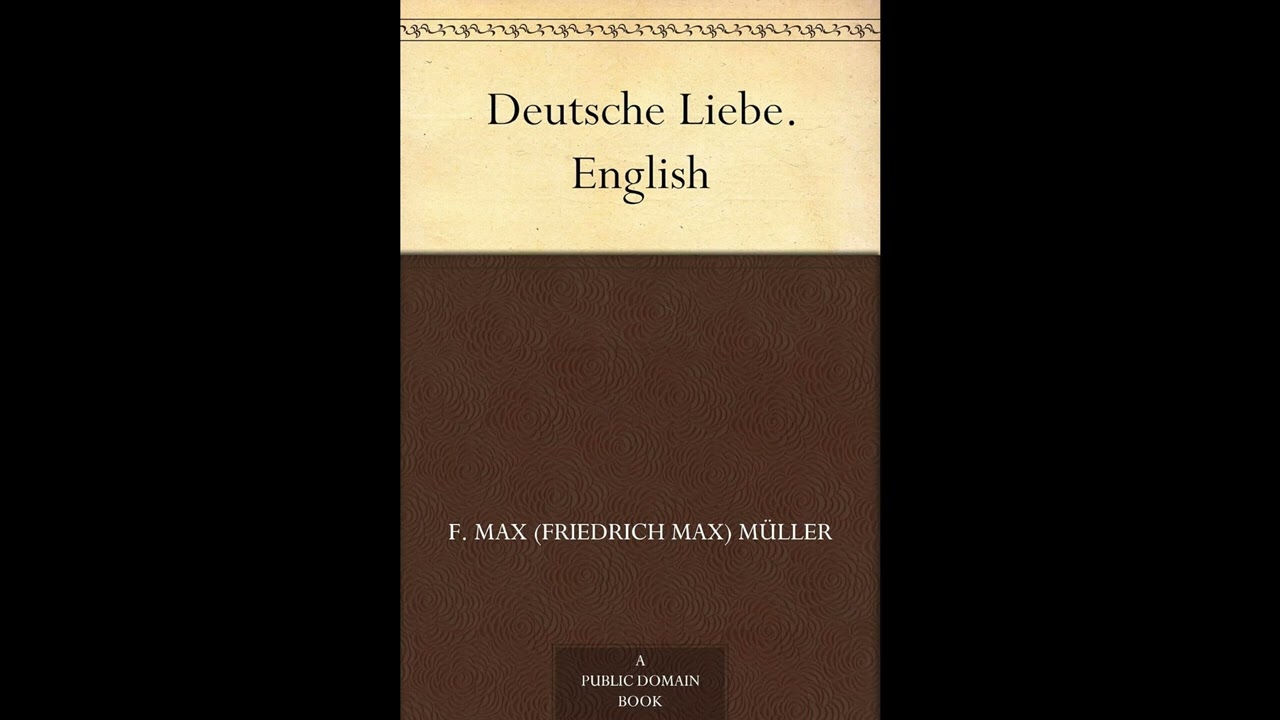
Deutsche Liebe. by F. Max (Friedrich Max) Müller. The underlying text is in the U.S. public domain. We do not republish any modern copyrighted edition, translation, or commentary.
The 4K cinematic visuals accompanying this audiobook are generated by an AI image model from prompts derived from the source text. No copyrighted photos, paintings, or stock footage are used. AI generation is disclosed on every video on our YouTube channel as required by YouTube's altered/synthetic content policy.
English subtitles are transcribed from the LibriVox recording with OpenAI Whisper. Translations into the 11 other supported languages are produced by Meta's NLLB-200 neural translation model. No human translator's copyrighted translation is used.
Questions about sourcing or rights? See our DMCA & Sourcing policy or contact us.
Enjoyed this audiobook?
If you'd like to own a copy of Deutsche Liebe. or hear a professionally produced edition, the links below help support free audiobook production at no extra cost to you.
As an Amazon Associate we earn from qualifying purchases. Audible / print links are affiliate.