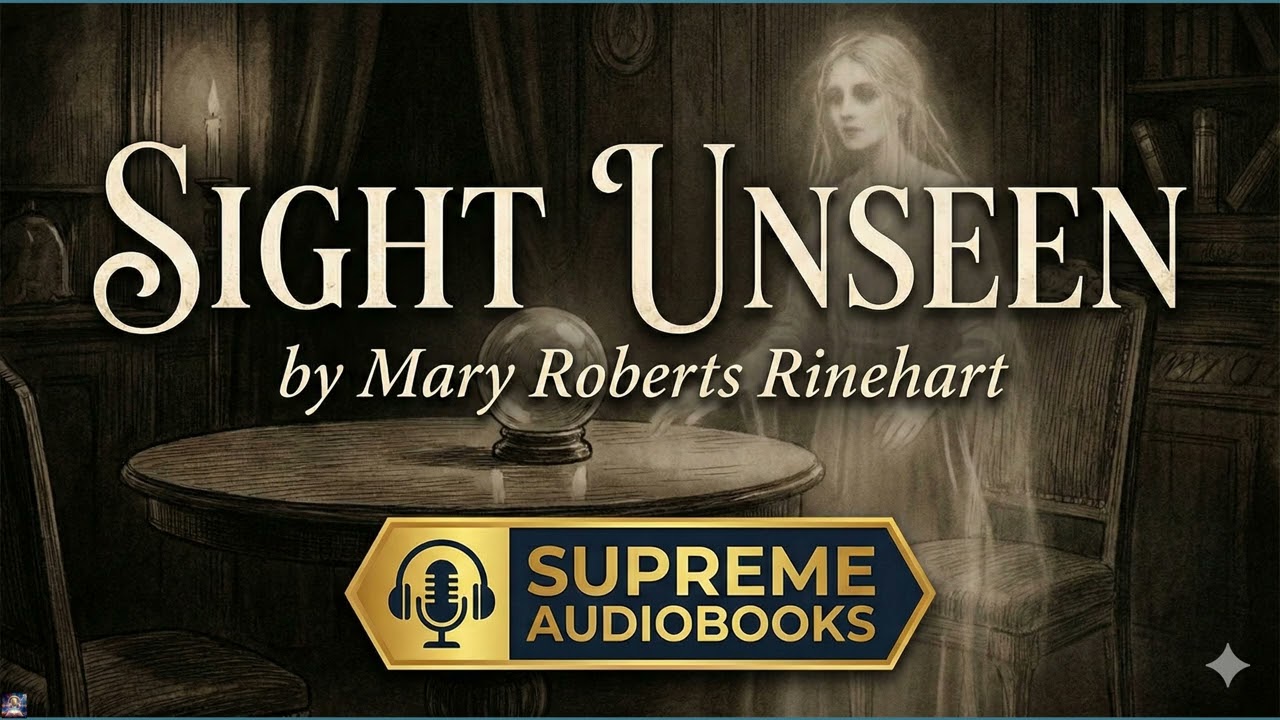
Sight Unseen
The very title, "Sight Unseen," offers a chilling invitation, a promise of hidden truths and deceptions that lie just beyond the reach of ordinary perception. This classic mystery, born from the insightful mind of Mary Roberts Rinehart, still holds a remarkable power to unsettle and intrigue listeners today. It reminds us that what we believe to be solid and real can often be a mere illusion, and that danger frequently lurks not in the obvious shadows, but in the familiar spaces we inhabit and the people we presume to know. For anyone who appreciates the slow burn of suspense, the careful unveiling of a secret, and the psychological drama of a mind grappling with elusive terror, this story remains as potent as it was upon its original publication, a testament to Rinehart’s enduring skill in crafting a tale that reaches beyond simple whodunit to question the very nature of observation and truth. The story introduces us to a world that feels both comforting and subtly menacing—a stately home, perhaps one that has seen generations pass through its doors, now harboring a deep-seated secret. Our protagonist finds herself drawn into circumstances that defy easy explanation, events that suggest a sinister undercurrent beneath the placid surface of daily life. What begins as a series of strange occurrences, perhaps dismissed as coincidence or the product of an overactive imagination, gradually escalates into a genuine threat, making it clear that something profoundly unsettling has taken root within these walls. The characters surrounding the central figure—family members, servants, and neighbors—each harbor their own unspoken histories and potential motives, creating a web of suspicion where trust becomes a fragile commodity. As the narrative unfolds, the search for answers becomes increasingly urgent and fraught with peril. The central conflict does not merely revolve around identifying a culprit, but more profoundly, understanding the nature of the threat itself. Is it a malicious individual, a ghostly presence, or perhaps a manipulation so clever that it challenges the protagonist's sanity? Rinehart masterfully builds an atmosphere of unease, where every sound, every shadow, every fleeting glance carries potential significance, forcing the protagonist, and by extension the listener, to constantly question what is real and what is fabricated. The story's arc is a relentless ascent into psychological suspense, pushing the boundaries of perception as the protagonist attempts to piece together a reality that seems determined to remain, quite literally, "sight unseen." Mary Roberts Rinehart (1876-1958) was an American author who carved out an astonishingly successful career in popular fiction during the early 20th century, cementing her place as a literary giant of her time. Born in Pittsburgh, Pennsylvania, Rinehart initially trained as a nurse, a profession that undoubtedly offered her a unique window into human nature, suffering, and the quiet dramas of life and death—experiences that would later infuse her fiction with realistic detail and psychological depth. She married Dr. Stanley Marshall Rinehart and raised three sons, all while balancing a demanding writing schedule that would eventually produce more than sixty books, several plays, and countless short stories. Rinehart is often credited as a progenitor of the "Had-I-But-Known" school of mystery writing, a style characterized by a first-person narrator who frequently foreshadows danger with phrases like "Little did I know then..." or "If only I had understood..." This narrative technique, while sometimes parodied, allowed Rinehart to build suspense effectively and draw her readers deeply into the protagonist's fearful experience. She achieved widespread recognition with early successes like The Circular Staircase (1908) and The Man in Lower Ten (1909), establishing her as a formidable presence in the nascent genre of American detective fiction. Beyond her mysteries, she also penned adventure novels and the popular Tish stories, featuring the elderly, eccentric Miss Letitia Carberry, showcasing her versatility and humor. Rinehart’s influence helped shape the landscape of mystery writing, bridging the gap between earlier Gothic narratives and the more formal "Golden Age" detective stories that followed. "Sight Unseen" powerfully enacts several enduring themes, foremost among them the elusive nature of perception versus reality. The title itself points to this central idea; characters struggle to discern truth from deception, often misinterpreting events or dismissing crucial clues because they appear ordinary. For instance, a seemingly harmless domestic item might later prove to be a pivotal piece of evidence, its true significance hidden in plain sight. This constant questioning of what is seen and what is genuinely happening creates a pervasive sense of paranoia, both for the protagonist and the listener. The story demonstrates how easily one's understanding of events can be manipulated, and how trust in one's own senses can be utterly undermined. Another prominent theme in the narrative is the hidden dangers within domesticity. Rinehart frequently places her mysteries within the confines of seemingly safe, respectable homes, transforming the familiar into the threatening. In "Sight Unseen," the home becomes a stage for unfolding terror, a place where secrets fester and violence lurks beneath a veneer of order. This theme resonates strongly by suggesting that the greatest threats often come not from the outside world, but from within the intimate circles of family and acquaintances, turning places of supposed refuge into arenas of suspicion and fear. A third theme is the fragility and malleability of memory, as characters recount past events differently or struggle to recall details accurately, complicating the search for the truth and adding another layer of uncertainty to the unfolding mystery. The early 20th century, the probable period of "Sight Unseen's" creation and publication, was a fascinating time of social and cultural flux in America. It followed the Gilded Age and preceded the Roaring Twenties, marked by rapid industrialization, burgeoning cities, and the lingering shadows of Victorian sensibilities clashing with emerging modern ideas. Women were gaining greater independence and agency, though still largely confined to traditional roles, a tension often reflected in Rinehart's female protagonists who frequently navigate dangerous situations with intelligence and courage. This was also a boom time for popular fiction; advancements in printing and distribution made books and magazines accessible to a wider middle-class audience, creating a voracious demand for engaging stories. The public's appetite for mystery and detective fiction was growing exponentially, providing fertile ground for authors like Rinehart to thrive. Her stories often tapped into anxieties of the era: concerns about crime in increasingly anonymous urban environments, the secrets that respectable families might conceal, and the psychological toll of modernity. "Sight Unseen" likely emerged from this cultural moment, offering readers an escape into suspense while also subtly reflecting the societal shifts and psychological complexities of a nation finding its footing in a rapidly changing world. The story captures the lingering sense of unease and the fascination with the hidden undercurrents of human nature that characterized the period. Listening to "Sight Unseen" as an audiobook offers a uniquely immersive way to experience Rinehart's masterful storytelling. The "several hours" runtime makes it an ideal companion for a long drive, a productive afternoon of household tasks, or simply an evening spent unwinding. A skilled narrator breathes life into Rinehart’s carefully constructed world, allowing the listener to truly sink into the building suspense. Pay attention to the pacing of the narration, how it subtly quickens during moments of discovery or slows to emphasize a character's internal turmoil. The narrator's voice will bring out the nuances of dialogue, distinguishing characters and conveying their hidden motivations, anxieties, or feigned composure. The auditory experience particularly enhances the oppressive atmosphere of the story—the creaks of an old house, the muffled sounds beyond a closed door, the whispered secrets, all contribute to a heightened sense of dread that is palpable through sound alone, making the unseen elements of the narrative feel more immediate and chilling.
Enjoyed Sight Unseen? A few ways to support us
Audible & Amazon links are affiliate; we may earn a small commission at no extra cost.
About this production
Human narration by a volunteer reader from LibriVox.org, the public-domain audiobook project. LibriVox volunteers record literary works whose copyright has expired in the United States, releasing the resulting recordings into the public domain.
Sight Unseen by Mary Roberts Rinehart. The underlying text is in the U.S. public domain. We do not republish any modern copyrighted edition, translation, or commentary.
The 4K cinematic visuals accompanying this audiobook are generated by an AI image model from prompts derived from the source text. No copyrighted photos, paintings, or stock footage are used. AI generation is disclosed on every video on our YouTube channel as required by YouTube's altered/synthetic content policy.
English subtitles are transcribed from the LibriVox recording with OpenAI Whisper. Translations into the 11 other supported languages are produced by Meta's NLLB-200 neural translation model. No human translator's copyrighted translation is used.
Questions about sourcing or rights? See our DMCA & Sourcing policy or contact us.
Enjoyed this audiobook?
If you'd like to own a copy of Sight Unseen or hear a professionally produced edition, the links below help support free audiobook production at no extra cost to you.
As an Amazon Associate we earn from qualifying purchases. Audible / print links are affiliate.