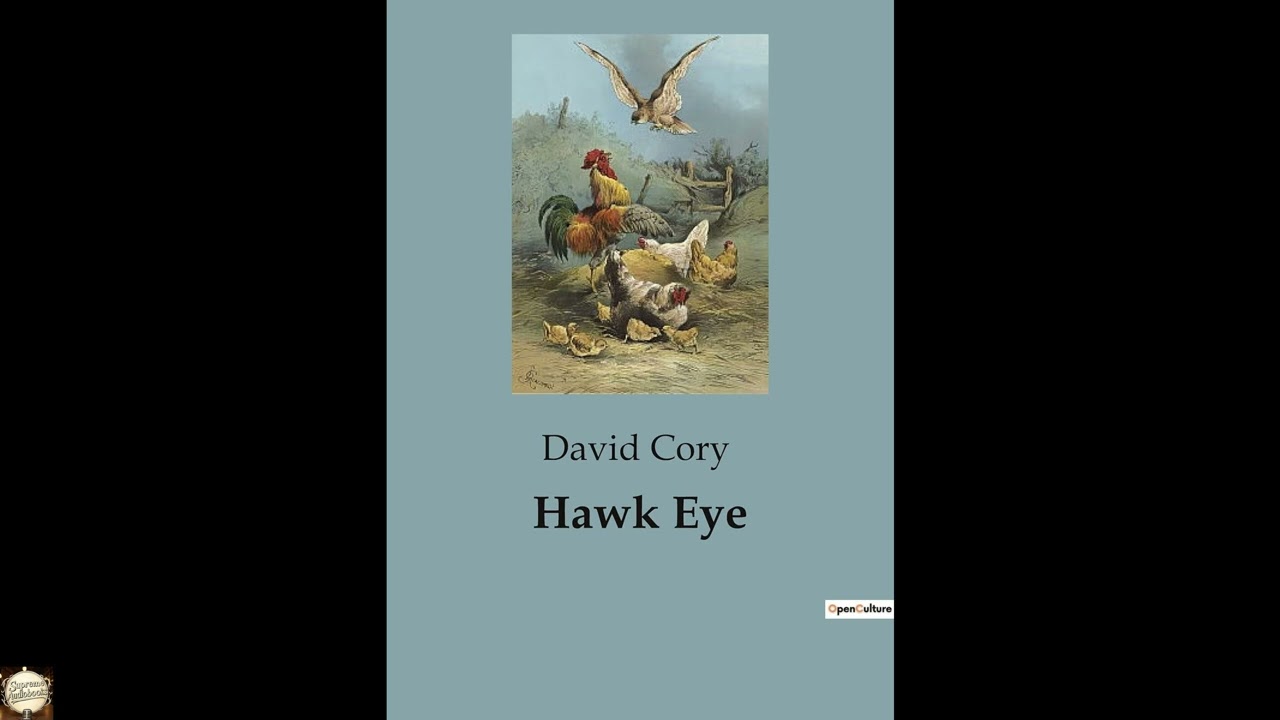
Hawk Eye
Step into a world where keen observation unveils hidden truths, where the veneer of polite society cracks under the unwavering gaze of an individual whose insight pierces through illusion. David Cory’s Hawk Eye is more than a simple narrative; it is an enduring examination of perception, reality, and the subtle yet profound power of seeing what others miss. Decades after its initial emergence, this classic piece of literature continues to resonate, challenging listeners to look closer at their own surroundings, to question the surface, and to appreciate the quiet strength of those who truly understand the human condition. Its relevance endures because the fundamental human tendency to overlook or misinterpret remains a constant, making Cory’s observations as piercing today as they were when first penned. The story unfolds in the bustling, turn-of-the-century city of Veridian, a place of grand Victorian architecture and stark social divides, where gaslight illuminates cobblestone streets and horse-drawn carriages share thoroughfares with nascent motorcars. Our central figure is Elias Thorne, affectionately – or perhaps mockingly – known as "Hawk Eye" among his limited circle. Thorne is not a detective in the conventional sense, nor a man of action, but rather a solitary scholar and an unmatched observer, possessing an almost preternatural ability to connect disparate details into a cohesive whole. He lives a quiet existence, largely unnoticed by the city's glittering elite, yet his mind is constantly at work, processing the silent narratives unfolding around him. The central conflict arises not from a dramatic crime, but from a pervasive sense of unease, a subtle current of deception that seems to permeate the city's most respected institutions and families, particularly concerning the benevolent, seemingly unblemished reputation of the powerful and philanthropic Atherton family. As Thorne begins to piece together seemingly unrelated events—a quiet financial scandal, a peculiar change in a respected socialite's demeanor, the sudden disappearance of a skilled artisan—he realizes that a far grander illusion is being maintained than anyone suspects. The narrative meticulously follows Thorne’s mental deductions, his patient gathering of fragments from newspaper clippings, overheard conversations, and the unnoticed subtleties of human behavior. He doesn't confront or accuse, but rather builds a silent case within his own mind, observing the subtle shifts in power dynamics and the carefully constructed facades. The story’s arc is a gradual, almost imperceptible unveiling, as Thorne’s internal certainty solidifies into an undeniable understanding of the true mechanics beneath Veridian’s polished surface, exposing not a single villain, but a complex web of complicity and self-deception that has grown to define the city’s upper echelons. David Cory, a name perhaps more whispered among literary enthusiasts than shouted from the rooftops, was a distinctive voice active in the late nineteenth and early twentieth centuries. Born in a quiet New England town, Cory cultivated a lifelong fascination with human psychology and societal structures, often finding himself drawn to the bustling urban centers where these forces converged. Little is known about the more sensational aspects of his personal life; indeed, Cory himself seemed to prefer the role of detached observer, a quality that profoundly influenced his literary output. His writing is characterized by a precise, almost clinical prose that belies a deep empathy for his characters and a sharp critical eye for the world they inhabit. Before Hawk Eye cemented his place as a nuanced social commentator, Cory had gained a modest reputation for works such as The Gilded Cage, a searing but understated critique of inherited wealth, and Beneath the Surface, a collection of short stories that similarly probed the hidden lives of ordinary people. Though he was not affiliated with any specific literary school in a formal sense, his leanings aligned closely with the American Realists, sharing their commitment to depicting life as it truly was, often highlighting the socio-economic pressures that shaped individual destinies. Cory’s position in the literary canon is that of a quiet but essential bridge-builder, a writer whose methodical style anticipated later psychological fiction while retaining the grounded authenticity of his realist predecessors. Among the central themes in Hawk Eye is the pervasive distinction between appearance and reality. Cory masterfully illustrates how the established order in Veridian relies heavily on carefully curated facades, from the immaculate public image of the Atherton family to the seemingly benevolent institutions they champion. Elias Thorne’s “hawk eye” does not merely observe; it sees through these constructed realities. For instance, in a pivotal scene, Thorne notes the precise, almost ritualistic way Mrs. Atherton holds her teacup during a charity gala – a detail that seems insignificant until Thorne recalls a newspaper photograph from her youth, revealing a natural, almost clumsy grip. This minute shift, combined with other observations, suggests a lifetime of deliberate self-fashioning, a performance rather than an authentic being, thereby exemplifying the theme of social performance masking genuine character. Another significant theme is the nature of perception itself and its power to either illuminate or obscure truth. Thorne’s strength lies in his willingness to trust his own senses and intellect over widely accepted narratives. A compelling example arises when he walks past the grand new public library, a gift from the Athertons, and where others see only progress and generosity, Thorne notices a particular shade of newly painted green on the ironwork—a shade he recognizes from the private estate of a recently disgraced, lesser industrialist, linking two seemingly disparate spheres of influence. This small detail, missed by everyone else, becomes a thread in a larger web, demonstrating how individual perception, when honed and trusted, can unravel widespread deceptions that remain invisible to the collective, uncritical gaze. When David Cory penned Hawk Eye, the Western world was in a state of rapid transformation. The late 19th and early 20th centuries were marked by an accelerating pace of industrialization, leading to massive demographic shifts as populations moved from rural areas to burgeoning cities like Veridian. This period also saw significant social upheaval, with growing disparities between the extremely wealthy and the working classes, and new ideas challenging established hierarchies. Culturally, there was a growing fascination with psychology and the inner workings of the human mind, as well as a societal anxiety about the transparency of institutions and the ethics of unfettered capitalism. Hawk Eye emerged from this environment as a commentary on these very anxieties. It reflects a growing skepticism towards the public pronouncements of the powerful and a burgeoning interest in the hidden motivations behind societal actions. The detailed urban setting and the focus on social observation align with the broader literary movement of Realism, which sought to depict life with unflinching accuracy, often exposing the undercurrents of hypocrisy and injustice beneath a seemingly orderly surface. Cory’s work resonated because it gave voice to a quietly held suspicion that not everything was as it appeared, offering a sophisticated literary lens through which to examine the burgeoning complexities of modern urban life. Listening to Hawk Eye as an audiobook offers a singular opportunity to immerse oneself in Cory’s meticulously crafted world and Elias Thorne’s unique perspective. The narrator’s measured pacing allows the listener to absorb the subtle details and intellectual deductions that are the very heart of the story, giving each observation its due weight. The nuanced vocal performances, particularly in conveying Thorne’s quiet intensity and the varied social cadences of Veridian’s inhabitants, build a palpable atmosphere of genteel deception and underlying tension. Listen for the precise inflection in dialogue, the way a pause can signify more than words, and the unfolding soundscape that transports you directly into the bustling yet secretive milieu Cory so artfully described. With a run time of several hours, this makes for an ideal companion during long commutes, extended walks, or any time one seeks a thoughtful, engaging narrative that rewards close attention.
Enjoyed Hawk Eye? A few ways to support us
Audible & Amazon links are affiliate; we may earn a small commission at no extra cost.
About this production
Human narration by a volunteer reader from LibriVox.org, the public-domain audiobook project. LibriVox volunteers record literary works whose copyright has expired in the United States, releasing the resulting recordings into the public domain.
Hawk Eye by David Cory. The underlying text is in the U.S. public domain. We do not republish any modern copyrighted edition, translation, or commentary.
The 4K cinematic visuals accompanying this audiobook are generated by an AI image model from prompts derived from the source text. No copyrighted photos, paintings, or stock footage are used. AI generation is disclosed on every video on our YouTube channel as required by YouTube's altered/synthetic content policy.
English subtitles are transcribed from the LibriVox recording with OpenAI Whisper. Translations into the 11 other supported languages are produced by Meta's NLLB-200 neural translation model. No human translator's copyrighted translation is used.
Questions about sourcing or rights? See our DMCA & Sourcing policy or contact us.
Enjoyed this audiobook?
If you'd like to own a copy of Hawk Eye or hear a professionally produced edition, the links below help support free audiobook production at no extra cost to you.
As an Amazon Associate we earn from qualifying purchases. Audible / print links are affiliate.