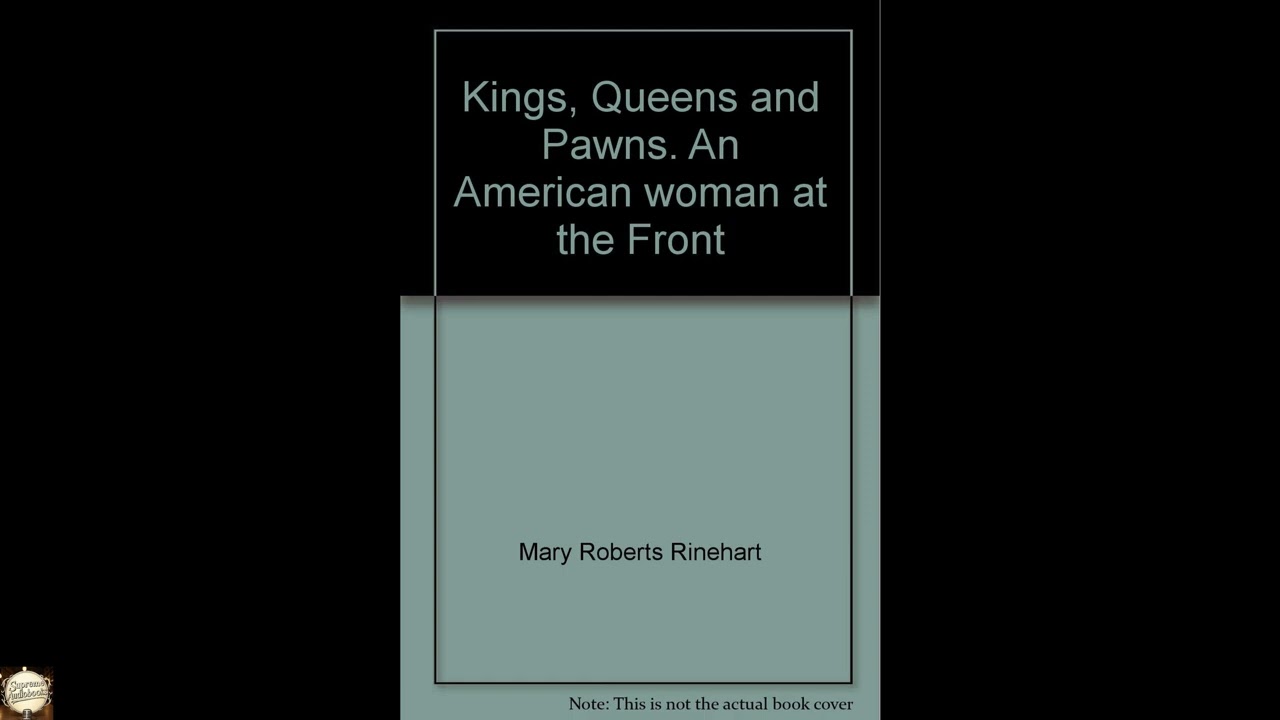
Kings, Queens, and Pawns: An American Woman at the Front
Few events in history have reshaped the world as profoundly as the First World War, and few accounts bring the listener closer to its initial, bewildering horror than Mary Roberts Rinehart's Kings, Queens, and Pawns: An American Woman at the Front. Published a mere year after the conflict began, this extraordinary non-fiction work offers an immediate, unvarnished look at the Western Front through the eyes of an American woman reporter at a time when such access was virtually unheard of. It is a story not just of military strategy or political upheaval, but of individual suffering, resilience, and the stark contrast between the romantic ideals of war and its brutal reality. Even today, Rinehart's direct observations speak to the enduring impact of conflict on humanity and the courage required to bear witness, offering a vital human perspective on the genesis of the modern world. The narrative drops us into Europe in the autumn of 1914, just as the initial fervor of mobilization gives way to the grinding, horrifying realities of trench warfare. Mary Roberts Rinehart, an established American author and journalist, found herself in the very heart of the conflict, primarily in Belgium and France. She moved among the wounded in hastily constructed field hospitals, witnessed the endless streams of refugees fleeing their homes, and interviewed soldiers, nurses, and high-ranking officers, all while the sound of distant artillery rumbled. Her account establishes a setting defined by both immense destruction and desperate human effort—from the muddy, shell-pocked landscapes near the front lines to the crowded, make-shift medical stations behind them. The central conflict of the story is not a single battle, but Rinehart's profound struggle to comprehend and communicate the overwhelming scale of the suffering she encountered. She arrives with a reporter's keen eye and a humanitarian's empathy, but finds herself confronted by horrors that defy easy description. She details the human cost, showing the silent bravery of the wounded, the quiet despair of families dispossessed, and the grim determination of those fighting. The story's arc follows her journey from initial shock and curiosity to a deeper, more somber understanding of the war's true nature, all relayed with a sense of urgency and directness that reflects the immediacy of her experience. She recounts her access to areas few civilians—let alone women—were permitted, providing a privileged glimpse into the chaos and heroism of the war's opening months without revealing the ultimate trajectory of the global struggle. Mary Roberts Rinehart (1876-1958) was a phenomenally prolific and popular American writer, often referred to as "America's Agatha Christie" for her pioneering work in detective and mystery fiction. Born in Pittsburgh, Pennsylvania, she initially trained as a nurse, a background that would undoubtedly inform her later observations of human suffering. Her first major literary success came in 1907 with The Circular Staircase, which helped establish the "had-I-but-known" school of mystery writing. Her career spanned five decades, producing more than 60 books, numerous plays, and countless short stories. Beyond her mysteries, Rinehart was a versatile author, writing adventure novels, romantic comedies, and travelogues. She became one of the highest-earning writers of her time, celebrated for her engaging plots, strong characterizations, and keen psychological insights. Her decision to travel to the European front as a war correspondent in 1914 was a bold move for any journalist, especially a woman, and solidified her reputation not just as an entertainer but as a serious observer of the world. Her experiences during the war provided a stark counterpoint to the escapism of much of her fiction, yet always retained her signature clarity and human focus. Kings, Queens, and Pawns enacts several significant themes, perhaps none more forcefully than the brutal reality of modern warfare versus the romanticized notions of glory. Rinehart's prose strips away any pretense, presenting vivid descriptions of the wounded, the unsanitary conditions, and the sheer mechanical scale of destruction. For instance, she recounts entering a field hospital, describing not just the bandages and blood, but the quiet dignity of the suffering soldiers, their shared humanity transcending national loyalties. This stands in stark contrast to the distant, strategic discussions of the "kings and queens" of diplomacy and military command. Another vital theme is the profound impact of war on the civilian population and the often-overlooked resilience of non-combatants. Rinehart repeatedly brings into focus the plight of refugees—lines of families pushing meager belongings, children orphaned, entire villages abandoned or destroyed. She might describe a particular scene where an old woman carefully salvifies a cherished, broken teapot from the ruins of her home, underscoring the personal, often devastating, cost of a conflict initiated by distant powers. Her presence as a woman correspondent also subtly highlights the evolving role of women in the public sphere and the unique perspectives they brought to traditionally male-dominated arenas, even as she often had to navigate skepticism and protectiveness from military officials. When Kings, Queens, and Pawns was published in 1915, the world was in a state of unprecedented upheaval. The First World War, which had begun just a few months prior, was quickly escalating from a regional conflict into a global catastrophe. America, under President Woodrow Wilson, was officially neutral, but public opinion was deeply divided and fascinated by the events unfolding across the Atlantic. There was an immense hunger for first-hand accounts, and Rinehart's reporting offered a crucial window into the war's reality for American readers, many of whom still harbored idealized notions of combat. The literary world was also in transition, moving away from Victorian sensibilities towards modernism and realism. Rinehart's work, while not experimental in style, contributed to this shift by delivering unvarnished truth, blending journalistic objectivity with personal reflection. Her account emerged at a time when photography and film were still nascent in their ability to convey the full scope of war, making written reports like hers essential. Her celebrity status likely helped open doors, allowing her to report from positions few others could access, providing an urgent, immediate portrait of a world irrevocably changed. Listening to Kings, Queens, and Pawns: An American Woman at the Front as an audiobook offers a uniquely intimate experience of Mary Roberts Rinehart's powerful reporting. A skilled narrator can bring out the urgency in her prose, conveying the hushed tension of the front lines, the weary resignation in the voices of soldiers, and the underlying current of profound empathy that permeates her observations. The several hours of listening time allow the narrative to unfold at a measured pace, mirroring the careful, often somber, rhythm of Rinehart's own journey through the war-torn landscape. The atmosphere of a world on the brink, and the specific sounds and sights Rinehart details, are enhanced by a voice that can capture both her journalistic precision and her deep humanity, transforming a historical document into a deeply personal account of witness.
Enjoyed Kings, Queens, and Pawns: An American Woman at the Front? A few ways to support us
Audible & Amazon links are affiliate; we may earn a small commission at no extra cost.
About this production
Human narration by a volunteer reader from LibriVox.org, the public-domain audiobook project. LibriVox volunteers record literary works whose copyright has expired in the United States, releasing the resulting recordings into the public domain.
Kings, Queens, and Pawns: An American Woman at the Front by Mary Roberts Rinehart. The underlying text is in the U.S. public domain. We do not republish any modern copyrighted edition, translation, or commentary.
The 4K cinematic visuals accompanying this audiobook are generated by an AI image model from prompts derived from the source text. No copyrighted photos, paintings, or stock footage are used. AI generation is disclosed on every video on our YouTube channel as required by YouTube's altered/synthetic content policy.
English subtitles are transcribed from the LibriVox recording with OpenAI Whisper. Translations into the 11 other supported languages are produced by Meta's NLLB-200 neural translation model. No human translator's copyrighted translation is used.
Questions about sourcing or rights? See our DMCA & Sourcing policy or contact us.
Enjoyed this audiobook?
If you'd like to own a copy of Kings, Queens, and Pawns: An American Woman at the Front or hear a professionally produced edition, the links below help support free audiobook production at no extra cost to you.
As an Amazon Associate we earn from qualifying purchases. Audible / print links are affiliate.