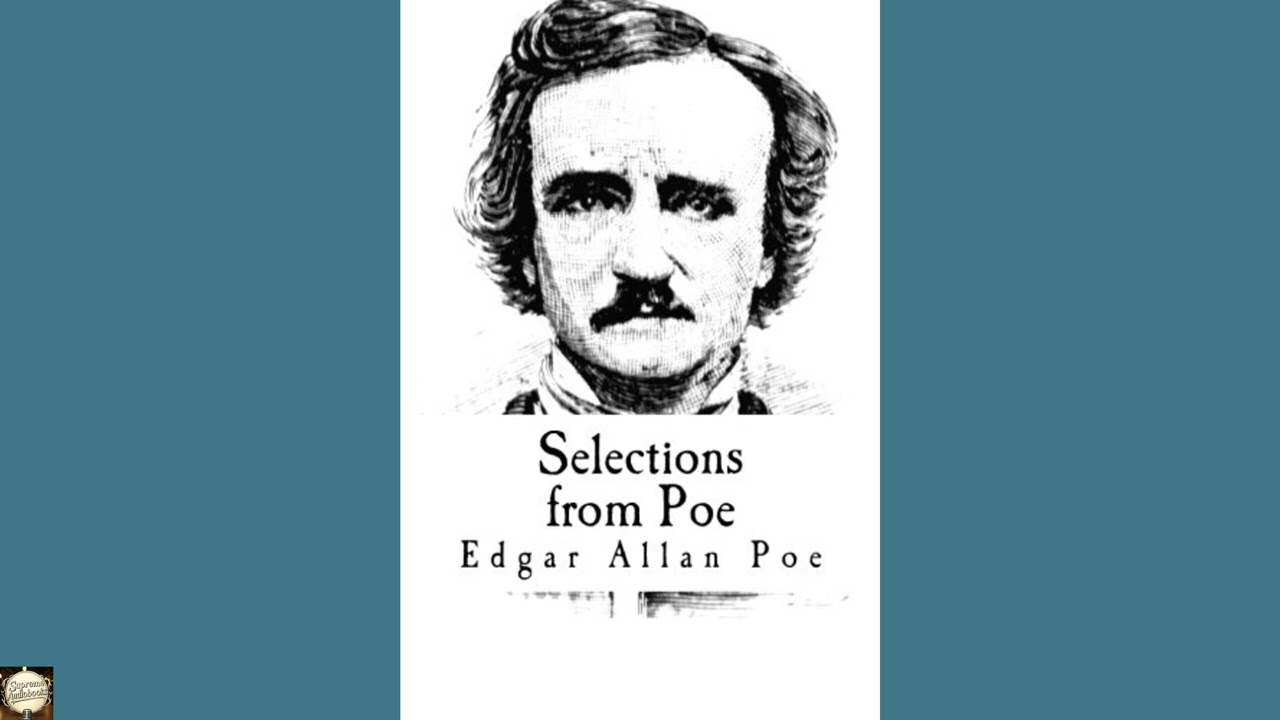
Selections from Poe
Step into the unsettling, exquisitely crafted world of Edgar Allan Poe, a realm where beauty and terror entwine, where the human mind grapples with its darkest impulses, and where the veil between the known and the unknowable often thins to transparency. This collection, "Selections from Poe," gathers some of the most haunting tales and evocative poems from a writer who defined psychological horror and lyrical despair for generations to come. More than just chilling narratives, these stories and verses offer a profound look into the anxieties, obsessions, and internal struggles that remain remarkably relevant today. They confront us with questions about sanity, guilt, and the nature of reality itself, inviting listeners to confront the shadows that lurk not only in old mansions and misty graveyards, but within the very depths of the self. Listeners will find themselves drawn into narratives propelled by an inexorable sense of dread, often narrated by protagonists teetering on the brink of madness, or already fully immersed in its grip. Consider the narrator of "The Tell-Tale Heart," whose meticulous recounting of a heinous act only serves to underscore his profound psychological disturbance, his sanity slowly unraveling under the oppressive weight of a perceived imperfection. He plots and executes a chilling deed with chilling precision, believing himself entirely rational, yet his own twisted logic becomes the very instrument of his downfall. Similarly, in "The Fall of the House of Usher," we encounter a decaying estate and its equally decaying inhabitants – Roderick and Madeline Usher – whose fortunes and psyches are inextricably linked to the gloom and physical decrepitude of their ancestral home. The narrator, a childhood friend of Roderick, arrives to find a man consumed by hypochondria and a hyper-sensitivity to his surroundings, haunted by a sister seemingly fading away, and shadowed by a pervasive sense of an impending, nameless doom that seems to emanate from the very stones of the house itself. Poe's tales frequently feature isolated settings and characters pushed to extreme psychological states, where the line between natural phenomena and supernatural intervention blurs. Whether it's the claustrophobic dread of being buried alive, the agonizing wait for an execution in a torture chamber, or the obsessive grief that borders on necromancy, his stories often pit the individual against forces—both internal and external—that threaten to utterly consume them. The central conflict is rarely a simple external struggle; instead, it's often a battle against one's own sanity, one's own conscience, or the overwhelming power of obsession and despair. These narratives build a meticulous, oppressive atmosphere, leading characters and listeners alike through a carefully constructed labyrinth of fear and psychological torment, where every shadow seems to hold a secret, and every whisper a premonition. Edgar Allan Poe, born in Boston in 1809, lived a life almost as tragic and tumultuous as the characters in his stories. Orphaned at an early age and taken in by the wealthy Richmond merchant John Allan, Poe’s early years were marked by a strained relationship with his foster father, a pattern of financial difficulty, and a series of academic false starts, including a brief tenure at the University of Virginia and West Point. His literary career began with poetry, but he soon distinguished himself as a formidable, often scathing, literary critic and editor, a role in which he championed American letters while frequently excoriating what he perceived as mediocrity. Despite his brilliance, Poe struggled with poverty throughout his life, exacerbated by bouts of heavy drinking and gambling. The death of his young wife and cousin, Virginia Clemm, from tuberculosis in 1847, plunged him into a profound grief and further substance abuse that shadowed his remaining years. He died in Baltimore in 1849 under mysterious circumstances, his legacy cemented despite his personal struggles. Poe is credited with inventing the detective fiction genre with stories like "The Murders in the Rue Morgue," and his influence on science fiction, symbolism, and psychological horror is immeasurable. He stands as a towering figure in American Romanticism, an author who dared to peer into the darker corners of the human psyche and translate those observations into prose and poetry of unparalleled intensity and precision. Within these selected works, several potent themes rise to the surface, resonating with a disturbing clarity. Madness and the fragility of sanity are central, often presented through first-person narrators whose very reliability is suspect. The aforementioned narrator of "The Tell-Tale Heart," for example, insists on his sanity even as he describes an auditory hallucination – the beating of the murdered old man's heart – that drives him to confession, illustrating how a deranged mind can rationalize monstrous acts. Guilt and its torturous effects on the conscience also figure prominently. In stories such as "The Black Cat," an alcoholic's escalating cruelty toward animals leads to a horrific crime, and the subsequent appearance of a similar black cat seems to be the physical manifestation of his festering guilt, haunting him until his ultimate undoing. Furthermore, Poe frequently returns to the themes of death, loss, and the obsession with the deceased. "The Raven," one of his most famous poems, depicts a scholar's descent into a grief-stricken madness following the death of his beloved Lenore, tormented by a talking raven whose repeated utterance of "Nevermore" echoes his own despair and lost hope. The supernatural or macabre, while often explainable by psychology, provides the atmospheric backdrop for these internal struggles. In "The Pit and the Pendulum," the sheer terror of physical torment and slow, agonizing death forces the protagonist to confront his own mortality and the cruel ingenuity of his captors, blurring the line between hallucination born of fear and actual horror. These concrete instances reveal Poe’s masterful ability to use external horror as a mirror for internal psychological states. Poe’s writings emerged during a crucial period in American literary history, the first half of the 19th century, when the nascent nation was striving to establish its own cultural identity distinct from European traditions. It was an era of profound social and technological change, from the dawn of industrialization to westward expansion, creating both optimism and underlying anxieties. While transcendentalists like Ralph Waldo Emerson and Henry David Thoreau emphasized nature, individualism, and spiritual enlightenment, Poe often represented the counterpoint, a darker stream of American Romanticism. He reacted against the prevailing didacticism and moralizing in much contemporary literature, arguing instead for "art for art's sake" – a focus on beauty and emotional effect above overt moral instruction. His embrace of the Gothic tradition, with its focus on decay, dread, and the grotesque, provided a powerful vehicle for expressing the psychological terrors that lurked beneath the surface of an outwardly confident new republic. To truly appreciate the intricate atmosphere and psychological depth of Poe's work, listening to "Selections from Poe" as an audiobook offers a unique and profound experience. The deliberate pacing of a skilled narrator can emphasize the building dread in his prose, allowing the listener to sink into the oppressive silence before a scream, or the maddening repetition of a single word. The nuances of vocal performance can bring to life the unreliable narrators, highlighting their fragile hold on sanity through subtle shifts in tone and inflection, making their descent into madness all the more chillingly intimate. For his poetry, the spoken word restores its inherent musicality and rhythm, allowing the full impact of his meticulously chosen sounds and meter to wash over the listener, turning "The Raven" from words on a page into a mournful, haunting lament. This collection, several hours in length, provides ample opportunity to immerse oneself deeply in the vision of a literary genius, experiencing his tales and poems as they were meant to be absorbed: by sensing the quiet terror and listening to the whispers of the human heart in its darkest moments.
Enjoyed Selections from Poe? A few ways to support us
Audible & Amazon links are affiliate; we may earn a small commission at no extra cost.
About this production
Human narration by a volunteer reader from LibriVox.org, the public-domain audiobook project. LibriVox volunteers record literary works whose copyright has expired in the United States, releasing the resulting recordings into the public domain.
Selections from Poe by Edgar Allan Poe. The underlying text is in the U.S. public domain. We do not republish any modern copyrighted edition, translation, or commentary.
The 4K cinematic visuals accompanying this audiobook are generated by an AI image model from prompts derived from the source text. No copyrighted photos, paintings, or stock footage are used. AI generation is disclosed on every video on our YouTube channel as required by YouTube's altered/synthetic content policy.
English subtitles are transcribed from the LibriVox recording with OpenAI Whisper. Translations into the 11 other supported languages are produced by Meta's NLLB-200 neural translation model. No human translator's copyrighted translation is used.
Questions about sourcing or rights? See our DMCA & Sourcing policy or contact us.
Enjoyed this audiobook?
If you'd like to own a copy of Selections from Poe or hear a professionally produced edition, the links below help support free audiobook production at no extra cost to you.
As an Amazon Associate we earn from qualifying purchases. Audible / print links are affiliate.