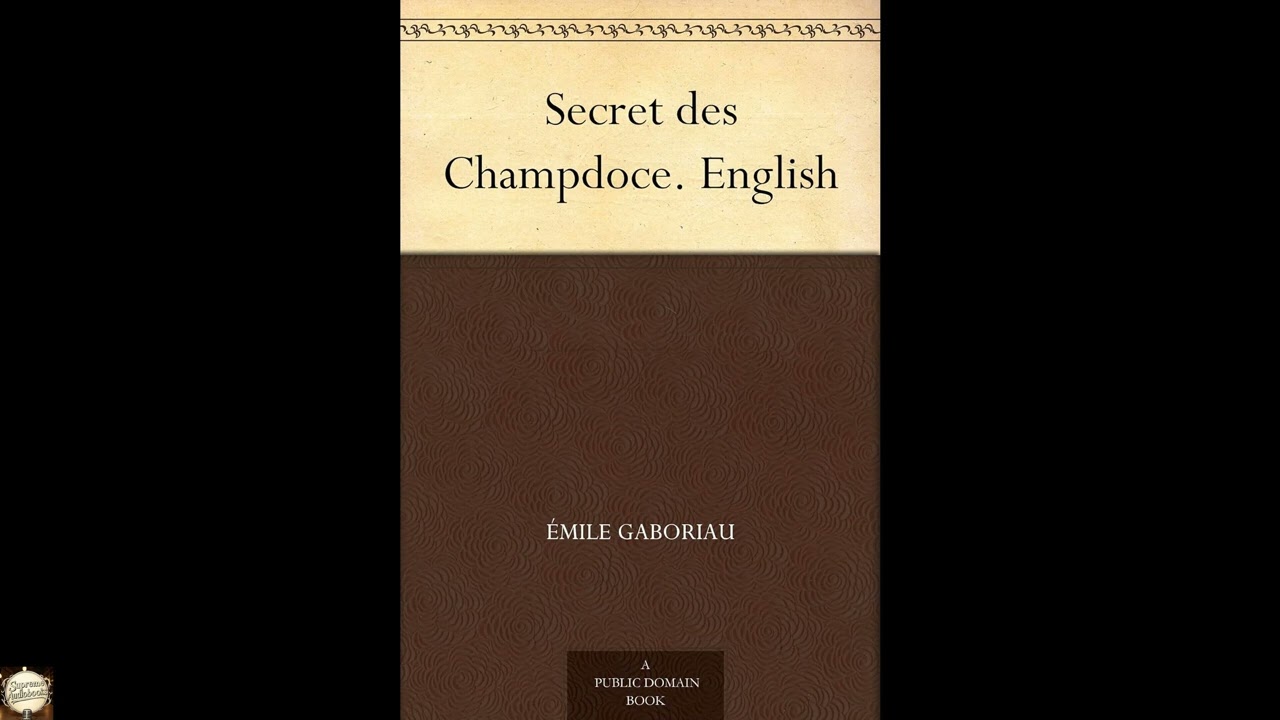
Secret des Champdoce. English
At the heart of every great mystery lies a question that gnaws at the soul, a secret demanding revelation. Émile Gaboriau’s "Secret des Champdoce," a pivotal work in the annals of crime fiction, presents just such a question, one that continues to resonate today. Far from merely a period piece, this novel stands as a cornerstone in the development of the detective genre, predating many of the more famous sleuths and establishing conventions still observed in contemporary thrillers. It offers listeners not just a cunningly constructed puzzle, but a window into the societal anxieties and human frailties of 19th-century France, making it a compelling listen for anyone fascinated by the origins of the genre or the enduring power of a well-told enigma. The story unfolds in a tranquil, seemingly idyllic corner of provincial France, at the estate of Champdoce. The peace of this pastoral setting is violently shattered when a horrific crime is discovered: the body of a man, brutally murdered. The initial investigation falls to local authorities, a cadre of well-meaning but often bumbling officials more accustomed to minor infractions than such a profound act of violence. Their initial findings are muddled, their theories conflicting, and the truth seems impossibly obscured by circumstance and conjecture. Suspicion quickly falls upon the immediate household, the prominent Champdoce family, whose outward respectability begins to fray under the pressure of intense scrutiny. Into this maelstrom of confusion and rising fear steps Monsieur Lecoq, a detective of the Paris Sûreté, a man whose reputation for keen intellect and methodical deduction precedes him. Lecoq, a character of singular focus and analytical prowess, arrives to take charge of the case, and his approach immediately distinguishes itself. He dismisses the hasty conclusions of the local gendarmes, preferring to painstakingly examine every detail of the crime scene, every nuance of testimony, every subtle inconsistency. As Lecoq slowly, deliberately peels back the layers of deceit and misdirection, the seemingly unblemished façade of the Champdoce family begins to crack, revealing long-held secrets, forbidden affections, and a complex web of interpersonal relationships that might provide a motive for the dreadful deed. The listener follows Lecoq as he navigates these treacherous revelations, piecing together a narrative that challenges assumptions and ultimately promises to expose the stark truth behind the Champdoce mystery. Émile Gaboriau, born in 1832 in Saujon, France, carved out a unique and profoundly influential niche in literary history as one of the true pioneers of modern detective fiction. His early career saw him working as a journalist and even as a secretary to poet Paul Féval, experiences that undoubtedly honed his observational skills and narrative craft. However, it was his transition to novel writing, particularly his serialized stories in newspapers, that truly established his legacy. Gaboriau's genius lay in understanding the public's growing appetite for logical puzzles and the drama of criminal investigation, and he met that demand with groundbreaking precision and psychological depth. His most enduring creation, Monsieur Lecoq, first appeared in L'Affaire Lerouge in 1866 and quickly became a sensation. Lecoq himself was inspired by Eugène-François Vidocq, a real-life French criminal who turned detective, adding a layer of authenticity to Gaboriau's fictional world. Gaboriau’s influence extended widely, shaping the very structure and tropes of the detective novel, from the meticulous crime scene analysis to the often-antagonistic relationship between the brilliant detective and less capable local police. His work, which also includes other notable titles such as Le Dossier No. 113 and Les Esclaves de Paris, firmly established the character archetype of the intellectually superior investigator who solves crimes through observation and reason. Though his life was cut short in 1873, Gaboriau's contribution to literature is immeasurable, providing a vital bridge between earlier tales of crime and the sophisticated detective stories that would follow. "Secret des Champdoce" skillfully brings to life several compelling themes that elevate it beyond mere genre fiction. One prominent theme is the deceptive nature of appearances and the pervasive hypocrisy within society. The Champdoce family, initially presented as pillars of their community, are gradually exposed as having lives riddled with hidden desires, illicit relationships, and carefully constructed lies. Lecoq's investigation functions as a surgical dissection of this social veneer, revealing how respectability can mask profound moral failings and how deeply entrenched secrets can fester beneath a tranquil surface. Gaboriau shows how easily public perception can be manipulated and how swiftly a carefully curated reputation can crumble. Another central theme is the nascent power of rational deduction and forensic methodology in the face of baffling crime. Lecoq stands as the embodiment of this emerging scientific approach, contrasting sharply with the often-superficial and emotion-driven investigations of the local police. He meticulously scrutinizes physical evidence, reconstructs timelines, and applies psychological insight to motives, essentially inventing the blueprint for modern criminal investigation. For example, Lecoq's careful analysis of footprints, stray objects, and the precise layout of the crime scene, coupled with his astute questioning of witnesses, demonstrates a reliance on empirical data rather than speculation. This systematic pursuit of truth, building a case from minute details, underlines Gaboriau's foundational contribution to the genre. This audiobook presentation of "Secret des Champdoce" immerses the listener in a pivotal moment in literary history, a period of significant change and intellectual ferment. The novel was first published in 1867, during the Second French Empire under Napoleon III. This era was characterized by rapid industrialization, the growth of cities, and a corresponding rise in societal complexity, all of which contributed to a fascination with crime and its detection. The anonymity of urban life, coupled with advances in communication and transportation, made the concept of a master criminal and a brilliant detective all the more compelling. Gaboriau's serialized novels, appearing in popular newspapers, perfectly captured the public imagination, providing both escapism and a reflection of contemporary anxieties about social order and justice. Culturally, France was transitioning from the Romantic idealism of earlier decades towards the gritty realism and naturalism that would define much of late 19th-century literature. Gaboriau's work, with its focus on detailed observation and logical progression, aligns perfectly with this shift, even while retaining elements of dramatic flair. His stories spoke to a public eager for entertainment that also engaged their intellect, offering intricate puzzles to solve alongside Lecoq. The novel's emergence at this time was no accident; it perfectly synthesized a growing public appetite for crime stories with an evolving literary aesthetic that valued precision and the uncovering of hidden truths. Listening to "Secret des Champdoce" as an audiobook offers a singular opportunity to fully appreciate Gaboriau's meticulous plotting and the gradual unfolding of the mystery. The narrator’s skill in pacing becomes paramount, allowing the suspense to build organically through Lecoq’s methodical investigation, avoiding rushed revelations. Listen for the distinct vocal characterizations given to the array of individuals—from Lecoq’s calm, analytical tone to the often-distraught or defensive voices of the suspects and witnesses. This vocal differentiation adds considerable depth to the psychological drama, making it easier to follow the intricate network of relationships and motivations. The audio format also highlights the rich descriptions of 19th-century French settings and the tense atmosphere that permeates the Champdoce estate, drawing you into the heart of a seminal work of detective fiction.
Enjoyed Secret des Champdoce. English? A few ways to support us
Audible & Amazon links are affiliate; we may earn a small commission at no extra cost.
About this production
Human narration by a volunteer reader from LibriVox.org, the public-domain audiobook project. LibriVox volunteers record literary works whose copyright has expired in the United States, releasing the resulting recordings into the public domain.
Secret des Champdoce. English by Emile Gaboriau. The underlying text is in the U.S. public domain. We do not republish any modern copyrighted edition, translation, or commentary.
The 4K cinematic visuals accompanying this audiobook are generated by an AI image model from prompts derived from the source text. No copyrighted photos, paintings, or stock footage are used. AI generation is disclosed on every video on our YouTube channel as required by YouTube's altered/synthetic content policy.
English subtitles are transcribed from the LibriVox recording with OpenAI Whisper. Translations into the 11 other supported languages are produced by Meta's NLLB-200 neural translation model. No human translator's copyrighted translation is used.
Questions about sourcing or rights? See our DMCA & Sourcing policy or contact us.
Enjoyed this audiobook?
If you'd like to own a copy of Secret des Champdoce. English or hear a professionally produced edition, the links below help support free audiobook production at no extra cost to you.
As an Amazon Associate we earn from qualifying purchases. Audible / print links are affiliate.