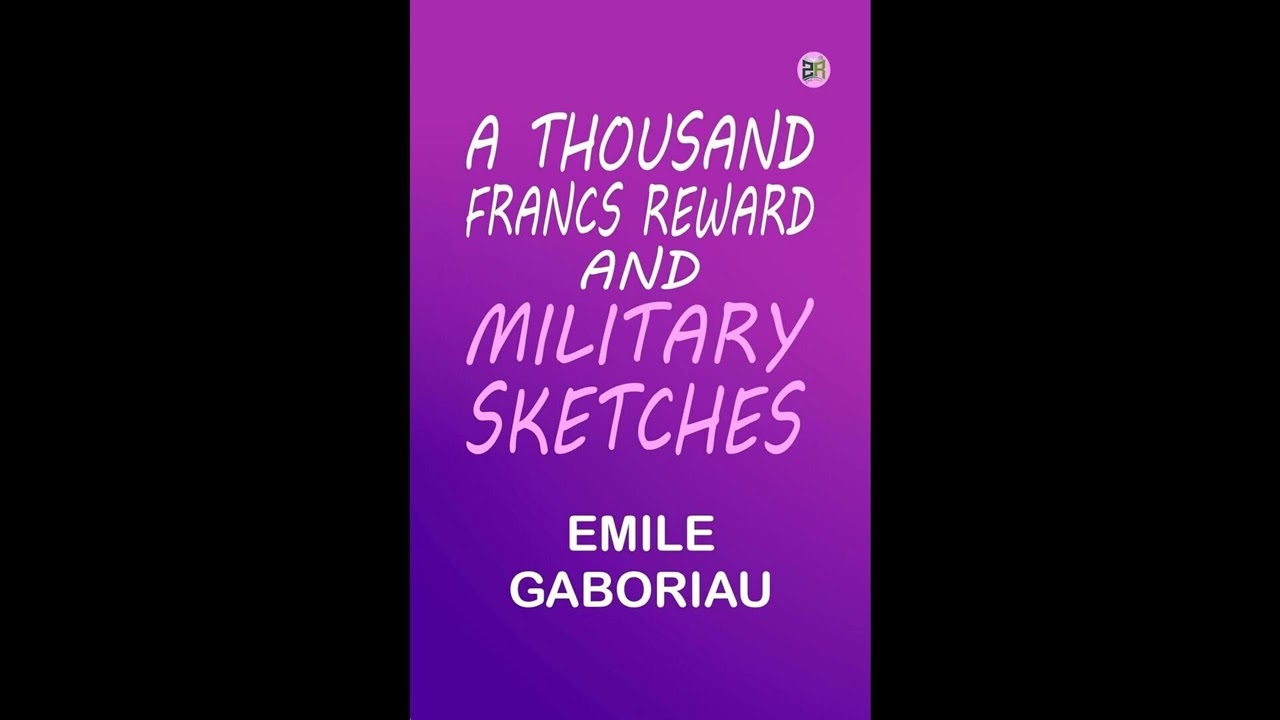
A Thousand Francs Reward; and Military Sketches
Step into the bustling, gaslit streets of 19th-century Paris and the stark realities of military life with Emile Gaboriau, a writer often credited as the father of modern French detective fiction. This compelling collection, A Thousand Francs Reward; and Military Sketches, presents two distinct facets of his genius: a taut, intricate crime novella that showcases his groundbreaking approach to detection, and a series of vivid vignettes from the barracks and battlefields. To experience these narratives is to witness the very genesis of the police procedural, to understand the social fabric of an era, and to appreciate the enduring human dramas that unfold within both the quiet desperation of a murder investigation and the boisterous camaraderie of soldiers. It offers not just suspense and insight, but a unique vantage point on the literary landscape that gave birth to many of the genre tropes we still cherish today. The centerpiece of this volume, "A Thousand Francs Reward," plunges us into a gripping mystery centered around a seemingly straightforward crime. A respectable Parisian gentleman has been found murdered in his study, and suspicion immediately falls upon a young man, a relative, who was known to be in the vicinity and had a strained relationship with the victim. As the narrative unfolds, Gaboriau masterfully introduces a cast of characters whose interwoven lives and hidden motives begin to complicate the initial, easy judgment. The early stages of the police inquiry, led by an earnest but somewhat conventional detective, seem to confirm the guilt of the accused, pushing him closer to conviction. However, the true genius of Gaboriau shines through with the arrival of Monsieur Lecoq, a brilliant and methodical detective whose keen observation and logical deduction cut through the superficial evidence. Lecoq scrutinizes every detail, from the arrangement of furniture to the minutiae of witness testimonies, piecing together a different, far more complex picture than anyone initially imagined. He tirelessly uncovers secrets, exposes deceptions, and challenges societal assumptions, demonstrating how often the obvious truth is merely a carefully constructed façade. The story follows Lecoq’s relentless pursuit of the real perpetrator, navigating a labyrinth of red herrings and class distinctions, and ultimately revealing the profound depths of human ambition and despair that can drive individuals to heinous acts. Complementing this thrilling novella, the "Military Sketches" offer a contrasting yet equally insightful look at the human spirit under different forms of pressure. These shorter pieces transport the listener from the regimented world of training grounds to the harrowing landscapes of conflict, depicting soldiers from various walks of life and ranks. We encounter tales of courage under fire, the quiet sacrifices made in the name of duty, and the often-overlooked moments of humor and camaraderie that bind men together in times of hardship. Gaboriau, having served in the military himself, brings an authentic touch to these portrayals, eschewing romanticized notions of warfare in favor of a more grounded, nuanced view of the common soldier’s experience. From the strategic brilliance of a seasoned officer to the simple loyalty of a foot soldier, these sketches provide a window into the professional and personal lives of those who served. Emile Gaboriau, born in 1832, was a quintessential figure of 19th-century French literature, though his beginnings were far from the literary salons. He initially served as a cavalryman in the French army, an experience that undoubtedly provided the rich material for his "Military Sketches." After leaving military service, he held various prosaic jobs, including a shipping clerk and secretary, before finding his calling as a journalist. This period of his life, interacting with diverse social strata and developing an eye for detail, proved invaluable for his later fiction, grounding his stories in a sense of lived reality. His literary career truly began to flourish when he started writing serialized novels, known as feuilletons, for Parisian newspapers, a popular format that allowed him to build suspense and engage a wide readership week after week. Gaboriau's significant contribution to literature lies in his pioneering efforts in the detective genre, establishing many of the conventions that would later be perfected by writers like Arthur Conan Doyle. His most famous creation, Monsieur Lecoq, first appeared in L'Affaire Lerouge (The Lerouge Case) in 1866, marking a pivotal moment in crime fiction. Lecoq was an ex-convict turned detective, whose brilliant powers of observation and deduction, combined with his understanding of the criminal underworld, made him a compelling and innovative character. Gaboriau’s meticulous plotting and his focus on forensic detail and police procedure distinguished his work from earlier tales of crime, moving away from purely sensational narratives toward a more analytical and investigative approach. He wrote several other notable works featuring Lecoq, including Le Crime d'Orcival (The Crime of Orcival) and Les Esclaves de Paris (The Slaves of Paris), cementing his reputation as the master of the roman policier, or police novel. Tragically, his life was cut short in 1873 at the age of 41, but his influence was profound and lasting. He elevated detective fiction from mere entertainment to a respected literary form, paving the way for future generations of crime writers and establishing France as a significant center for the genre. His narratives offer not just suspense but also a deep engagement with the social and legal systems of his time, making his body of work an invaluable historical and literary resource. Within "A Thousand Francs Reward," Gaboriau skillfully enacts several enduring themes. One prominent thread is the relentless pursuit of justice and truth, often in the face of prejudice and circumstantial evidence. Lecoq’s methodology, painstakingly reconstructing events from fragments and scrutinizing human behavior, underscores the idea that appearances can be deeply deceptive. For instance, the initial certainty of the police regarding the young man's guilt is slowly but surely dismantled by Lecoq’s deductions, illustrating how preconceived notions can blind investigators to the real facts. This quest for objective truth, irrespective of social standing or initial impressions, stands as a cornerstone of the burgeoning detective genre. Another significant theme is the complex interplay of social class and morality in 19th-century France. Gaboriau often depicts how crime is not confined to the lower echelons of society but can equally fester beneath the respectable veneer of the bourgeoisie. Characters from different social strata are drawn into the web of the murder, revealing the hypocrisies, hidden desires, and economic pressures that often drive individuals to desperate measures. The investigation in "A Thousand Francs Reward" inevitably pulls back the curtain on the supposedly upright lives of several figures, exposing secrets that families have long labored to keep hidden. Even in the "Military Sketches," themes of duty, honor, and sacrifice are frequently examined against the backdrop of a rigid social hierarchy, showing how individuals navigate these expectations, sometimes with heroic fortitude and other times with tragic failure. Gaboriau’s work emerged during a fascinating period in French history, spanning the Second Empire of Napoleon III and the turbulent early years of the Third Republic. This was a time of significant social and technological change, marked by increasing urbanization, industrialization, and the rise of a new middle class. Paris itself was undergoing dramatic modernization under Baron Haussmann, transforming from a medieval labyrinth into a city of grand boulevards and modern infrastructure. These changes brought both progress and new social anxieties, providing fertile ground for crime and the need for more sophisticated methods of policing. The public, increasingly literate and engaged with daily newspapers, hungered for compelling stories that reflected the rapidly changing world around them, making serialized fiction an immensely popular medium. In the literary world, Gaboriau’s rise coincided with a growing interest in realism and naturalism, movements that sought to depict life as it truly was, often focusing on the struggles of ordinary people and the darker aspects of society. While Gaboriau’s primary aim was entertainment, his detailed portrayals of Parisian life, criminal investigation, and social dynamics aligned with these broader literary trends. He built upon the foundations laid by earlier writers like Edgar Allan Poe, who had introduced the concept of the brilliant detective, but Gaboriau’s genius lay in his procedural realism, drawing inspiration from real-life figures like Eugène Vidocq, a former criminal who became the head of the French Sûreté. Gaboriau formalized the police novel, providing readers with not just a puzzle, but a window into the workings of criminal justice. Listening to A Thousand Francs Reward; and Military Sketches as an audiobook offers a singular opportunity to immerse oneself directly into Gaboriau's world. The spoken word allows the period language to flow naturally, drawing the listener into the intricate dialogue and detailed descriptions without distraction. A skilled narrator can bring Lecoq's meticulous thought process to life, emphasizing the subtle shifts in tone and the methodical pacing that build suspense during the investigation. For the "Military Sketches," distinct vocal interpretations can differentiate the myriad characters—from grizzled sergeants to nervous recruits—lending authenticity to their experiences and enhancing the atmosphere of both the peacetime barracks and the battlefield. The audiobook format encourages focused attention, allowing the listener to absorb the nuances of plot and character, experiencing Gaboriau's pioneering narratives exactly as they were intended: as captivating tales told with dramatic flair.
Enjoyed A Thousand Francs Reward; and Military Sketches? A few ways to support us
Audible & Amazon links are affiliate; we may earn a small commission at no extra cost.
About this production
Human narration by a volunteer reader from LibriVox.org, the public-domain audiobook project. LibriVox volunteers record literary works whose copyright has expired in the United States, releasing the resulting recordings into the public domain.
A Thousand Francs Reward; and Military Sketches by Emile Gaboriau. The underlying text is in the U.S. public domain. We do not republish any modern copyrighted edition, translation, or commentary.
The 4K cinematic visuals accompanying this audiobook are generated by an AI image model from prompts derived from the source text. No copyrighted photos, paintings, or stock footage are used. AI generation is disclosed on every video on our YouTube channel as required by YouTube's altered/synthetic content policy.
English subtitles are transcribed from the LibriVox recording with OpenAI Whisper. Translations into the 11 other supported languages are produced by Meta's NLLB-200 neural translation model. No human translator's copyrighted translation is used.
Questions about sourcing or rights? See our DMCA & Sourcing policy or contact us.
View 10 famous quotes from this book →
Enjoyed this audiobook?
If you'd like to own a copy of A Thousand Francs Reward; and Military Sketches or hear a professionally produced edition, the links below help support free audiobook production at no extra cost to you.
As an Amazon Associate we earn from qualifying purchases. Audible / print links are affiliate.