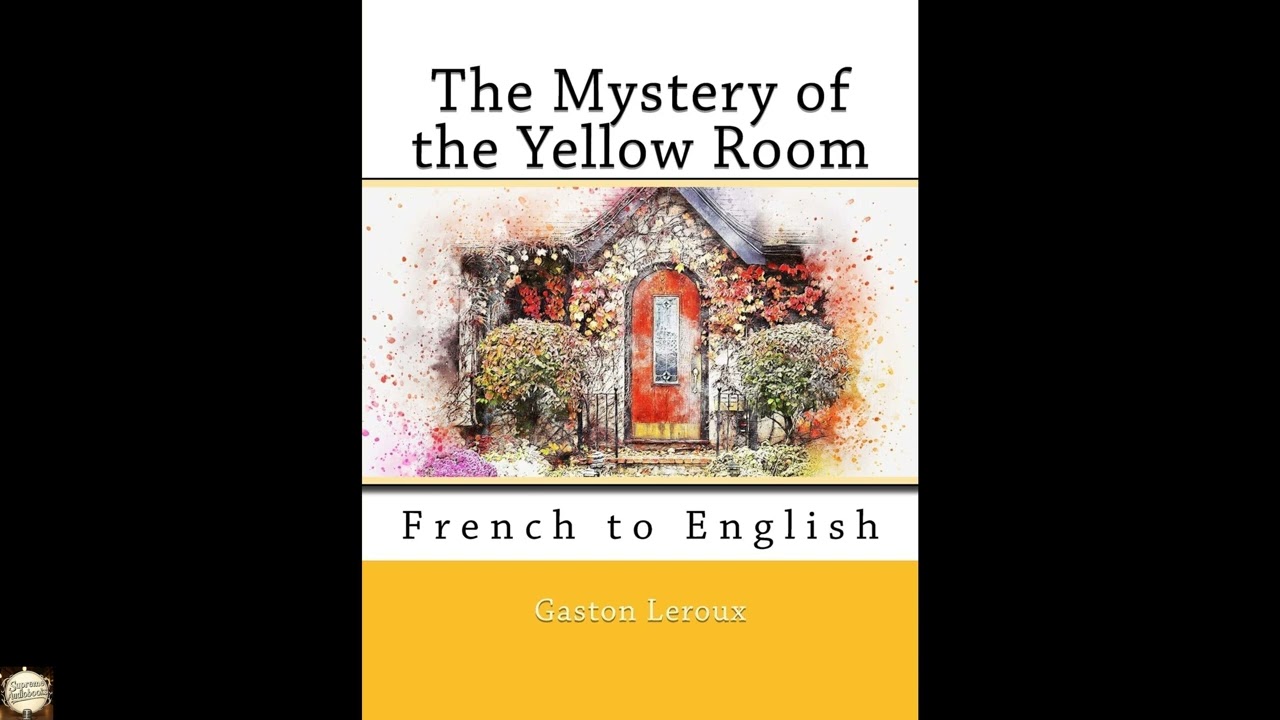
Mystère de la chambre jaune. English
Step into the chilling heart of an impossible crime with Gaston LeRoux's The Mystery of the Yellow Room, a foundational pillar of the locked-room mystery that continues to confound and delight listeners over a century after its initial publication. This is not merely a tale of suspense, but a rigorous intellectual challenge, inviting you to pit your wits against one of detective fiction's most perfect paradoxes. It stands as a testament to pure logic, demonstrating how even the most impenetrable enigma can yield to sharp observation and relentless deduction. If you appreciate a story that demands your full mental engagement, where every detail matters and nothing is as it first appears, this classic will grip your attention and refuse to let go, offering the enduring satisfaction of a truly clever puzzle. The story opens at the isolated Château du Glandier, a secluded estate in rural France. Here, the esteemed Professor Stangerson is conducting groundbreaking scientific research, but his work is overshadowed by a horrific event. His daughter, Mathilde Stangerson, is discovered barely alive in her seemingly impenetrable yellow room. The door was bolted from the inside, the window barred, yet someone attacked her, and vanished without a trace. The room itself, a study in baffling contradictions, becomes the central character in a crime that baffles local authorities and defies all rational explanation. There is no visible escape route, no sign of forced entry or exit, only the gravely injured Mathilde and a few perplexing clues left behind. Into this perplexing scene steps Joseph Rouletabille, a precocious young reporter with an uncanny knack for observation and a relentless logical mind. Though barely out of his teens, Rouletabille possesses an extraordinary ability to see beyond the obvious, to connect seemingly disparate facts, and to challenge conventional assumptions. He immediately clashes with the official police inspector, Frédéric Larsan, a celebrated detective whose methods are more traditional and who struggles to reconcile the physical evidence with the apparent impossibility of the crime. As Rouletabille interviews witnesses, examines the scene, and pieces together fragments of information, he uncovers a web of secrets surrounding the Stangerson family, drawing the listener deeper into the baffling layers of the incident. Gaston LeRoux, born in Paris in 1868, lived a life almost as dramatic and adventurous as his fiction. He initially studied law but soon turned to journalism, distinguishing himself as a legal and crime reporter for publications like Le Matin. His experiences covering trials and investigations provided him with an unparalleled understanding of criminal psychology, police procedure, and the intricacies of legal arguments, all of which he skillfully wove into his narratives. LeRoux quickly gained a reputation for his vivid reporting and his ability to uncover hidden details, often embedding himself in dangerous situations, including acting as a war correspondent during the tumultuous period leading up to the First World War. It was this background that directly informed his literary career, which began around the turn of the century. LeRoux published his first novel in 1903, but it was The Mystery of the Yellow Room, serialized in 1907 and published in book form the following year, that cemented his place in literary history. He would go on to create other memorable characters and scenarios, perhaps most famously contributing The Phantom of the Opera in 1910 and continuing the adventures of Rouletabille in The Perfume of the Lady in Black (1908). LeRoux’s work stands at the forefront of early 20th-century French popular literature, bridging the gap between sensational serials and carefully constructed genre fiction, and he is rightly considered a significant figure in the development of detective stories. He passed away in 1927, leaving behind a legacy of ingenious plots and unforgettable characters. The primary theme running through The Mystery of the Yellow Room is the supremacy of reason over superficial appearance. Rouletabille consistently demonstrates that what seems impossible is merely a failure of imagination or observation. He dissects the physical facts of the crime scene with an almost scientific rigor, insisting that every detail, no matter how small or seemingly insignificant—a tear in a curtain, a specific footprint, the exact angle of a window latch—holds a piece of the ultimate solution. This meticulous approach contrasts sharply with the more intuitive or experience-based methods of other investigators, highlighting a modern emphasis on empirical evidence and logical deduction. Another central idea is the unreliability of perception and testimony. As Rouletabille interviews various individuals connected to the château, he finds that personal biases, emotional states, and even simple misunderstandings can distort what people recall or claim to have seen. The story continually challenges the listener to question their own assumptions and to doubt initial interpretations of events, reinforcing the notion that truth is often hidden beneath layers of subjective interpretation. The genius of the locked room itself is a grand illusion, designed to mislead not just the police, but also the audience, playing on our instinctive trust in what our eyes tell us. When The Mystery of the Yellow Room was first published in 1907, France was in the midst of the Belle Époque, a period of relative peace, economic prosperity, and cultural innovation. There was a burgeoning fascination with science, technology, and rational thought, which deeply influenced the arts and public discourse. Detective fiction, though already established by pioneers like Edgar Allan Poe and Arthur Conan Doyle, was still evolving. LeRoux’s novel represented a significant step forward for the genre, particularly in its focus on the "impossible crime." The turn of the century saw a growing readership for serialized stories in newspapers and magazines, and LeRoux, with his journalistic background, excelled at crafting narratives that kept readers eagerly awaiting the next installment. This was an era where the public was increasingly interested in crime and justice, fueled by sensational newspaper reporting. The Mystery of the Yellow Room capitalized on this, providing not just suspense, but an intricate, brain-teasing puzzle that perfectly aligned with the period's appreciation for intellectual challenges and the power of human ingenuity. It tapped into a societal desire for order and logic to prevail, even in the face of baffling chaos. Listening to The Mystery of the Yellow Room as an audiobook offers a singular opportunity to fully immerse yourself in its atmosphere and the methodical unfolding of its mystery. A skilled narrator brings Rouletabille’s sharp intellect and the tense exchanges of dialogue to life, allowing the listener to follow the intricate web of clues and deductions without the distraction of page turns. The run time, several hours in length, is ideal for extended listening sessions, whether you are on a long drive, tackling household tasks, or simply settling in for focused enjoyment. The pacing of the narration can heighten the suspense as Rouletabille zeroes in on critical details, and the distinct voices given to each character—from the baffled police to the nervous witnesses—clarify the complex interactions and personalities that populate the isolated château. You can pay close attention to the subtle inflections, the moments of doubt or triumph, and the intellectual sparring that makes this story such a lasting pleasure, letting the narrator guide you through one of literature's most ingenious puzzles.
Enjoyed Mystère de la chambre jaune. English? A few ways to support us
Audible & Amazon links are affiliate; we may earn a small commission at no extra cost.
About this production
Human narration by a volunteer reader from LibriVox.org, the public-domain audiobook project. LibriVox volunteers record literary works whose copyright has expired in the United States, releasing the resulting recordings into the public domain.
Mystère de la chambre jaune. English by Gaston LeRoux. The underlying text is in the U.S. public domain. We do not republish any modern copyrighted edition, translation, or commentary.
The 4K cinematic visuals accompanying this audiobook are generated by an AI image model from prompts derived from the source text. No copyrighted photos, paintings, or stock footage are used. AI generation is disclosed on every video on our YouTube channel as required by YouTube's altered/synthetic content policy.
English subtitles are transcribed from the LibriVox recording with OpenAI Whisper. Translations into the 11 other supported languages are produced by Meta's NLLB-200 neural translation model. No human translator's copyrighted translation is used.
Questions about sourcing or rights? See our DMCA & Sourcing policy or contact us.
Enjoyed this audiobook?
If you'd like to own a copy of Mystère de la chambre jaune. English or hear a professionally produced edition, the links below help support free audiobook production at no extra cost to you.
As an Amazon Associate we earn from qualifying purchases. Audible / print links are affiliate.