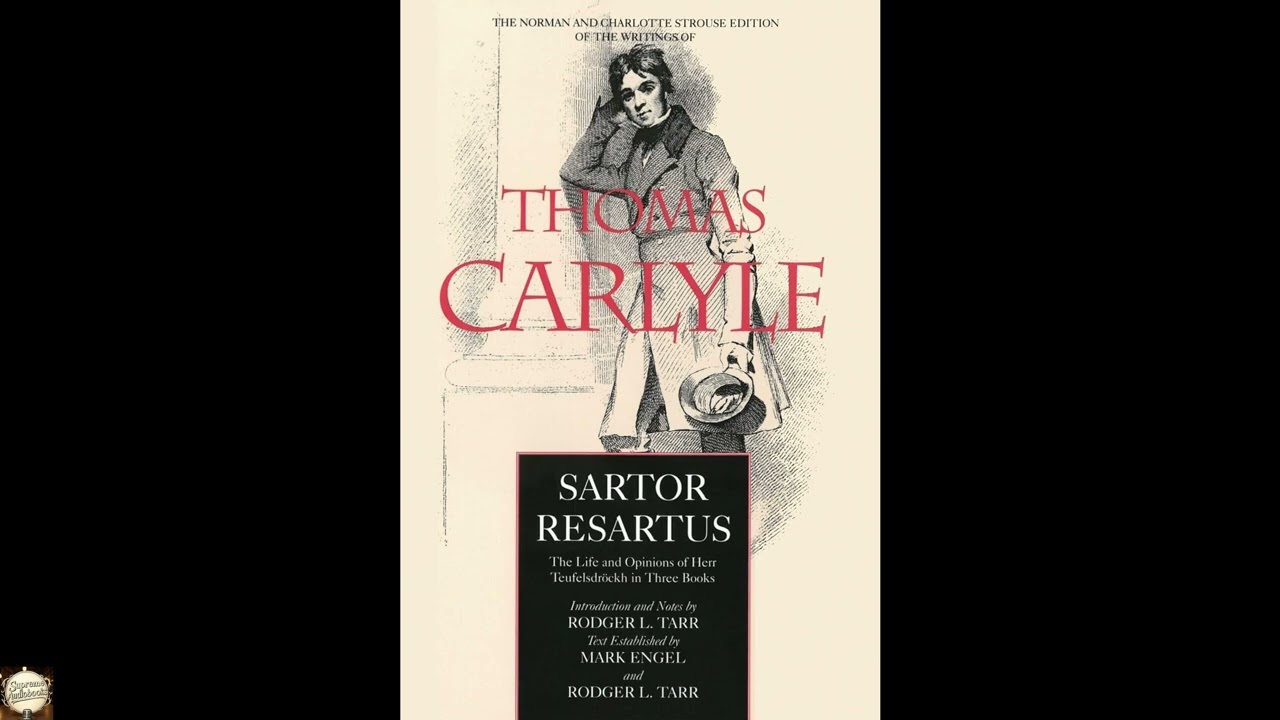
Sartor Resartus: The Life and Opinions of Herr Teufelsdrockh in Three Books
Step into a mind-bending, genre-defying experience, a book that feels as contemporary and urgent today as it did nearly two centuries ago. Sartor Resartus is not merely a novel; it is a grand philosophical jest, a spiritual autobiography masquerading as literary criticism, and a profound meditation on the very fabric of existence. Imagine receiving the scattered papers of an eccentric German professor—a jumble of profound insights, cynical observations, and fragmented life stories—and then trying to piece them together into a coherent narrative. This is the ambitious task undertaken by the unnamed English Editor who guides the listener through the bizarre and brilliant "Life and Opinions of Herr Teufelsdrockh," forcing us to question everything from the clothes we wear to the institutions that govern our lives, inviting a radical re-evaluation of meaning in a world increasingly stripped of old certainties. Our story begins not with a conventional plot, but with the frustrated efforts of an English Editor, a figure of academic meticulousness, who has taken on the seemingly impossible assignment of reviewing a German philosophical treatise titled Clothes, Their Origin and Influence. The author of this strange and dense volume is one Herr Diogenes Teufelsdrockh, a Professor of Things-in-General at the University of Weissnichtwo ("Know-not-where"). The Editor finds himself overwhelmed by Teufelsdrockh's sprawling, chaotic genius, which uses the seemingly mundane topic of clothing as a metaphor for all human constructs: society, religion, government, even the human body itself. Unable to simply review the book, the Editor determines he must first understand the man behind it. What follows is the Editor's painstaking, often bewildered, attempt to construct a biography of Teufelsdrockh from a collection of "biographical documents" – six canvas bags filled with cryptic notes, scraps of paper, and autobiographical fragments. We learn of Teufelsdrockh's mysterious childhood, his parentage unknown, raised by a kindly couple in a quiet village. We follow his education, his early intellectual awakenings, his unrequited love for a woman named Blumine, and his subsequent descent into a period of profound spiritual despair. This "Everlasting No" sees Teufelsdrockh wandering through Europe, tormented by existential doubt and a sense of cosmic indifference, rejecting all traditional beliefs and finding the universe a cold, meaningless machine. His eventual escape from this abyss, a moment of defiant self-assertion and a turning towards duty, marks his "Everlasting Yea," an embrace of the present moment and a commitment to action. The Editor pieces together these key life episodes, attempting to reconcile the wild philosopher with the fragments of his past, all the while interspersing Teufelsdrockh's abstract philosophical disquisitions with the human story. The precise identity of the author behind Sartor Resartus was initially obscured, a deliberate choice that fueled much speculation and bemusement among its earliest readers. The very premise of the work—a perplexed English editor wrestling with the writings of a German savant—played into a period fascinated by new forms of intellectual discourse and the philosophical trends emanating from Continental Europe. This singular voice emerged during a period of intense intellectual ferment in the early nineteenth century, at a crossroads where Enlightenment rationalism was giving way to Romantic idealism, and where established religious and social orders faced increasing scrutiny. The unconventional presentation, mixing biography, philosophy, and satire, defied easy categorization, challenging contemporary notions of what a "book" could be. Its initial serialization in a prominent literary magazine sparked both confusion and admiration, establishing a tradition of philosophical inquiry presented through an unorthodox narrative lens. It represents a bold step in literary experimentation, reflecting a period when authors sought new ways to articulate complex ideas and critique society without resorting to didactic prose, instead creating a persona and a world through which to refract these concerns. At its core, Sartor Resartus grapples with the profound theme of appearances versus reality. Teufelsdrockh's "Clothes Philosophy" asserts that everything—from a king's robes to a nation's laws, from a church's dogma to our very flesh—is merely a "clothing" or an outer manifestation of a deeper, spiritual reality. He argues that we must learn to see through these "garments" to apprehend the "naked truth" beneath. For instance, he dissects the absurdity of human vanity, observing how a perfectly sensible man becomes a "foolish creature, standing on two legs and pluming himself on his tail" merely by donning fine apparel, illustrating how societal constructs shape our perception more than inherent worth. Another central theme is the spiritual crisis and regeneration of the individual. Teufelsdrockh's journey through the "Everlasting No" embodies a profound moment of doubt and alienation, a sensation of being utterly alone in a vast, indifferent universe. His subsequent emergence into the "Everlasting Yea" is a testament to the human capacity for self-reaffirmation, for finding purpose not in external validation or predefined dogmas, but in an internal commitment to duty and creative work. His epiphany, where he throws off the yoke of fear and asserts his own will against the universe's perceived indifference, serves as a powerful model for overcoming existential despair. This work burst forth into a rapidly changing world of the mid-nineteenth century, a time profoundly shaped by the Industrial Revolution and the accompanying societal shifts. Old feudal structures were crumbling, replaced by an industrializing economy and the rise of a new scientific rationalism that often challenged traditional religious belief. Politically, the spirit of revolution continued to ripple across Europe, questioning established hierarchies and demanding new forms of governance. Intellectually, German Idealism, particularly the philosophies of Kant and Fichte, was making significant inroads into Anglo-Saxon thought, offering new ways to conceive of subjective experience and the role of the individual in shaping reality. The text emerged as a direct response to this environment, an attempt to reassert a sense of spiritual purpose and human agency in a world increasingly defined by materialism, mechanism, and a pervasive sense of social fragmentation. It offered a critique of utilitarian thought and a passionate defense of the inner life, seeking to ignite a spiritual awakening in an era grappling with the loss of traditional faith and the search for new foundations for meaning. Listening to Sartor Resartus as an audiobook transforms a potentially daunting text into an engaging, even intimate, experience. The shifting narrative voice, between the German professor's rhetorical flourishes and the English editor's often wry, sometimes exasperated commentary, truly comes alive through skilled narration. You can appreciate the bombast and the profound sincerity of Teufelsdrockh's pronouncements, contrasted with the Editor's earnest attempts to make sense of the chaos. The several hours of listening time allow the listener to absorb the intricate arguments and philosophical digressions at a natural pace, letting the ideas sink in without the pressure of reading complex prose on the page. Pay particular attention to how the voice artist handles the abrupt shifts in tone, moving from philosophical abstraction to poignant biographical detail, from biting satire to moments of profound spiritual reflection, creating an immersive atmosphere that highlights the book's unique blend of humor, wisdom, and intellectual daring.
Enjoyed Sartor Resartus: The Life and Opinions of Herr Teufelsdrockh in Three Books? A few ways to support us
Audible & Amazon links are affiliate; we may earn a small commission at no extra cost.
About this production
Human narration by a volunteer reader from LibriVox.org, the public-domain audiobook project. LibriVox volunteers record literary works whose copyright has expired in the United States, releasing the resulting recordings into the public domain.
Sartor Resartus: The Life and Opinions of Herr Teufelsdrockh in Three Books by Thomas Carlyle. The underlying text is in the U.S. public domain. We do not republish any modern copyrighted edition, translation, or commentary.
The 4K cinematic visuals accompanying this audiobook are generated by an AI image model from prompts derived from the source text. No copyrighted photos, paintings, or stock footage are used. AI generation is disclosed on every video on our YouTube channel as required by YouTube's altered/synthetic content policy.
English subtitles are transcribed from the LibriVox recording with OpenAI Whisper. Translations into the 11 other supported languages are produced by Meta's NLLB-200 neural translation model. No human translator's copyrighted translation is used.
Questions about sourcing or rights? See our DMCA & Sourcing policy or contact us.
Enjoyed this audiobook?
If you'd like to own a copy of Sartor Resartus: The Life and Opinions of Herr Teufelsdrockh in Three Books or hear a professionally produced edition, the links below help support free audiobook production at no extra cost to you.
As an Amazon Associate we earn from qualifying purchases. Audible / print links are affiliate.