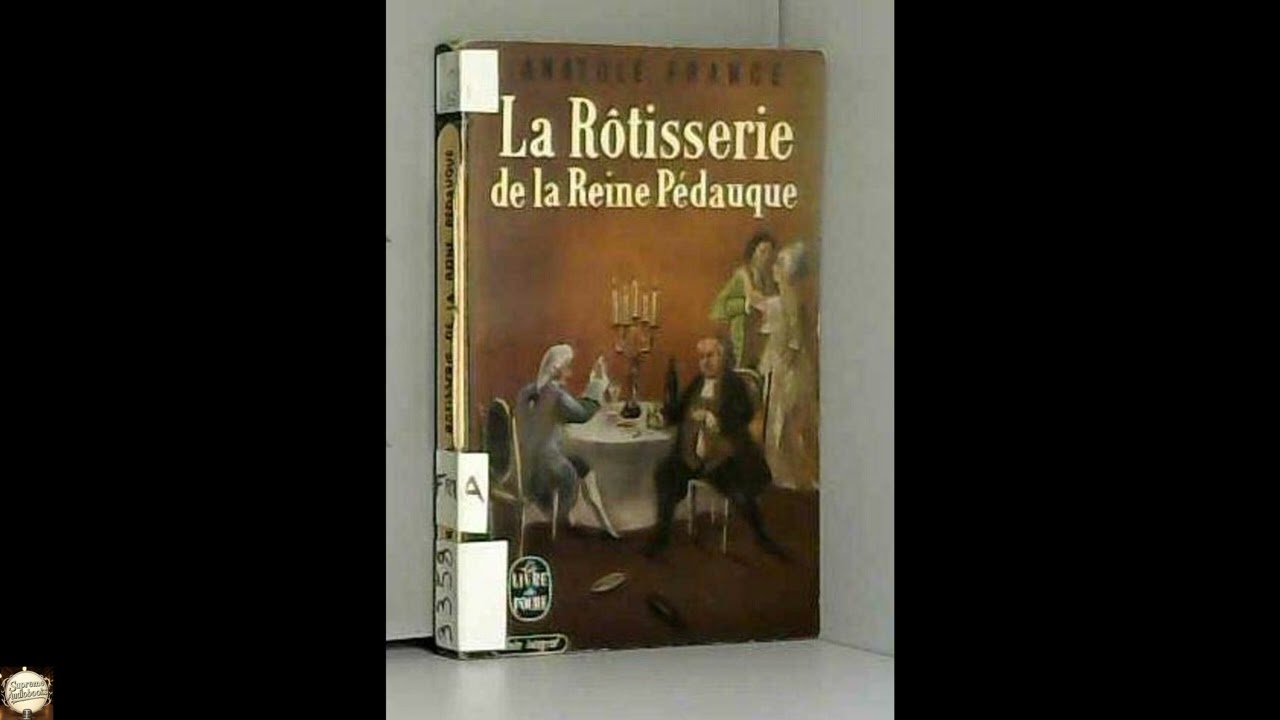
La rôtisserie de la reine pedauque
Step into the bustling, philosophical heart of eighteenth-century Paris with La rôtisserie de la reine Pédauque, a slyly intelligent and genuinely charming novel by Anatole France. This book offers more than just a historical tableau; it presents a spirited debate on human nature, morality, and the very essence of knowledge that resonates powerfully even today. At its core, it is a story of a young man’s unexpected education under the wing of a brilliant, albeit unorthodox, mentor, challenging listeners to reconsider their own assumptions about virtue, sin, and the pursuit of wisdom. It asks, with a twinkle in its eye, whether true enlightenment comes from rigid dogma or from an open, if sometimes scandalous, embrace of life's contradictions. The narrative introduces us to Jacques Tournebroche, a guileless young man working at a Parisian rotisserie, innocently observing the world around him. His life takes a pivotal turn when he falls under the tutelage of the Abbé Jérôme Coignard, a dishevelled but profoundly learned cleric whose wit is as sharp as his moral compass is unconventional. Coignard, a former Dominican whose past is as clouded as his future prospects, becomes Jacques’s guide through the labyrinthine streets and intellectual salons of a pre-Revolutionary Paris on the cusp of the Enlightenment. Their adventures lead them through encounters with a colorful array of characters: eccentric alchemists, worldly courtesans, skeptical philosophers, and fanatical zealots, each presenting a new facet of human folly and wisdom. The central dynamic of the book unfolds through Coignard's meandering lectures and Jacques's wide-eyed observations. Coignard champions a philosophy of benevolent skepticism, often arguing for the inherent goodness of human inclination over the strictures of rigid morality, all delivered with an elegant command of classical literature and theological doctrine. Jacques, initially a blank slate, grapples with his mentor’s paradoxical teachings, which often blur the lines between piety and libertinism, reason and instinct. Their adventures grow more complicated as they become entangled with an eccentric alchemist obsessed with summoning an angel, pulling them further into a world where science, superstition, and desire intertwine. The story follows Jacques’s coming-of-age, his gradual understanding of the world’s complexities, and the profound, often humorous, influence of his mentor’s unique worldview on his developing conscience. Anatole France, born François-Anatole Thibault in Paris in 1844, was a towering figure in French letters at the turn of the twentieth century. The son of a bookseller, he inherited a profound love for literature and classical learning, which would shape his entire career. After beginning as a poet associated with the Parnassian movement and a literary critic, France achieved widespread fame as a novelist, known for his elegant, ironic, and erudite prose. He was elected to the Académie française in 1896 and was awarded the Nobel Prize in Literature in 1921, primarily for his substantial literary output and his intellectual courage. France’s career spanned a period of significant intellectual and social upheaval in France. He famously championed Alfred Dreyfus during the divisive Dreyfus Affair, a stand that marked a shift in his public persona from a detached aesthetician to an engaged public intellectual and socialist. His body of work includes historical novels like Les dieux ont soif, which paints a vivid picture of the French Revolution’s Reign of Terror, and satirical allegories such as L'Île des Pingouins, a biting critique of French society and human civilization. France’s prose is celebrated for its clarity, wit, and a certain detached melancholy, placing him firmly in the tradition of French moralists and satirists, heir to Voltaire and Renan. He passed away in 1924, leaving behind a legacy of graceful skepticism and profound humanism. One of the central themes that runs through La rôtisserie de la reine Pédauque is the eternal conflict between rationalism and superstition, or rather, between dogmatic reason and a more humane, skeptical embrace of human fallibility. Abbé Coignard often articulates this through his paradoxical pronouncements on morality, suggesting that true virtue lies not in rigid adherence to rules but in a compassionate understanding of human desires and weaknesses. For instance, he might argue that a seemingly sinful act, if born of natural inclination and tempered by kindness, is less reprehensible than a supposedly virtuous one performed out of hypocrisy. This challenges the listener to consider the nuances of ethical judgment beyond simple black-and-white distinctions. Another prominent theme is the questioning of absolute truth and the nature of knowledge itself. Through Coignard’s philosophical discussions with Jacques, the novel consistently highlights the subjective and often contradictory nature of human understanding. The abbé revels in exposing the absurdities of rigid systems of thought, whether religious or scientific, favoring instead a playful intellectual agility. This is seen in his encounters with alchemists and other pseudo-scientists, where he often demonstrates the limits of their empirical pursuits while subtly hinting at the greater mysteries beyond simple factual ascertainment, always with a good-natured, if pointed, irony. The narrative suggests that wisdom might reside more in the questioning than in any definitive answer. When Anatole France penned this novel in 1893, France, and indeed much of Europe, was settling into the "Belle Époque," a period characterized by relative peace, economic prosperity, and significant scientific and technological advances. However, beneath this veneer of progress, there was also a deep intellectual ferment and a sense of fin-de-siècle unease. The certainties of the past were eroding under the weight of Darwinian evolution, Freudian psychology, and rising secularism. It was a time when established institutions were being re-examined, and traditional morality was under scrutiny. La rôtisserie de la reine Pédauque, though set in the eighteenth century, served as a brilliant commentary on France’s contemporary world. By revisiting the Age of Enlightenment—a period often celebrated for its triumph of reason—France skillfully uses the historical distance to expose the enduring human flaws of fanaticism, superstition, and hypocrisy. He channels the spirit of Voltaire and other Enlightenment philosophers, using satire and wit to critique both the rigid dogmatism of organized religion and the emerging, sometimes equally dogmatic, certainties of scientific materialism. The book emerged as a plea for intellectual freedom, compassionate skepticism, and a rejection of any ideology that denies the richness and complexity of human experience, whether that experience leans towards the sacred or the profane. For those seeking to truly immerse themselves in Anatole France's brilliant prose and the philosophical depths of La rôtisserie de la reine Pédauque, the audiobook format offers a uniquely compelling experience. The novel's elegant language, rich with classical allusions and subtle ironies, gains immense clarity and emphasis when rendered by a skilled narrator. The conversational yet profound exchanges between Jacques and the Abbé Coignard, along with Coignard’s wonderfully rambling and insightful monologues, demand a voice that can convey both erudition and mischievous wit. A careful narration can truly distinguish the personalities, from the youthful earnestness of Jacques to Coignard's world-weary sagacity, allowing listeners to fully appreciate the philosophical debates and character nuances. The run length, several hours, makes it an ideal companion for extended listening sessions, providing ample time to absorb the atmosphere of eighteenth-century Paris and reflect on the enduring questions it poses, all brought to life through the subtle shifts in pacing, tone, and character voice that only an expert vocal performance can provide.
Enjoyed La rôtisserie de la reine pedauque? A few ways to support us
Audible & Amazon links are affiliate; we may earn a small commission at no extra cost.
About this production
Human narration by a volunteer reader from LibriVox.org, the public-domain audiobook project. LibriVox volunteers record literary works whose copyright has expired in the United States, releasing the resulting recordings into the public domain.
La rôtisserie de la reine pedauque by Anatole France. The underlying text is in the U.S. public domain. We do not republish any modern copyrighted edition, translation, or commentary.
The 4K cinematic visuals accompanying this audiobook are generated by an AI image model from prompts derived from the source text. No copyrighted photos, paintings, or stock footage are used. AI generation is disclosed on every video on our YouTube channel as required by YouTube's altered/synthetic content policy.
English subtitles are transcribed from the LibriVox recording with OpenAI Whisper. Translations into the 11 other supported languages are produced by Meta's NLLB-200 neural translation model. No human translator's copyrighted translation is used.
Questions about sourcing or rights? See our DMCA & Sourcing policy or contact us.
Enjoyed this audiobook?
If you'd like to own a copy of La rôtisserie de la reine pedauque or hear a professionally produced edition, the links below help support free audiobook production at no extra cost to you.
As an Amazon Associate we earn from qualifying purchases. Audible / print links are affiliate.