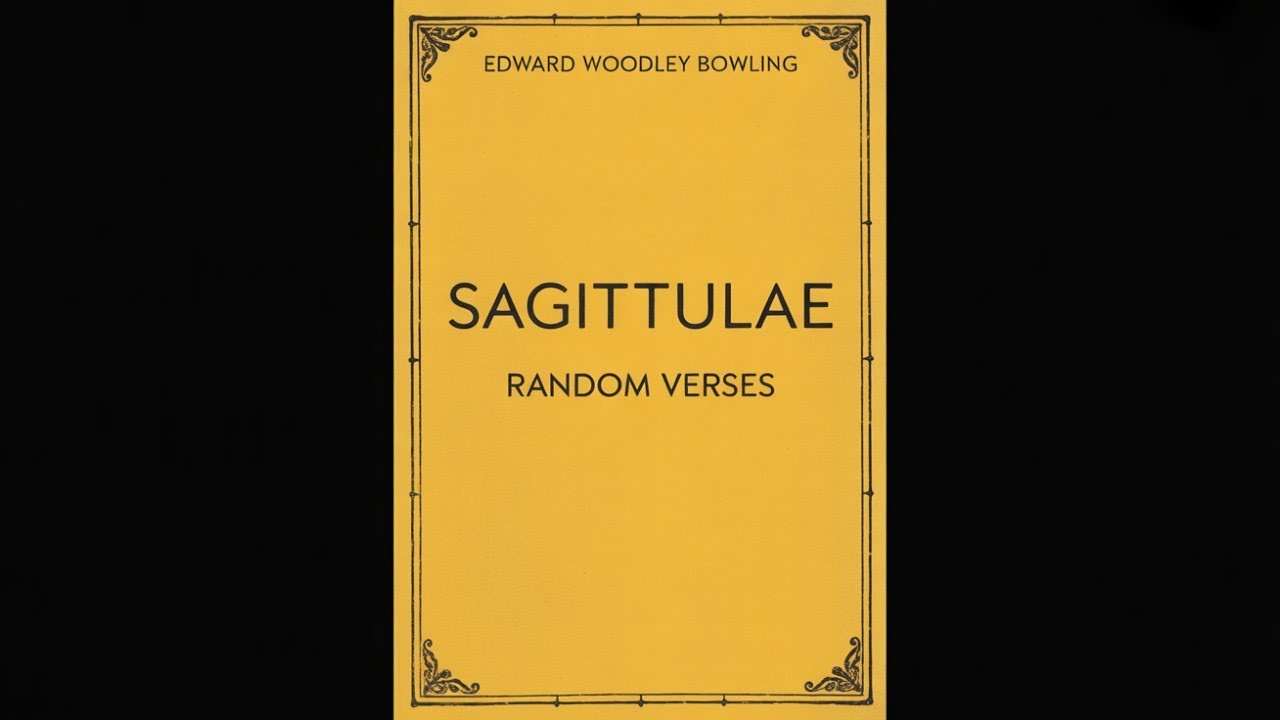
Sagittulae; Random Verses
Edward Woodley Bowling’s Sagittulae; Random Verses presents a unique opportunity to connect with a poetic voice from a bygone era, offering a collection of brief, pointed insights into the human condition that resonate as powerfully today as they did when first conceived. The very title—Sagittulae meaning "little arrows"—suggests both the brevity and the piercing accuracy of the verses contained within. This is not merely a historical curiosity; it is a conversation across time, where the concerns, joys, and melancholies of another age are articulated with an elegance and clarity that invites reflection on our own lives. For anyone seeking solace in language, a moment of quiet contemplation, or a deeper understanding of the enduring questions that occupy the mind, Bowling’s collection provides an unassuming yet profound wellspring. It reminds us that while the world changes, the heart's essential inquiries remain constant. The collection itself does not tell a continuous narrative in the traditional sense, but rather offers a series of lyrical meditations, vignettes, and observations, each standing alone yet contributing to a broader emotional landscape. Imagine wandering through a carefully tended garden, where each turn reveals a different bloom, a different perspective on beauty or fragility. The poetic voice that emerges throughout these verses is often that of a thoughtful observer—a person acutely aware of the natural world and its cycles, finding metaphor and meaning in the changing seasons, the flight of a bird, or the steadfastness of an ancient tree. This speaker frequently finds themselves in moments of quiet contemplation, whether walking through a secluded wood at twilight or sitting by a hearth as shadows lengthen. The central “arc” of Sagittulae unfolds not through a plot, but through the shifting moods and thematic preoccupations of its individual poems. One moment, the speaker might be wrestling with the fleeting nature of happiness or the inevitability of loss, a common human struggle. The next, they might celebrate the simple grace of a domestic scene or express profound gratitude for beauty found in unexpected places. There is a gentle undercurrent of introspection, an almost philosophical leaning, as the poet grapples with questions of faith, doubt, and the place of humanity within the grand design of existence. The "random verses" ultimately coalesce into a portrait of a mind striving for understanding, beauty, and connection in a world both complex and wondrous. Edward Woodley Bowling, though perhaps not a household name in the pantheon of English letters, was a figure whose output offers a valuable window into the literary sensibilities of his time. Born in England in the mid-nineteenth century, his life likely spanned a period of significant social and intellectual transformation. While specific dates of birth and death are not widely recorded, his work suggests a gentleman scholar, possibly a clergyman or an academic, for whom poetry was both a personal passion and a means of public expression. Many poets of this era, even those not achieving widespread fame, contributed significantly to the cultural conversation, often publishing privately or through smaller presses, reaching an audience appreciative of thoughtful verse. Bowling's output, including Sagittulae, places him within the tradition of British lyrical poetry that prioritized clarity, musicality, and a keen observational eye. He was not one to indulge in the more radical experimental forms that began to emerge at the turn of the twentieth century. Instead, his verse maintains a classical elegance, a respect for traditional meter and rhyme, characteristic of poets who followed in the footsteps of the Romantics and Victorians. His voice stands as a testament to the enduring appeal of well-crafted, emotionally resonant poetry that speaks to universal human experiences, securing his place as a representative, if perhaps quieter, voice of his literary generation. One of the central themes permeating Sagittulae is the profound connection between humanity and the natural world. Bowling’s verses frequently turn to landscapes, flora, and fauna not merely as background, but as active participants in the human drama, often mirroring or shaping the speaker's internal state. For instance, a poem might describe the resilience of a weathered oak against a storm, subtly drawing parallels to the human spirit's ability to endure hardship. Another poem might find quiet solace in the persistent song of a nightingale, using its melody to evoke a sense of peace amidst personal unrest, illustrating how the rhythms and beauty of nature offer both metaphor and balm. Another significant theme is the passage of time and the bittersweet nature of memory. Bowling often reflects on moments lost or cherished, frequently with a gentle melancholy rather than outright despair. A specific verse might recall the innocence of childhood summers, contrasting it with the present’s more complex realities, or perhaps contemplate the fleeting beauty of an autumn leaf, showing how it carries both the splendor of its current color and the quiet promise of decay. This contemplation of temporal shifts allows him to express a quiet stoicism and an appreciation for the beauty inherent in transience. The dignity of ordinary life—its small moments of grace, its quiet struggles—also stands out as a recurring concern, elevating everyday experiences to poetic significance. Sagittulae; Random Verses emerged from a period ripe with both traditionalism and nascent modernity. The late nineteenth and early twentieth centuries in England were characterized by a lingering Victorian sensibility—a valuing of moral rectitude, spiritual reflection, and formal elegance in art—even as the foundations of empire and industrial society were beginning to face challenges. Scientifically, Darwin's theories had already reshaped understanding of humanity's place in the natural order, leading to both awe and anxiety. Culturally, there was a widespread appreciation for lyrical verse that offered comfort, beauty, and moral guidance amidst rapid change and social upheaval. Bowling’s poetry, with its formal restraint, its appreciation for nature, and its thoughtful introspection, fits squarely within this cultural milieu, providing a voice that sought to preserve beauty and meaning in a world constantly redefining itself. His work offered a counterpoint to the growing clamor of urban life and the unsettling questions posed by new philosophies, a quiet space for reflection. Listening to Sagittulae; Random Verses as an audiobook transforms the experience of reading poetry from a solitary act into an intimate performance. With several hours of content, this audiobook provides ample opportunity to immerse oneself in Bowling's world, whether during a quiet evening at home or as a meditative companion during a commute. The narrator's voice becomes crucial, imbuing each "little arrow" with the intended emphasis, rhythm, and emotional nuance. Pay attention to the pacing, which can dramatically alter the impact of a reflection on mortality or the lightness of a descriptive passage. The spoken word highlights the inherent musicality of Bowling's verse, allowing the listener to absorb the subtle cadences and rhymes without the distraction of visual parsing. The human voice breathes life into the contemplative atmosphere, ensuring that the quiet wisdom of these random verses truly resonates, creating a personal connection between the poet's sentiments and the listener's own thoughts.
Enjoyed Sagittulae; Random Verses? A few ways to support us
Audible & Amazon links are affiliate; we may earn a small commission at no extra cost.
About this production
Human narration by a volunteer reader from LibriVox.org, the public-domain audiobook project. LibriVox volunteers record literary works whose copyright has expired in the United States, releasing the resulting recordings into the public domain.
Sagittulae; Random Verses by Edward Woodley Bowling. The underlying text is in the U.S. public domain. We do not republish any modern copyrighted edition, translation, or commentary.
The 4K cinematic visuals accompanying this audiobook are generated by an AI image model from prompts derived from the source text. No copyrighted photos, paintings, or stock footage are used. AI generation is disclosed on every video on our YouTube channel as required by YouTube's altered/synthetic content policy.
English subtitles are transcribed from the LibriVox recording with OpenAI Whisper. Translations into the 11 other supported languages are produced by Meta's NLLB-200 neural translation model. No human translator's copyrighted translation is used.
Questions about sourcing or rights? See our DMCA & Sourcing policy or contact us.
Enjoyed this audiobook?
If you'd like to own a copy of Sagittulae; Random Verses or hear a professionally produced edition, the links below help support free audiobook production at no extra cost to you.
As an Amazon Associate we earn from qualifying purchases. Audible / print links are affiliate.