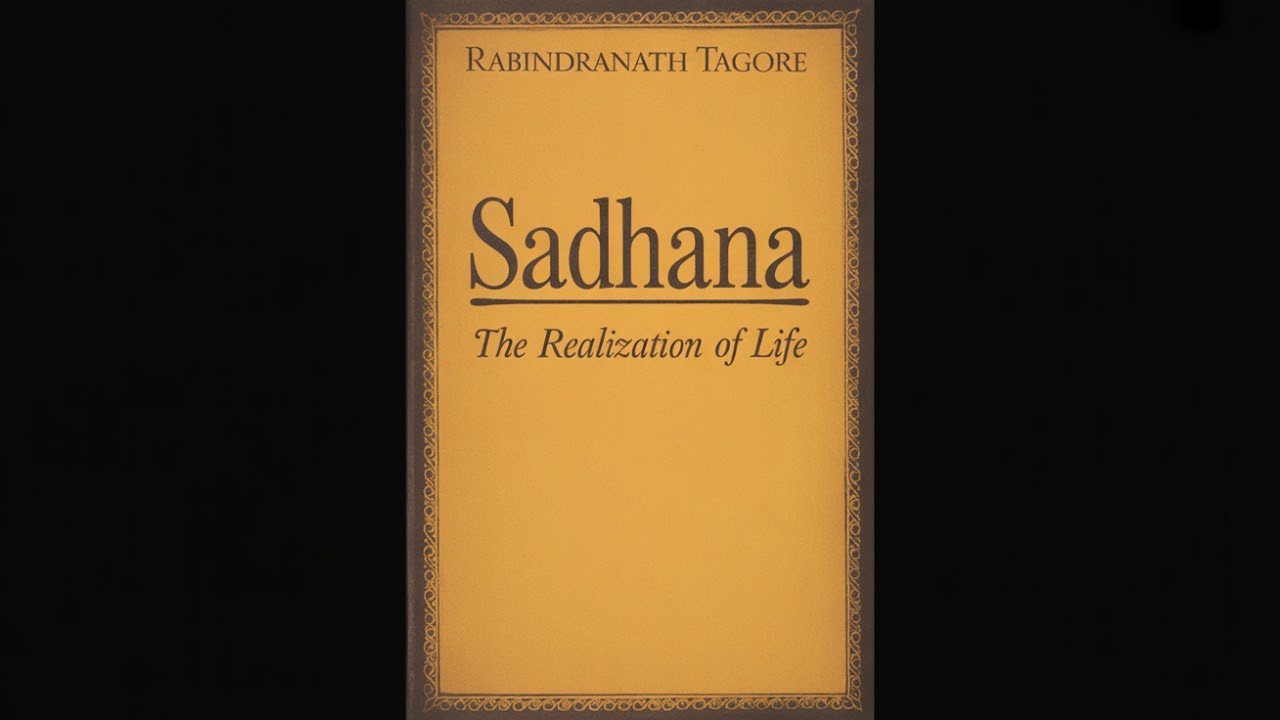
Sadhana: The Realization of Life
Rabindranath Tagore’s Sadhana: The Realization of Life offers a profound invitation to consider the fundamental questions of human existence, our place in the cosmos, and the deepest sources of joy and suffering. This collection of essays, originally delivered as lectures to an American audience, distills a lifetime of philosophical inquiry, spiritual reflection, and poetic insight into a series of illuminating discourses. For anyone seeking clarity amidst modern complexities, or yearning for a deeper connection to the world and themselves, Tagore’s work provides not only answers, but also a framework for how to live with greater purpose and awareness. It is a voice from a different era, yet one that speaks with striking relevance to the struggles and aspirations of today’s individual, urging a re-evaluation of what constitutes true happiness and fulfillment. The listener who approaches Sadhana is led on an intellectual and spiritual voyage rather than through a conventional narrative with characters and a plot. Tagore sets the stage by first addressing the relationship between the individual and the vast universe, immediately challenging the common perception of isolation. He frames the human mind as the setting for this introspection, where the seeker is the central figure, grappling with an inherent tension: the desire for unity against the experience of separation. The unfolding of the book’s eight chapters constitutes the arc of this discovery, each section building upon the last to gradually dissolve misconceptions and reveal deeper truths. Tagore guides us through distinct yet interconnected concepts, beginning with a meditation on the infinite that permeates nature and our very being, moving then to the significance of "Sadhana" itself – the spiritual discipline required to perceive this reality. He confronts the perplexing "problem of evil" not as a malevolent force, but as an incomplete manifestation of truth, a shadow that defines the light. Subsequently, he addresses the "problem of self," urging us beyond egoistic attachments to a larger, more inclusive identity. The discourse then shifts from theoretical understanding to practical application, discussing "realization in action," emphasizing how selfless engagement with the world is a vital part of spiritual growth. This path culminates in the powerful themes of "realization in love" and "realization in beauty," where human connection and aesthetic appreciation are presented as direct conduits to the divine. The ultimate destination, though never fully unveiled to preserve the transformative experience for each listener, points towards a grand unification, where the individual consciousness merges with the universal. Rabindranath Tagore, born in Calcutta, Bengal Presidency, British India, in 1861, stands as one of the most towering figures in the history of world literature and thought. A true polymath, he was a poet, novelist, playwright, composer, philosopher, social reformer, and painter, whose influence extended across continents and disciplines. His family background was deeply cultured and reformist; his father, Debendranath Tagore, was a prominent leader of the Brahmo Samaj, a monotheistic reformist movement in Hinduism, which undoubtedly shaped Rabindranath’s own spiritual leanings. Though largely self-educated, he founded Visva-Bharati University, an institution dedicated to bridging the cultural understanding between East and West, fostering a holistic approach to education. Tagore’s literary output was prodigious, encompassing over two thousand songs (Rabindra Sangeet), numerous plays, essays, novels, and volumes of poetry. He became the first non-European to win the Nobel Prize in Literature in 1913, primarily for his collection of poems, Gitanjali (Song Offerings), which gained widespread acclaim for its lyrical beauty and spiritual depth. Other celebrated works include the novels Ghare Baire (The Home and the World) and Chokher Bali, as well as short stories like Kabuliwala. He was knighted by the British Crown in 1915 but renounced the title in 1919 following the Jallianwala Bagh massacre, demonstrating his profound commitment to human rights and justice. Tagore passed away in 1941, leaving behind a legacy that continues to inspire and challenge thinkers globally. He remains a pivotal voice of the Bengal Renaissance, a movement that redefined Indian literature and culture, placing it firmly on the world stage. Among the central themes resonating throughout Sadhana is the profound unity of the individual with the universe. Tagore consistently shows that human beings are not isolated entities but integral parts of a boundless cosmic order. He illustrates this by observing the natural world—the flow of rivers, the expanse of the sky, the growth of trees—not merely as scenic backdrops, but as living embodiments of the divine spirit. This perception allows him to reframe the common apprehension of the "problem of evil." Rather than viewing evil as an opposing force, Tagore presents it as an incomplete manifestation, a partial truth that, when viewed from a larger perspective, ceases to be purely destructive and instead contributes to the expansion of consciousness, like shadows that define light, making its presence known. Another crucial theme is the realization of truth through action and love, rather than through withdrawal or asceticism. Tagore insists that true spiritual growth occurs not in isolation, but in active engagement with the world and with fellow beings. He shows how selfless work, performed with a joyful spirit and without attachment to its fruits, can transform mundane activities into sacred acts. Similarly, love, especially that which extends beyond the self to embrace all of humanity and nature, is presented as the most direct route to understanding the infinite. For Tagore, beauty is not a superficial adornment but a profound pathway to truth, a reflection of the universal harmony. The experience of beauty, whether in art or nature, is an ecstatic moment where the individual glimpses the divine, momentarily transcending the limitations of the self and perceiving the underlying unity of existence. Sadhana: The Realization of Life emerged into a world experiencing significant upheaval and intellectual ferment. Published in 1913, just a year after Tagore delivered the initial lectures in America and the same year he received the Nobel Prize, the book was born at a fascinating crossroads. In India, British colonial rule was entrenched, yet nationalist sentiments were steadily gaining momentum, particularly within the educated elite. The Bengal Renaissance, of which Tagore was a leading light, was fostering a vibrant intellectual and cultural awakening, blending traditional Indian philosophies with Western progressive thought. Globally, the pre-World War I era was marked by rapid industrialization, social changes, and a burgeoning interest in Eastern philosophies and spirituality among Western thinkers. Tagore’s work thus served as a vital bridge, presenting sophisticated Indian philosophical concepts in elegant, accessible English prose to a global audience. His writings offered a compelling counterpoint to the materialist tendencies of the burgeoning modern world, advocating for a spiritual foundation to life. He presented a vision that was universalist, humanist, and deeply rooted in a spiritual understanding of existence, resonating with many who felt a disconnect in their own societies. His approach was neither dogmatic nor prescriptive, but rather an invitation to a shared contemplation, appealing to the individual’s inherent capacity for wisdom and compassion at a time when cultural exchange was becoming increasingly important. Listening to Sadhana: The Realization of Life as an audiobook offers a uniquely immersive experience, particularly suited to the meditative and reflective nature of Tagore’s prose. The entire work, running for several hours, allows for a sustained period of contemplation, making it ideal for quiet mornings, reflective walks, or as a companion during focused work. A skilled narrator can bring out the inherent musicality and poetic cadence of Tagore’s language, which often feels like a spoken sermon or a profound personal reflection. The pacing of the narration will likely be deliberate, allowing the listener ample time to absorb complex philosophical ideas without feeling rushed. One can listen for the subtle shifts in voice as the narrator moves from grand cosmic themes to intimate human struggles, cultivating an atmosphere of deep wisdom and gentle guidance. This aural presentation emphasizes the rhetorical power and spiritual resonance that characterized Tagore’s original lectures, transforming a reading experience into a shared moment of realization.
Enjoyed Sadhana: The Realization of Life? A few ways to support us
Audible & Amazon links are affiliate; we may earn a small commission at no extra cost.
About this production
Human narration by a volunteer reader from LibriVox.org, the public-domain audiobook project. LibriVox volunteers record literary works whose copyright has expired in the United States, releasing the resulting recordings into the public domain.
Sadhana: The Realization of Life by Rabindranath Tagore. The underlying text is in the U.S. public domain. We do not republish any modern copyrighted edition, translation, or commentary.
The 4K cinematic visuals accompanying this audiobook are generated by an AI image model from prompts derived from the source text. No copyrighted photos, paintings, or stock footage are used. AI generation is disclosed on every video on our YouTube channel as required by YouTube's altered/synthetic content policy.
English subtitles are transcribed from the LibriVox recording with OpenAI Whisper. Translations into the 11 other supported languages are produced by Meta's NLLB-200 neural translation model. No human translator's copyrighted translation is used.
Questions about sourcing or rights? See our DMCA & Sourcing policy or contact us.
Enjoyed this audiobook?
If you'd like to own a copy of Sadhana: The Realization of Life or hear a professionally produced edition, the links below help support free audiobook production at no extra cost to you.
As an Amazon Associate we earn from qualifying purchases. Audible / print links are affiliate.