Rossmoyne
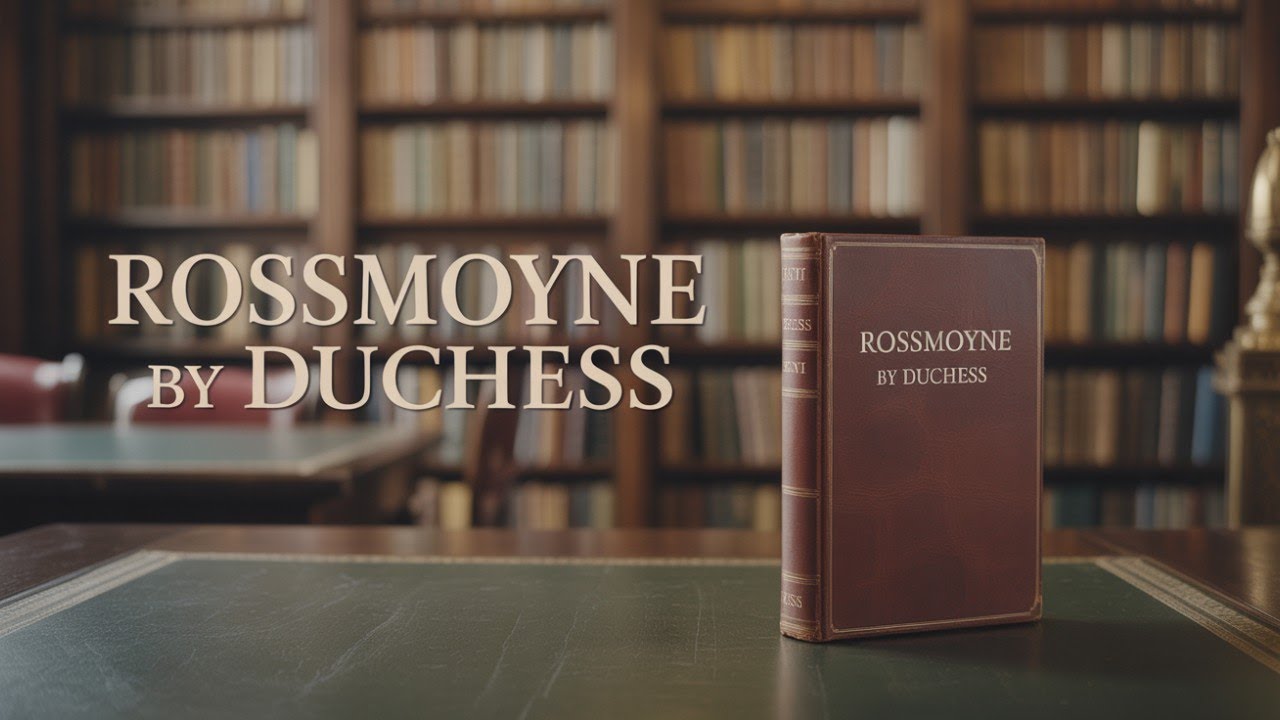
Step into the drawing rooms and sprawling estates of a bygone era with Rossmoyne, a quintessential novel by the prolific Victorian author known simply as Duchess. For listeners today, this audiobook offers more than just a historical romance; it's a meticulously crafted social drama, a fascinating window into the complex web of propriety, passion, and class that defined late nineteenth-century society. We meet characters whose struggles with love, ambition, and the unyielding expectations of their world resonate with surprising clarity, demonstrating that the human heart, for all its changing costumes, remains a remarkably consistent organ. Anyone who appreciates sharp wit, emotional depth, and a story where the stakes are as high as a lady's reputation or a gentleman's honor will find themselves utterly absorbed by the dilemmas and desires unfolding within these pages. The story of Rossmoyne unfolds primarily in the secluded, often gossipy, world of the English landed gentry. Our central figure is undoubtedly Honor Carmichael, a young woman of striking beauty and considerable spirit, whose circumstances are complicated by a family history shadowed by scandal and a precarious financial situation. She lives in a genteel poverty that forces her to confront the realities of a society where a woman’s worth is often measured by her marital prospects and inheritance. Into her orbit comes a cast of compelling figures: the enigmatic and seemingly aloof Lord Rossmoyne, whose reserved demeanor hides depths of feeling; the charming but potentially untrustworthy Captain Armytage; and the various members of society, both well-meaning and malicious, who observe and comment upon Honor's every move. The central conflict arises from a series of misunderstandings, societal pressures, and the ever-present question of whether true love can conquer the formidable barriers of wealth, status, and damaging rumor. As the narrative progresses, Honor finds herself navigating a labyrinth of social engagements, whispered criticisms, and increasingly complex romantic entanglements. She strives to maintain her integrity and dignity in the face of snobbery and an almost suffocating sense of public scrutiny. Her affections are tested, her loyalties strained, and her future hangs precariously balanced between a marriage of convenience and the elusive promise of genuine affection. The story builds with a classic Victorian pacing, meticulously detailing the emotional lives of its characters and the subtle shifts in their relationships, all leading towards a dramatic resolution that challenges expectations and reveals the true nature of their hearts. The author behind the pseudonym "Duchess" was Margaret Wolfe Hungerford, born Margaret Wolfe Argles around 1855 in County Cork, Ireland. Her life, though relatively short, was marked by both personal challenge and immense literary productivity. She was the daughter of a Church of Ireland rector, and her upbringing instilled in her a strong sense of social observation. After an early marriage to Edward Argles, which produced three children, she was left a widow at a young age. To support her growing family, she turned to writing, quickly discovering a talent for crafting engaging popular fiction. Her second marriage, to Thomas Hungerford, brought her more children and a measure of domestic stability, but her writing career continued to flourish, driven by both creative impulse and financial necessity. Margaret Hungerford became one of the most widely read novelists of her time, publishing an astounding number of books—over fifty—during her lifetime. Her works were immensely popular, particularly the "three-volume novels" that were a staple of the circulating libraries. She specialized in what was often termed "light romance," but her stories, including well-known titles like Molly Bawn and Phyllis, possessed a wit and a keen eye for social dynamics that elevated them beyond mere escapism. While she may not have achieved the "serious" literary reputation of contemporaries like George Eliot or Thomas Hardy, she carved out a significant place in the popular literary landscape, influencing countless readers with her narratives of love, class, and convention, all delivered with an appealing charm and narrative drive. She passed away in 1897, leaving behind a substantial body of work that continues to entertain and enlighten. Rossmoyne enacts several enduring themes that resonate far beyond its Victorian setting. One prominent theme is the conflict between love and social obligation. Honor Carmichael constantly weighs her personal desires against what society dictates is prudent or proper for a woman of her standing. We see this in scenes where she must politely deflect undesirable suitors, even as her heart is drawn elsewhere, understanding that a misstep could ruin her family's fragile respectability. Another significant theme is appearance versus reality. Characters often present one facade to the world while harboring vastly different intentions or feelings. Lord Rossmoyne’s initial coldness, for instance, serves as a crucial example, forcing Honor and the listener to look beyond superficial impressions to discern his true character and motivations. Furthermore, the novel subtly explores the constraints and small freedoms afforded to women in the late nineteenth century. Honor, though limited by her gender and social status, demonstrates a quiet resilience and intelligence, using her wit and courage to navigate treacherous social waters rather than succumbing to despair. Her struggles highlight the period's emphasis on marriage as a woman's primary path to security, yet the story also champions the idea of choosing love and self-respect over mere convenience. Finally, the role of class and status is ever-present. The novel dissects how lineage, wealth, and reputation dictate social interactions, marital prospects, and even personal happiness, showing how characters must constantly contend with the rigid hierarchies of their world. The late nineteenth century, when novels like Rossmoyne were published, was a period of fascinating social and cultural flux in Britain. Queen Victoria reigned, and while the empire was at its zenith, beneath the surface of seemingly unshakeable order, societal norms were subtly shifting. The rise of a burgeoning middle class created a vast readership hungry for fiction, leading to the proliferation of circulating libraries that made novels accessible to many. Women, though still largely confined to the domestic sphere, were increasingly prominent as both readers and writers, and the popular romance genre provided a space for exploring female experiences within the strictures of Victorian morality. This era also saw growing discussions around women's roles, hinted at by the emerging "New Woman" debates, even if Duchess's heroines generally operated within more conventional frameworks. Politically, the country was stable, but socially, the lines of class and propriety were sharply drawn. Novels like Rossmoyne thrived because they offered readers a blend of escapism and familiar social commentary. They allowed an immersion into the lives of the aristocracy and gentry, often portraying their foibles and fascinations while upholding, and sometimes gently questioning, prevailing moral codes. The demand for engaging narratives that could be read over several weeks, often discussed in polite company, perfectly suited the format and style of authors like Margaret Hungerford, cementing their place in the popular imagination of the time. Listening to Rossmoyne as an audiobook transforms the experience of this classic novel. The inherent dramatic tension in Duchess's prose, with its lengthy, often emotionally charged dialogues and vivid descriptions of setting and character, comes alive through a skilled narrator's voice. You’ll find yourself drawn into the nuances of conversations, hearing the unspoken emotions behind a carefully worded compliment or a pointed remark. The pacing, characteristic of late Victorian fiction, encourages a gradual immersion into the story's world, allowing the listener to savor the descriptive passages and the slow burn of emotional development. The "several hours" of run length make it an ideal companion for long drives, focused afternoons, or winding down in the evening, allowing the detailed atmosphere of the drawing rooms and gardens of Rossmoyne to envelop you fully. It's an intimate way to connect with a story that, at its heart, speaks to the universal desire for love, acceptance, and a place in the world.
Enjoyed Rossmoyne? A few ways to support us
Audible & Amazon links are affiliate; we may earn a small commission at no extra cost.
About this production
Human narration by a volunteer reader from LibriVox.org, the public-domain audiobook project. LibriVox volunteers record literary works whose copyright has expired in the United States, releasing the resulting recordings into the public domain.
Rossmoyne by Duchess. The underlying text is in the U.S. public domain. We do not republish any modern copyrighted edition, translation, or commentary.
The 4K cinematic visuals accompanying this audiobook are generated by an AI image model from prompts derived from the source text. No copyrighted photos, paintings, or stock footage are used. AI generation is disclosed on every video on our YouTube channel as required by YouTube's altered/synthetic content policy.
English subtitles are transcribed from the LibriVox recording with OpenAI Whisper. Translations into the 11 other supported languages are produced by Meta's NLLB-200 neural translation model. No human translator's copyrighted translation is used.
Questions about sourcing or rights? See our DMCA & Sourcing policy or contact us.
Enjoyed this audiobook?
If you'd like to own a copy of Rossmoyne or hear a professionally produced edition, the links below help support free audiobook production at no extra cost to you.
As an Amazon Associate we earn from qualifying purchases. Audible / print links are affiliate.