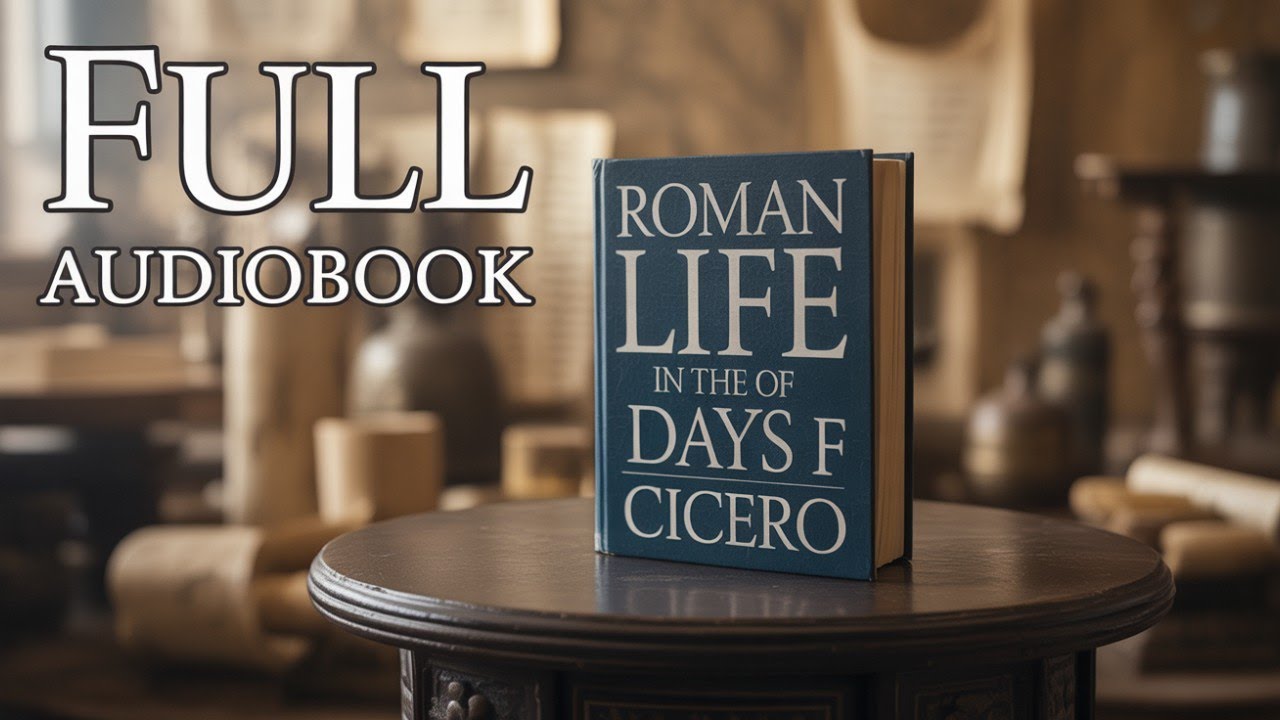
Roman Life in the Days of Cicero
Imagine the dusty streets of ancient Rome, not as a backdrop for grand historical events, but as the stage for everyday human existence. Alfred John Church's "Roman Life in the Days of Cicero" pulls back the curtain on this distant world, inviting us to witness the mundane alongside the monumental during one of history's most pivotal epochs. Far from a dry historical chronicle, this book acts as a detailed portal, transporting the listener directly into the homes, forums, and public spaces of the 1st century BCE. It’s a compelling invitation to understand the people who built an empire — their routines, their values, their challenges — as they navigated a society poised between republican ideals and imperial ambition. For anyone seeking to grasp the fundamental human experiences that underpinned a foundational civilization, or simply wishing to stand, however briefly, shoulder-to-shoulder with the inhabitants of ancient Rome, this account offers an unparalleled sense of presence and connection to a past that continues to echo in our present. The narrative itself doesn't follow a single character's dramatic arc but rather presents a panoramic survey of Roman society as seen through the lens of Cicero's lifetime. The setting is Rome itself, its sprawling urban center, bustling markets, grand public buildings, and the quiet dignity of patrician villas, stretching also to the surrounding countryside where vast estates supported the city's elite. The "main characters" are the collective Roman people — from the senator engaged in heated debates within the Curia Hostilia to the merchant haggling in the Forum, from the matron overseeing her household slaves to the aspiring young student reciting oratory. Church brings to life the various stations and duties of these individuals, painting a collective portrait of a society structured by birth, wealth, and civic expectation. The central narrative thread, if one considers it as such, is the unfolding of a typical day, week, or year in this ancient metropolis, detailing the minutiae of existence often overlooked by grand histories. We watch as the city stirs at dawn, observe the morning salutatio where clients pay respects to their patrons, follow the crowds to the Forum where legal cases are argued and political speeches delivered. Later, the account shifts to the public baths, the gladiatorial spectacles, or the elaborate banquets hosted by the wealthy. The "arc of the story" is therefore a progression through these communal experiences, revealing how each aspect of daily existence, from religious observance to family dynamics, from education to entertainment, contributed to the unique fabric of Roman identity. The underlying tension throughout is the subtle recognition of a society at a turning point, where old traditions are challenged by new power structures, all viewed through the immediate, lived experience of its citizens. The text illustrates not just what Romans did, but how they did it, and perhaps even why, without revealing the ultimate political fate that awaited the Republic. Alfred John Church (1829-1912) was an English classical scholar and educator whose prolific writing career helped popularize ancient history for generations of readers. Born in London, Church received his education at King's College London and Lincoln College, Oxford, where he cultivated a deep love and rigorous understanding of the classical world. His professional life saw him hold significant positions in education, notably serving as the headmaster of Merchant Taylors' School in London and later of Retford Grammar School. Throughout these years, he also took Holy Orders, becoming an Anglican priest, a role that perhaps deepened his humanistic approach to history and his desire to convey moral and cultural lessons from antiquity. Church's literary output was vast, primarily consisting of retellings and popularizations of classical texts and historical events. He possessed a remarkable talent for distilling complex narratives and detailed historical records into accessible, engaging prose, often aimed at younger audiences but equally appreciated by adults. Among his most celebrated works are "Stories from Homer," "Stories from Virgil," "Stories from Livy," and "The Story of the Persian War," each designed to introduce readers to the foundational narratives of Western civilization. He also wrote "The Story of the Last Days of Jerusalem," showcasing his breadth of historical interest. As a prominent voice of the late Victorian and Edwardian eras, Church belonged to a literary tradition that sought to bridge academic scholarship with popular understanding. He was not an innovator of literary forms but rather a meticulous and artful communicator, a master of clear exposition. His place in the canon is secured as a pivotal figure in classical reception, a scholar who didn't merely translate or analyze, but recreated the ancient world with vivid imagination and scrupulous attention to historical detail, ensuring that the stories and lives of Greeks and Romans remained a living part of English letters. "Roman Life in the Days of Cicero" brings several crucial themes into sharp focus, offering more than just historical facts but also a deeper understanding of human society. One dominant theme is the rigid social hierarchy that permeated every aspect of Roman existence. Church illustrates this by describing the morning salutatio, where plebeian clients would queue outside a patrician's home, seeking favors or simply paying respects, a scene that vividly underscores the power dynamics and dependency inherent in Roman social structures. We see the stark contrast between the senator who dictated laws and the enslaved person who served his meals, revealing a society meticulously stratified, yet bound together by a complex web of duties and expectations. Another central theme is the continuous interplay between public duty and private life. The book shows Romans moving from the bustling public spaces of the Forum, where political careers were forged and legal battles fought, to the relative quiet of their domestic settings. Within the home, the paterfamilias held immense authority, guiding family religious rites dedicated to the lares and penates, the household gods. This constant negotiation between the demanding responsibilities of citizenship and the intimate, often ritualistic world of the family reveals the dual nature of Roman identity. Church also excels at detailing the material culture and daily routines, from the specific layout of a Roman villa, with its atrium and peristyle garden, to the type of food served at a cena. He describes the process of bathing at the public thermæ or the specific clothing (toga, stola) worn for different occasions, grounding the listener in the tangible realities of an ancient civilization and making its inhabitants feel remarkably close and relatable. When Alfred John Church penned "Roman Life in the Days of Cicero," in the early years of the 20th century, Western Europe, particularly Britain, was experiencing a profound fascination with classical antiquity. The Victorian and Edwardian eras had witnessed significant archaeological discoveries, such as ongoing excavations at Pompeii and Herculaneum, which revealed not just grand monuments but the remarkably preserved details of everyday Roman life. This sparked a broader public interest beyond academic circles, a desire to understand the ordinary people who inhabited these ancient worlds, rather than just their emperors and generals. Culturally, Britain was at the height of its imperial power, and there was a subconscious, and sometimes explicit, drawing of parallels between the British Empire and the Roman Empire. Understanding Rome's administration, law, and social structures was seen by many as instructive. In the literary world, there was a trend towards making history and classical literature accessible to a wider audience, moving beyond specialist scholarly texts. Authors like Church excelled in this role, providing narratives that were both historically accurate and engagingly written. His particular contribution was to shift the focus from traditional political and military histories to the social history of daily life, presenting a more intimate and humanistic perspective on a civilization that profoundly shaped the modern world. This work emerged from a context that valued both rigorous historical study and the popular dissemination of knowledge, bridging the gap between the academy and the general reader. Listening to "Roman Life in the Days of Cicero" as an audiobook offers a uniquely immersive experience, transforming what could be a dense historical text into a lively auditory panorama. The narrator's voice becomes our personal guide through the streets of ancient Rome, painting pictures with sound and inflection. With several hours of content, this production provides ample time to settle into the pace of Roman existence, allowing the listener to absorb the intricate details without feeling rushed. A skilled narration can bring to life the distinctions between the formal pronouncements of a senator, the casual chatter in the baths, or the domestic commands within a Roman household, adding texture and authenticity to the described scenes. The pacing of the narration can effectively match the rhythm of daily Roman routines, from the early morning stirrings to the quiet of evening. Through careful vocal interpretation, the atmosphere of ancient Rome — its sounds, its smells imagined, its very essence — becomes palpable, inviting contemplation and a deeper connection to this foundational era.
Enjoyed Roman Life in the Days of Cicero? A few ways to support us
Audible & Amazon links are affiliate; we may earn a small commission at no extra cost.
About this production
Human narration by a volunteer reader from LibriVox.org, the public-domain audiobook project. LibriVox volunteers record literary works whose copyright has expired in the United States, releasing the resulting recordings into the public domain.
Roman Life in the Days of Cicero by Alfred John Church. The underlying text is in the U.S. public domain. We do not republish any modern copyrighted edition, translation, or commentary.
The 4K cinematic visuals accompanying this audiobook are generated by an AI image model from prompts derived from the source text. No copyrighted photos, paintings, or stock footage are used. AI generation is disclosed on every video on our YouTube channel as required by YouTube's altered/synthetic content policy.
English subtitles are transcribed from the LibriVox recording with OpenAI Whisper. Translations into the 11 other supported languages are produced by Meta's NLLB-200 neural translation model. No human translator's copyrighted translation is used.
Questions about sourcing or rights? See our DMCA & Sourcing policy or contact us.
View 10 famous quotes from this book →
Enjoyed this audiobook?
If you'd like to own a copy of Roman Life in the Days of Cicero or hear a professionally produced edition, the links below help support free audiobook production at no extra cost to you.
As an Amazon Associate we earn from qualifying purchases. Audible / print links are affiliate.