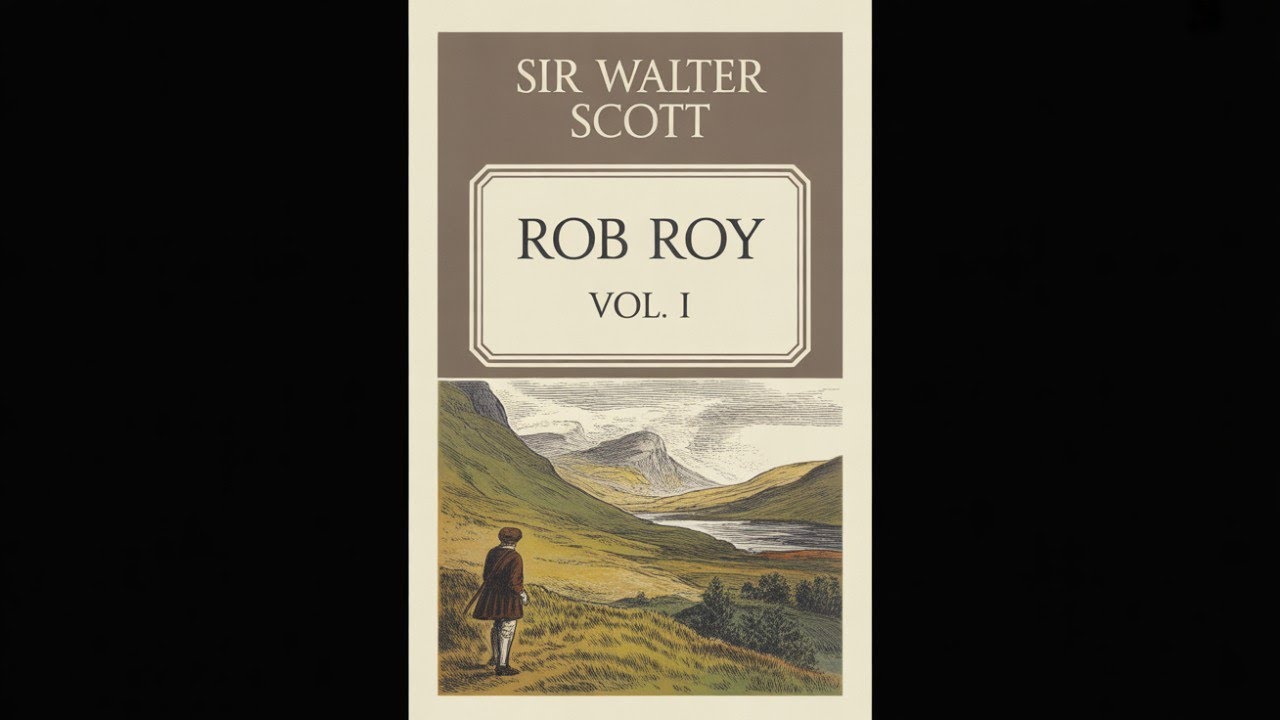
Rob Roy - Vol. I
Long before the rugged landscapes of Scotland became a dramatic backdrop for countless tales of adventure and romance, Sir Walter Scott gave the world a true foundational work of historical fiction: "Rob Roy." This isn't just an antiquated historical piece; it’s a swirling saga of conflicting loyalties, the clash between ancient ways and nascent modernity, and the perilous education of a young man caught between them. What begins as a polite refusal to join the family business quickly spirals into a thrilling ordeal of political intrigue, highway robbery, and desperate heroism, all set against the wild, untamed beauty of the Scottish Highlands in a period of intense upheaval. For anyone who appreciates stories where personal courage is tested against grand historical forces, where character is forged in the fires of adversity, "Rob Roy" remains a pulse-quickening experience, speaking to enduring questions of justice, identity, and the price of freedom. The story unfolds in the early 18th century, specifically the period following the abortive Jacobite Rising of 1715, a time of simmering tension between the English Crown and the Highland clans. Our protagonist is Francis Osbaldistone, the younger son of a wealthy London merchant. A sensitive and artistic young man, Francis finds himself at odds with his stern, commercially minded father, who wishes him to take up a place in the family’s counting-house. When Francis declines, his father, in a fit of pique and a calculated act of discipline, disinherits him and sends him north to live among his rougher, landowning relatives in Northumberland. This abrupt displacement throws Francis into a starkly different world, a far cry from the polite society of London. He quickly finds himself among a dysfunctional family, including his villainous cousin, Rashleigh, whose machinations soon lead to the Osbaldistone family's financial ruin and Francis's own involvement in a dangerous quest. As Francis attempts to unravel the mystery of his family's lost fortunes, he is drawn deeper into the turbulent political landscape of the Anglo-Scottish Border. It is here that he encounters the enigmatic Diana Vernon, a spirited young woman caught in her own web of family secrets and loyalties, and the legendary figure of Rob Roy MacGregor. Rob Roy, a charismatic Highland outlaw, operates by his own code of honor, defying English law and protecting his clan in a brutal world where traditional loyalties are under siege. Francis, initially a naive and somewhat ineffectual observer, finds himself relying on Rob Roy’s cunning and courage to navigate the treacherous territory of betrayal, escape capture, and fight for his family’s honor and his own survival. His personal journey of self-discovery is inextricably bound to the fate of a nation grappling with its identity. Sir Walter Scott, born in Edinburgh in 1771, became perhaps the most significant literary figure of his era. A lawyer by training, his true passion lay in the ancient ballads, legends, and history of his native Scotland. His early career saw him collecting and publishing "Minstrelsy of the Scottish Border," a foundational collection of traditional poems and songs that sparked renewed interest in Scottish folklore. He moved from poetry—with works like "The Lady of the Lake"—to prose, fundamentally altering the literary landscape with his groundbreaking historical novels. Scott’s early life, marked by a childhood struggle with polio that left him lame, gave him an acute observer's eye and a deep appreciation for the landscape and lore of the Scottish Borders where he spent much of his time. Scott’s financial dealings, including secret partnerships in printing and publishing firms, led to significant debt late in his life. Rather than declare bankruptcy, he dedicated himself to writing at a furious pace to pay off his creditors, an immense testament to his personal integrity and prodigious literary talent. He produced a staggering number of works, solidifying his reputation as the "Wizard of the North." His books, including "Waverley," "Ivanhoe," and "The Heart of Mid-Lothian," created and defined the historical novel as a genre. He meticulously researched his settings, bringing to life figures and events from the past with a vividness that had rarely been seen before, earning him a lasting place in the literary canon and influencing generations of writers across Europe and America until his death in 1832. "Rob Roy" is a vibrant showcase for several potent themes that resonate far beyond its historical setting. One prominent thread is the clash of civilizations and cultures, specifically between the ordered, commercial world of 18th-century England and the wild, clan-based society of the Scottish Highlands. Francis Osbaldistone's initial bewilderment at the manners and customs of his Northumberland relatives, and later his awe and fear in the face of Highland traditions, vividly illustrates this divide. For instance, the meticulous account of Francis's father's London business contrasts sharply with the untamed glens where Rob Roy holds sway, highlighting a fundamental tension between emerging capitalism and ancient, feudal loyalties. Another central theme is the complex relationship between law and individual justice. While England’s legal system attempts to impose order, Rob Roy operates outside it, often presenting himself as a champion of his people against injustice, even if his methods are those of an outlaw. His actions, though technically criminal, are often depicted with a degree of moral ambiguity, suggesting that formal law does not always align with what is honorable or right, particularly for a people whose traditions have been suppressed. Francis himself undergoes a significant coming-of-age, transformed from a bookish, somewhat timid gentleman into a man capable of courage and decisive action. His encounters with hardship, betrayal, and the raw beauty of the wilderness strip away his youthful naiveté, compelling him to face his own limitations and discover an inner strength he never knew he possessed. He learns that the world is a far more dangerous and complex place than his London upbringing ever suggested. When "Rob Roy" was published in 1817, Britain was entering a period of significant change. The Napoleonic Wars had recently concluded, leaving a sense of national pride but also a re-examination of Britain's identity and its constituent parts. The Romantic movement, with its emphasis on emotion, nature, the individual, and the past, was in full swing, creating a fertile ground for Scott's brand of historical storytelling. There was a burgeoning interest in folk culture, antiquities, and the distinctive character of Scotland, which had only been formally united with England for just over a century. Scott's novels catered to this cultural yearning, offering a window into a romanticized past that, while often violent, was also seen as possessing a heroic purity lost to the industrializing present. His work helped shape how a broad audience imagined Scotland—its history, its people, and its wild landscapes—playing a crucial role in the development of a shared British national consciousness that nevertheless celebrated regional distinctiveness. The novel's emergence then was not merely entertainment; it was a cultural phenomenon, a way for readers to connect with a foundational chapter of British history, understand the roots of modern identities, and find adventure in the romanticized figures of rebels and heroes who defied the march of progress. Listening to "Rob Roy - Vol. I" as an audiobook offers an exceptional way to experience Scott's vivid storytelling. A skilled narrator can bring to life the distinct dialects and accents—from the cultured tones of London to the rougher brogue of the Borders and the guttural pronouncements of the Highlanders—making the varied cast of characters immediately distinguishable and memorable. The several hours of listening time allow for a true immersion into the world of 18th-century Britain, providing ample space for the atmospheric descriptions of scenery and the intricate plotting to unfold naturally. Listen for the narrator's subtle shifts in tone that convey Francis’s evolving perspective, Rob Roy’s commanding presence, and Diana Vernon’s spirited independence. The pace of the narration, moving from leisurely descriptions to urgent action, can enhance the dramatic tension, ensuring that every perilous encounter and whispered secret holds you spellbound in a historical adventure that feels as immediate as if it were happening today.
Enjoyed Rob Roy - Vol. I? A few ways to support us
Audible & Amazon links are affiliate; we may earn a small commission at no extra cost.
About this production
Human narration by a volunteer reader from LibriVox.org, the public-domain audiobook project. LibriVox volunteers record literary works whose copyright has expired in the United States, releasing the resulting recordings into the public domain.
Rob Roy - Vol. I by Sir Walter Scott. The underlying text is in the U.S. public domain. We do not republish any modern copyrighted edition, translation, or commentary.
The 4K cinematic visuals accompanying this audiobook are generated by an AI image model from prompts derived from the source text. No copyrighted photos, paintings, or stock footage are used. AI generation is disclosed on every video on our YouTube channel as required by YouTube's altered/synthetic content policy.
English subtitles are transcribed from the LibriVox recording with OpenAI Whisper. Translations into the 11 other supported languages are produced by Meta's NLLB-200 neural translation model. No human translator's copyrighted translation is used.
Questions about sourcing or rights? See our DMCA & Sourcing policy or contact us.
Enjoyed this audiobook?
If you'd like to own a copy of Rob Roy - Vol. I or hear a professionally produced edition, the links below help support free audiobook production at no extra cost to you.
As an Amazon Associate we earn from qualifying purchases. Audible / print links are affiliate.