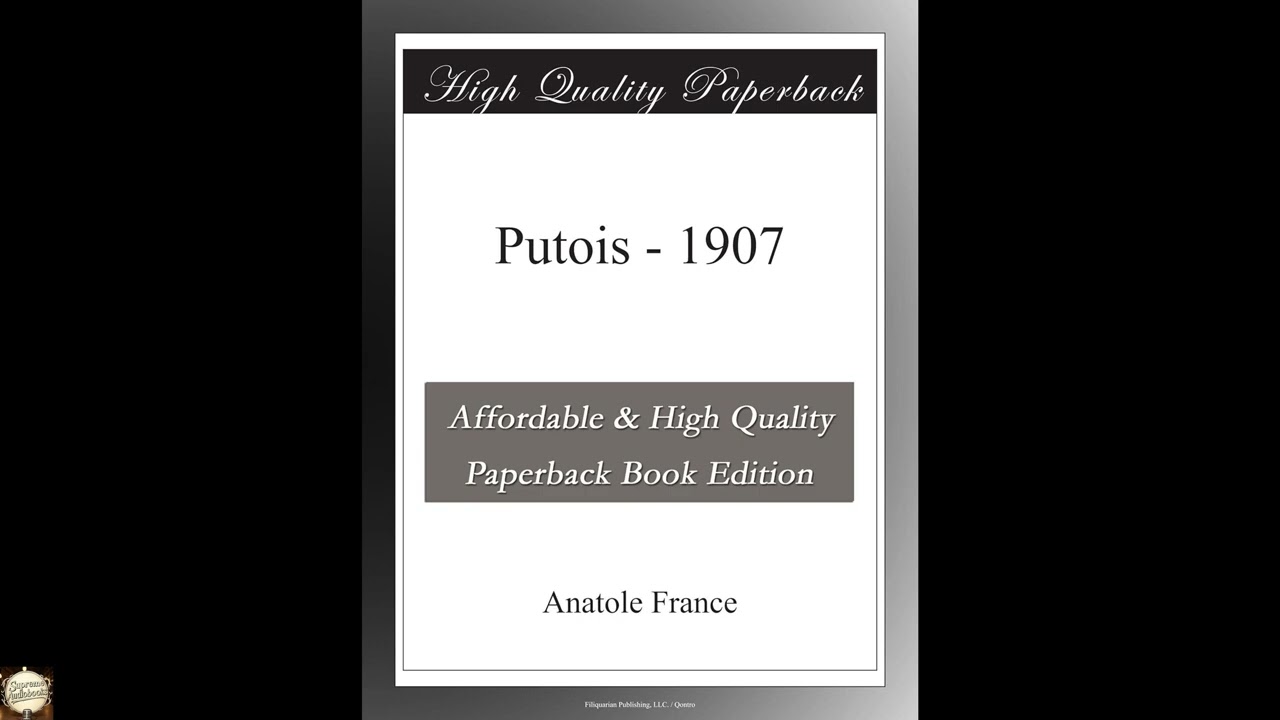
Putois - 1907
What happens when a fictional character, born from a playful whim, takes on a life of its own, becoming more real than some actual people? This is the central, delightfully unsettling question posed by Anatole France’s witty novella, Putois, first published in 1907. Far more than a whimsical tale, this brief but potent work by a Nobel laureate offers a sharp, satirical mirror to our own credulous natures, our collective need for narrative, and the often-fragile boundary between truth and fabrication. In an age saturated with misinformation and the rapid spread of invented realities, Putois stands as an eerily prescient examination of how easily a non-existent entity can become an undisputed fact, making it a story as relevant today as it was over a century ago. It’s an intellectual comedy that invites listeners to question the very foundations of what they believe to be true. The story unfolds within the comfortable, intellectual milieu of a Parisian household during the Belle Époque. Our main entry point into this world is Monsieur Bergeret, a philosopher and professor whose mind is often occupied with abstract thought, sometimes to the detriment of observing the mundane realities around him. His daughter, Pauline, possesses a more lively and imaginative spirit, and it is her innocent mischief that sets the whole curious chain of events in motion. When faced with the prospect of needing a new tutor, Pauline and her friend, Suzanne, concoct a scheme to deter this inconvenience. In a moment of spontaneous invention, they fabricate a potential candidate, a man named "Putois," describing him with vague but memorable characteristics—a sort of eccentric, unreliable, and ultimately unsuitable individual. What begins as a simple, youthful ruse quickly spirals into something far more complex and unexpected. As Pauline and Suzanne continue to speak of Putois, refining his fictitious traits and inventing anecdotes, others in their social circle begin to "recall" him, to attribute actions to him, and even to claim to have encountered him. The non-existent Putois gains a surprising degree of substance, not through any physical manifestation, but purely through the power of collective imagination and conversational reinforcement. Monsieur Bergeret, ever the logician, finds himself bewildered and increasingly frustrated as this phantom tutor becomes undeniably "real" in the minds of his acquaintances, demonstrating the peculiar way human belief can construct its own reality, often impervious to rational argument. The narrative follows the amusing and subtly alarming expansion of Putois's legend, watching as a minor invention balloons into a recognized social figure, demonstrating how quickly a myth can take root and flourish. The author behind this clever examination of human credulity was François-Anatole Thibault, better known by his pen name, Anatole France. Born in Paris in 1844, the son of a bookseller, France was immersed in literature from a young age, surrounded by books and scholarly discourse. His career began modestly, first as a bibliographer and then as a librarian at the French Senate, positions that granted him ample time for reading and reflection. He started writing poetry and literary criticism, gradually gaining recognition for his elegant prose and skeptical intellect. France's literary output was prodigious, encompassing novels, short stories, plays, and essays, often characterized by irony, wit, and a profound understanding of human nature and history. His reputation solidified with works like The Crime of Sylvestre Bonnard, which earned him the Prix de l'Académie française, and continued with influential novels such as Thaïs, Penguin Island, and The Revolt of the Angels. France became a prominent public intellectual, famously taking a stand during the Dreyfus Affair, advocating for justice and truth, a stance that reflected his growing socialist sympathies and anti-clerical views. His distinctive style—a blend of classical erudition, philosophical skepticism, and a gentle, often melancholy, humanism—earned him the Nobel Prize in Literature in 1921, recognizing his "brilliant literary achievements, characterized as they are by nobility of style, profound human sympathy, grace, and a true Gallic temperament." He passed away in 1924, leaving behind a body of work that bridged the intellectual currents of the late 19th and early 20th centuries. At its core, Putois enacts several significant themes. Foremost among them is the nature of truth and reality, particularly the idea that reality can be socially constructed. Putois, the fictional tutor, exists solely because people believe he exists; their conversations and shared stories create his being, complete with specific characteristics and a backstory. We see this vividly when characters describe his "appearance" or "recount" his past actions, even though no such individual has ever graced their presence. Another prominent theme is the power of collective imagination and myth-making. The novella shows how easily humans invent narratives to fill gaps, even when those gaps could simply be left empty. Pauline's initial playful invention quickly gains momentum, demonstrating the human propensity to elaborate upon an appealing falsehood rather than confront an inconvenient truth. Furthermore, France keenly observes social conformity and credulity. People are often inclined to accept information if it comes from within their social circle or if it aligns with their existing beliefs, even without solid evidence. The way Monsieur Bergeret's acquaintances, despite their intellectual pretensions, gradually fall prey to the Putois myth underscores how easily individuals can be swayed by group consensus. Finally, the story serves as a gentle satire of academia and intellectualism. Monsieur Bergeret, the philosopher, finds his logical frameworks completely inadequate to deal with the illogical yet undeniable "reality" of Putois. His rational attempts to dismantle the myth are consistently frustrated, highlighting the disconnect between abstract reason and the often irrational, narrative-driven impulses of human society. Anatole France published Putois in 1907, a period nestled within the Belle Époque in France, a time of relative peace and prosperity, marked by significant cultural efflorescence and rapid societal change. Yet beneath the veneer of progress and optimism, there were profound anxieties and shifts. Scientific advancements were challenging traditional worldviews, industrialization was reshaping daily life, and the growth of mass media was beginning to transform how information and ideas spread. France himself had been deeply involved in the Dreyfus Affair around the turn of the century, a scandal that exposed deep divisions in French society and the alarming ease with which prejudice and manufactured evidence could manipulate public opinion. This experience undoubtedly deepened his skepticism about official narratives and the fragility of truth, insights that strongly resonate in Putois. Literarily, this era saw the waning of Naturalism and Symbolism, with new modernist experiments on the horizon. France, while rooted in classical French literary tradition, offered a distinctive, critical voice. His elegant prose and ironic perspective provided a sophisticated commentary on human foibles and societal institutions. Putois thus emerges from a cultural moment grappling with the power of persuasion, the construction of identity, and the blurring lines between fact and fiction—themes that, far from being confined to its specific historical context, speak powerfully to the enduring questions of how we perceive and create our shared realities. Listening to Putois as an audiobook offers a unique opportunity to appreciate its subtle humor and profound observations. The conversational nature of the narrative, filled with dialogue and internal musings, lends itself perfectly to vocal interpretation. A skilled narrator can bring out the distinct personalities of Monsieur Bergeret, with his often-distracted intellectualism, Pauline's youthful imagination, and the various, increasingly convinced voices of their acquaintances. The pacing of the story, as the legend of Putois slowly but surely builds, can be artfully conveyed through vocal rhythm and emphasis, allowing listeners to fully immerse themselves in the unfolding absurdity. Pay attention to the shifts in tone, from initial skepticism to eventual, firm conviction, in the character voices. The run length of several hours makes it an ideal choice for a focused afternoon listen, a series of commutes, or as a thoughtful companion on a long walk, allowing the listener to truly savor Anatole France's elegant prose and enduring insights into the human condition.
Enjoyed Putois - 1907? A few ways to support us
Audible & Amazon links are affiliate; we may earn a small commission at no extra cost.
About this production
Human narration by a volunteer reader from LibriVox.org, the public-domain audiobook project. LibriVox volunteers record literary works whose copyright has expired in the United States, releasing the resulting recordings into the public domain.
Putois - 1907 by Anatole France. The underlying text is in the U.S. public domain. We do not republish any modern copyrighted edition, translation, or commentary.
The 4K cinematic visuals accompanying this audiobook are generated by an AI image model from prompts derived from the source text. No copyrighted photos, paintings, or stock footage are used. AI generation is disclosed on every video on our YouTube channel as required by YouTube's altered/synthetic content policy.
English subtitles are transcribed from the LibriVox recording with OpenAI Whisper. Translations into the 11 other supported languages are produced by Meta's NLLB-200 neural translation model. No human translator's copyrighted translation is used.
Questions about sourcing or rights? See our DMCA & Sourcing policy or contact us.
Enjoyed this audiobook?
If you'd like to own a copy of Putois - 1907 or hear a professionally produced edition, the links below help support free audiobook production at no extra cost to you.
As an Amazon Associate we earn from qualifying purchases. Audible / print links are affiliate.