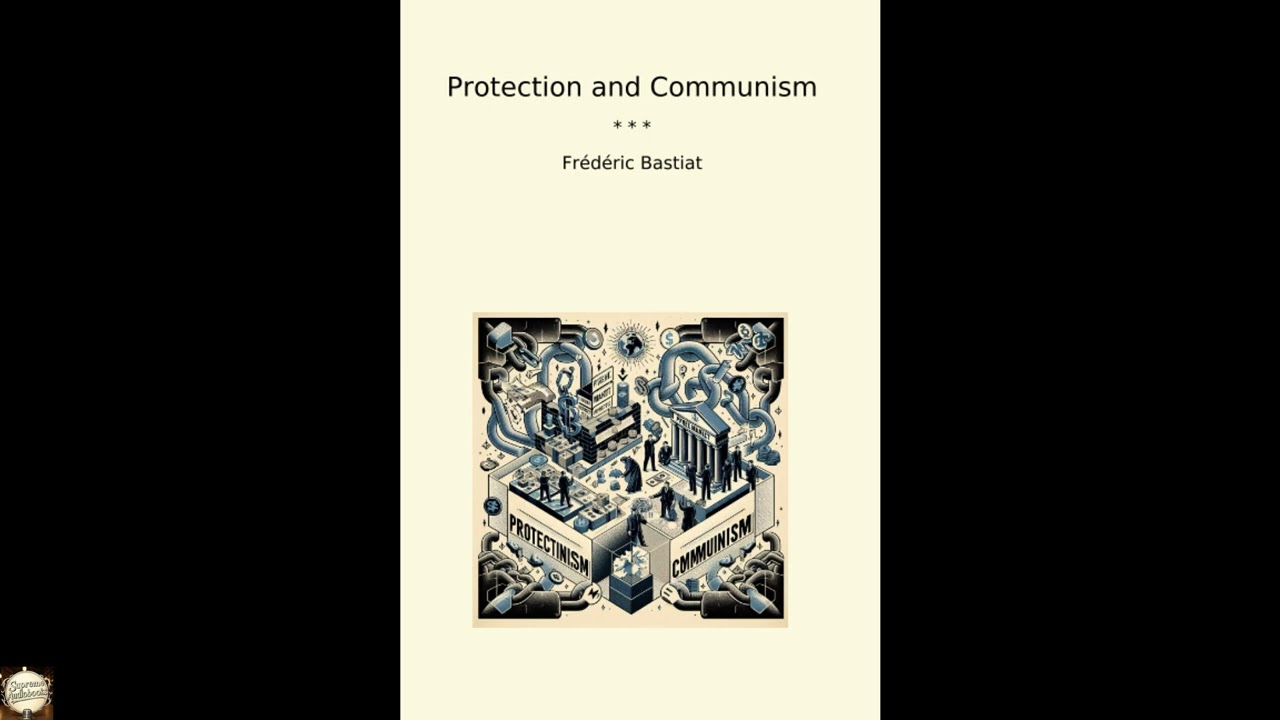
Protection and Communism
In an age of persistent debate over economic fairness, government intervention, and the balance between individual liberty and collective well-being, Frédéric Bastiat's Protection and Communism speaks with startling clarity. This profound intellectual work, though penned nearly two centuries ago, offers a powerful, concise critique of policies and philosophies that remain fiercely contested in our own time. It is a vital examination of foundational economic principles, challenging listeners to look beyond immediate appearances and understand the true, often hidden, consequences of state action. For anyone seeking to grasp the enduring arguments for free markets and the pitfalls of central planning, Bastiat's incisive analysis provides not just historical context but a framework for navigating contemporary economic challenges. Bastiat's work unfolds as a compelling intellectual drama, with the keen mind of the author serving as its protagonist, engaging directly with the prevailing economic philosophies of his era. The setting is mid-19th century France, a nation reeling from the upheavals of industrialization, political instability, and the fervent emergence of new social doctrines. Against this backdrop, Bastiat sets out to illuminate the inherent flaws and ultimate dangers of two seemingly disparate yet fundamentally connected economic systems: government-imposed protectionism and the burgeoning ideas of state-managed communism. He posits that both, despite their differing scales and professed intentions, ultimately sacrifice individual liberty and prosperity for a perceived collective good, representing two sides of a similar coin. The central conflict within Protection and Communism stems from Bastiat's systematic dismantling of these systems' intellectual foundations. He begins by challenging the popular notion that tariffs and trade barriers truly "protect" domestic industries and workers. Through ingenious allegories, such as the famous petition from the candlemakers asking for protection from the sun, and rigorous logic, he exposes how such measures invariably benefit a small, politically favored few at the expense of the vast majority of consumers. These policies, he argues, stifle innovation, distort natural market forces, and ultimately hinder overall economic growth. He then pivots his critical gaze to confront the more radical proposals of communism, which sought to reorganize society through collective ownership and state control of production. Here, the struggle is even more fundamental: a clash between the sanctity of private property and individual choice against the utopian visions of a centrally planned, egalitarian society. The book’s progression leads listeners through a landscape of policy debates, revealing how seemingly benevolent intentions can pave the way for unintended and detrimental consequences, building a robust case for individual liberty as the cornerstone of prosperity. Frédéric Bastiat, born in Bayonne, France, in 1801, was a self-taught economist, statesman, and eloquent advocate for classical liberalism. Orphaned at a young age, he inherited and managed a family estate in Mugron, where his keen observations of everyday economic life fueled his intellectual pursuits. It was not until the 1840s that he began writing extensively, quickly gaining recognition for his lucid prose and sharp wit. His short but impactful career saw him elected to the French National Assembly, where he tirelessly championed free trade and limited government. Sadly, his life was cut short by tuberculosis, and he passed away in Rome in 1850, leaving behind a profound legacy. Bastiat's other celebrated works, such as Economic Sophisms, The Law, and What is Seen and What is Not Seen, continue to shape discussions on political economy. He stands as a pivotal figure in the French liberal school, alongside thinkers like Jean-Baptiste Say, and his writings remain foundational texts for classical liberal, libertarian, and Austrian economic traditions. His unique ability to distill complex economic theories into accessible, often humorous, arguments earned him a lasting place in the canon of economic thought, influencing generations of thinkers who champion individual freedom and market principles. Among the several enduring themes woven throughout Protection and Communism, economic liberty stands paramount. Bastiat champions the freedom of individuals to produce, trade, and consume without undue government interference. He illustrates this with sharp contrasts, showing how tariffs, ostensibly designed to shield domestic industries, actually penalize consumers and distort natural market forces, ultimately harming the broader economy. His famed critique of protective tariffs, arguing that they protect politically powerful producers at the expense of ordinary citizens, remains a powerful example of this commitment to freedom. Another central theme is "The Seen and the Unseen," a concept for which Bastiat is justifiably renowned. He insists that sound economic understanding requires looking beyond immediate, obvious effects – what he calls "the seen" – to the less obvious, often negative, long-term consequences – "the unseen" – of government actions. He demonstrates this by dissecting policies like public works projects or subsidies, showing how the visible jobs created are often offset by the invisible opportunities and wealth destroyed elsewhere in the economy due to taxation or diversion of resources. His work also fundamentally addresses the role of government, advocating for a strictly limited state focused on protecting individual rights and enforcing contracts, rather than intervening in economic affairs or attempting to redistribute wealth through coercive means. This opposition to coercion forms the bedrock of his arguments against both protectionism and the socialist ideals of his time. Bastiat's seminal arguments arose from a period of intense societal flux in mid-19th century France. The Industrial Revolution was rapidly transforming the nation's economy and social structure, leading to significant wealth disparities and the rise of a powerful working class. Politically, France was volatile, experiencing the twilight of the July Monarchy, the tumultuous Revolution of 1848, and the subsequent establishment of the Second Republic, only to be followed by the rise of Napoleon III. It was a time when protectionist trade policies were commonplace across Europe, and the nascent ideas of socialism and communism, articulated by thinkers like Fourier, Saint-Simon, and later Marx and Proudhon, were gaining traction amidst social unrest. Bastiat was an active participant in these debates, using his clear, persuasive writing to counter the prevailing economic nationalism and the burgeoning calls for state control, emerging as a leading voice for individual liberty and free trade in a continent grappling with unprecedented change. Listening to Protection and Communism as an audiobook offers a uniquely immersive experience, allowing Bastiat's precise logic and dry wit to truly come alive. A clear, articulate narration guides you through the complexities of his arguments, ensuring his sometimes subtle distinctions are fully appreciated. With a run length of several hours, this allows for either focused, in-depth listening sessions or absorption during daily activities like commuting or household chores. Listen for the careful pacing of the narration, which allows Bastiat's arguments to build sequentially, drawing the listener naturally from premise to conclusion. A thoughtful voice enhances the persuasive power of the text, particularly as Bastiat constructs his imaginative allegories or engages in rhetorical exchanges with his intellectual opponents, bringing a sense of vital, ongoing debate to a work that remains remarkably pertinent today.
Enjoyed Protection and Communism? A few ways to support us
Audible & Amazon links are affiliate; we may earn a small commission at no extra cost.
About this production
Human narration by a volunteer reader from LibriVox.org, the public-domain audiobook project. LibriVox volunteers record literary works whose copyright has expired in the United States, releasing the resulting recordings into the public domain.
Protection and Communism by Frédéric Bastiat. The underlying text is in the U.S. public domain. We do not republish any modern copyrighted edition, translation, or commentary.
The 4K cinematic visuals accompanying this audiobook are generated by an AI image model from prompts derived from the source text. No copyrighted photos, paintings, or stock footage are used. AI generation is disclosed on every video on our YouTube channel as required by YouTube's altered/synthetic content policy.
English subtitles are transcribed from the LibriVox recording with OpenAI Whisper. Translations into the 11 other supported languages are produced by Meta's NLLB-200 neural translation model. No human translator's copyrighted translation is used.
Questions about sourcing or rights? See our DMCA & Sourcing policy or contact us.
Enjoyed this audiobook?
If you'd like to own a copy of Protection and Communism or hear a professionally produced edition, the links below help support free audiobook production at no extra cost to you.
As an Amazon Associate we earn from qualifying purchases. Audible / print links are affiliate.
More by Frédéric Bastiat
More Audiobooks
Manifest der Kommunistischen Partei Manifesto of the Communist Party
Essays on Political Economy
Dictatorship Vs: Democracy (Terrorism and Communism) a Reply to Karl Kautsky, By Le
A Letter to the Society for the Suppression of Vice, on Their Malignant Efforts to P- Full Audiobook