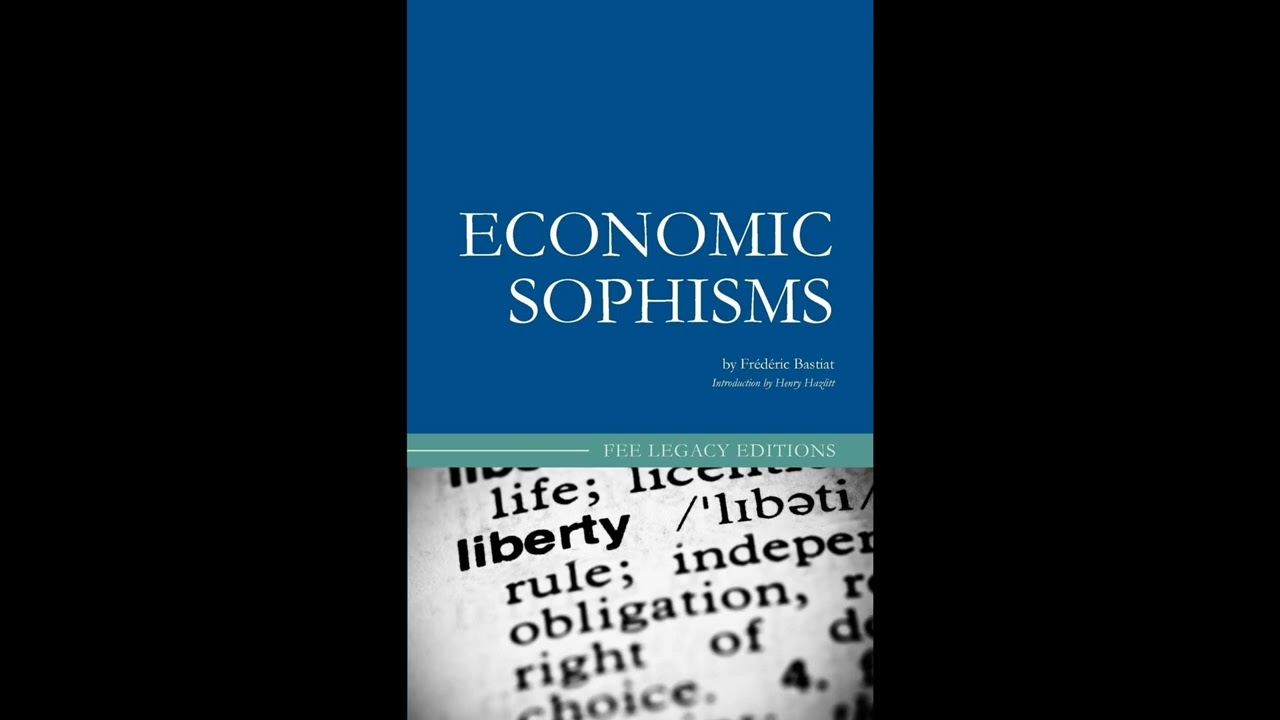
Economic Sophisms
Imagine a world where powerful interest groups routinely persuade governments to adopt policies detrimental to the general public, all under the guise of progress or protection. A world where complex economic arguments are distilled into misleading slogans, blinding citizens to the real costs of intervention. Does this sound familiar? It should, because this has been a recurring human drama for centuries, and it is precisely the landscape Frédéric Bastiat dissects with surgical precision in his incisive collection, Economic Sophisms. Far from a dusty relic, this compendium of short, witty essays and parables remains remarkably relevant today, offering a crucial framework for understanding persistent economic misunderstandings and the often-hidden motives behind political maneuvering. It serves as a potent antidote to common fallacies, equipping listeners with the clarity needed to discern sound policy from self-serving rhetoric, making it an essential listen for anyone seeking to make sense of contemporary economic debates. Economic Sophisms is not a conventional story with a single overarching narrative, but rather a series of brilliant intellectual vignettes, each acting as a miniature play designed to expose a specific economic fallacy. Bastiat casts an array of archetypal characters: the earnest but misguided politician, the self-interested manufacturer, the beleaguered consumer, and the ingenious inventor whose progress is often thwarted. The central conflict in each piece arises from the clash between superficial appearances and underlying realities, between immediate, visible benefits and long-term, unseen costs. For instance, in one unforgettable piece, Bastiat imagines a petition from candlemakers, lamplighters, and all producers of light, who demand legislative action to "exclude light from the sun." Their argument? That blocking out sunlight would stimulate domestic industry, create jobs, and boost the economy by increasing demand for artificial illumination. Another illustrative "scene" involves the famous "broken window" observation. A boy breaks a shop window. The onlookers lament the damage but then reason that this act will stimulate the economy by requiring the glazier to work, who will then spend his earnings, and so on. Bastiat meticulously unwraps this logic, demonstrating that while the glazier benefits, the shopkeeper has lost the money he would have spent on something else – a suit, a book – thus illustrating the unseen opportunity cost. The structure of the collection allows Bastiat to systematically dismantle a wide range of popular protectionist arguments, from tariffs designed to "save jobs" to government subsidies intended to "promote national industry." Each essay presents a distinct scenario, often using irony and humor to highlight the absurdity of the underlying fallacies, creating an experience that is both intellectually rigorous and surprisingly entertaining, ultimately building a robust understanding of free-market principles without ever resorting to dry academic jargon. Frédéric Bastiat, a towering figure in the French liberal tradition, lived a life marked by intellectual fervor and political engagement. Born in Bayonne, France, in 1801, Bastiat's early life was one of study and rural administration, but it was not until the 1840s that his ideas began to truly ignite public discourse. He inherited an estate in Mugron, where he cultivated a deep understanding of local economics and agricultural practices, fostering his commitment to free trade. Bastiat's intellectual awakening coincided with the rise of the English Anti-Corn Law League, and he was profoundly influenced by the arguments of Richard Cobden, dedicating himself to similar advocacy in France. Despite his relatively short public career, Bastiat's influence proved immense. He was elected to the French National Assembly in 1848, serving as a deputy, where he actively championed free-market policies and opposed socialist tendencies emerging in the wake of the 1848 revolution. He published the first series of Economic Sophisms in 1845 and the second in 1848, gaining widespread recognition for his clear, persuasive writing style. His other notable works, The Law (1850) and Harmonies Économiques (1850), further elaborated on his philosophy of individual liberty, limited government, and the natural harmony of economic interests. Tragically, Bastiat's life was cut short by tuberculosis; he passed away in Rome in 1850, at the age of 49, leaving behind a legacy as one of history's most articulate defenders of economic freedom and a progenitor of what would become known as the Austrian School of economics. The enduring power of Economic Sophisms lies in its ability to illuminate fundamental economic principles through compelling, relatable scenarios. One key theme Bastiat relentlessly champions is the distinction between "what is seen and what is not seen," or as it's often termed, opportunity cost. His work repeatedly emphasizes that every economic choice involves sacrificing an alternative, and wise policy must account for these hidden costs. For example, when he discusses government expenditures, he doesn't just look at the jobs created by a public project (what is seen), but also at the jobs and consumer goods that would have been funded by the tax money had it remained in private hands (what is not seen). This crucial insight forms the bedrock of much of his argumentation. Another prominent theme is the defense of free trade against the siren song of protectionism. Bastiat systematically dismantles arguments for tariffs, subsidies, and import restrictions, showing how they enrich specific producers at the expense of the broader consuming public and hinder overall prosperity. His satirical pieces, like the candlemakers' petition, brilliantly expose the absurdity of protectionist logic, showing how it invariably leads to self-defeating outcomes. Furthermore, Bastiat consistently advocates for individual liberty and limited government intervention, portraying government as a necessary but often overreaching institution whose attempts to "organize" society often result in unintended consequences and infringements on freedom. His writing acts as a powerful reminder that complex problems rarely have simple, centralized solutions. Bastiat's ideas emerged during a period of intense economic and political transformation in France and across Europe. The mid-19th century was characterized by the ongoing Industrial Revolution, which brought both immense progress and significant social upheaval. Debates raged over the role of the state in a rapidly changing economy, the proper scope of individual freedom, and the merits of protectionist trade policies versus increasingly popular calls for free trade. France, in particular, was experiencing frequent political instability, transitioning between monarchies, empires, and republics, culminating in the revolutions of 1830 and 1848. Against this backdrop of industrialization, political turmoil, and nascent socialist thought, Bastiat stood out as a clear voice for classical liberalism. He was actively engaged in the French free-trade movement, often in direct opposition to powerful agricultural and manufacturing interests that sought government protection. His writings were a direct response to the prevalent economic illiteracy and the prevailing sentiment that government intervention was the solution to economic woes. Economic Sophisms was not just an academic treatise; it was a potent weapon in the intellectual and political battles of its time, designed to educate the public and persuade legislators towards policies of peace and prosperity. Listening to Economic Sophisms as an audiobook offers a unique and highly effective way to absorb Bastiat's insights. The collection's episodic nature, with each "sophism" often presented as a standalone essay or dialogue, lends itself perfectly to segments of focused listening, whether during a commute, a walk, or while engaging in daily tasks. A skilled narrator brings Bastiat's sharp wit and often theatrical presentation to life, making the logical dismantling of fallacies all the more impactful. The subtle irony and conversational tone that define Bastiat's writing truly shine when heard, allowing listeners to fully appreciate the rhetorical brilliance behind his arguments. The concise arguments, delivered with clarity and often a touch of humor through a well-modulated voice, allow the listener to ponder each point before moving on, ensuring that the critical distinction between what is seen and what is unseen truly resonates.
Enjoyed Economic Sophisms? A few ways to support us
Audible & Amazon links are affiliate; we may earn a small commission at no extra cost.
About this production
Human narration by a volunteer reader from LibriVox.org, the public-domain audiobook project. LibriVox volunteers record literary works whose copyright has expired in the United States, releasing the resulting recordings into the public domain.
Economic Sophisms by Frédéric Bastiat. The underlying text is in the U.S. public domain. We do not republish any modern copyrighted edition, translation, or commentary.
The 4K cinematic visuals accompanying this audiobook are generated by an AI image model from prompts derived from the source text. No copyrighted photos, paintings, or stock footage are used. AI generation is disclosed on every video on our YouTube channel as required by YouTube's altered/synthetic content policy.
English subtitles are transcribed from the LibriVox recording with OpenAI Whisper. Translations into the 11 other supported languages are produced by Meta's NLLB-200 neural translation model. No human translator's copyrighted translation is used.
Questions about sourcing or rights? See our DMCA & Sourcing policy or contact us.
Enjoyed this audiobook?
If you'd like to own a copy of Economic Sophisms or hear a professionally produced edition, the links below help support free audiobook production at no extra cost to you.
As an Amazon Associate we earn from qualifying purchases. Audible / print links are affiliate.