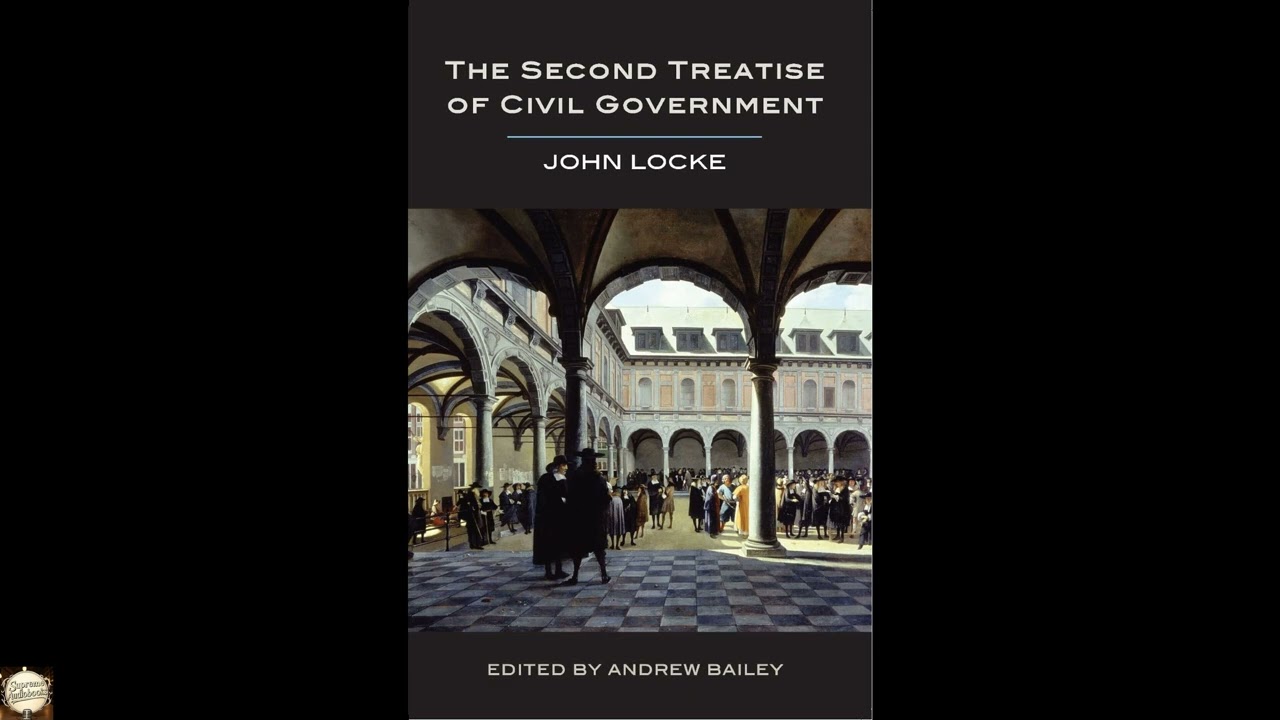
The Second Treatise of Civil Government
Imagine a world where the very foundations of government and individual liberty are called into question, where the rights you assume you possess are subject to fierce debate, and the power of the state is either divinely ordained or flows from the consent of the governed. This was the intellectual battleground of the late 17th century, and at its heart stands John Locke's The Second Treatise of Civil Government. More than just a historical document, this profound work continues to shape our understanding of democracy, human rights, and the social contract. It’s a text that doesn’t merely document the past; it actively participates in the ongoing conversation about what makes a government legitimate and how society should protect the freedoms of its members, making it astonishingly relevant to today’s political landscape, from debates over constitutional power to the very nature of individual autonomy. Locke opens his rigorous argument by asking us to consider a hypothetical "state of nature," a condition where all individuals are perfectly free and equal, subject only to the law of nature. This law, discoverable through reason, dictates that no one ought to harm another in their life, health, liberty, or possessions. From this fundamental premise, he builds his case for how individuals come to acquire property through their labor, merging their effort with the common bounty of the earth to make something distinctly their own. He meticulously outlines the inconveniences of this state of perfect freedom – primarily, the lack of an impartial judge to resolve disputes and enforce the natural law. This potential for disorder, even within a framework of natural rights, becomes the impetus for the formation of civil society. The narrative of Locke’s argument then progresses to the crucial transition from this state of nature to a political society. Individuals, driven by the desire to secure their "property" – by which Locke means their lives, liberties, and estates – voluntarily agree to unite into a community. This agreement, or social contract, establishes a common government with the authority to make laws and resolve disputes. The power of this government is not absolute, however. It is strictly limited by the very purpose for which it was created: to protect the natural rights of its citizens. Locke then systematically details the structure and functions of such a government, distinguishing between legislative, executive, and federative powers, explaining how each operates and remains accountable to the people. He describes the careful balance necessary to prevent any single branch from becoming tyrannical, ensuring that government remains a servant, not a master, of the populace. John Locke, born in Wrington, Somerset, England, in 1632, was a figure whose life and philosophy profoundly influenced the course of Western thought. He received his education at Westminster School and Christ Church, Oxford, where he pursued studies that ranged from classics to medicine. His medical expertise brought him into the household of Anthony Ashley Cooper, the first Earl of Shaftesbury, a prominent Whig politician. This association proved pivotal, immersing Locke directly in the turbulent political currents of England during the Restoration period. His close involvement with Shaftesbury's political activities, which included advocating for religious toleration and parliamentary supremacy, ultimately led to Locke living in exile in the Netherlands for several years during the reign of James II. It was during this period of exile and immediately following the Glorious Revolution of 1688, which saw the deposition of James II and the ascension of William and Mary, that many of Locke’s most significant works were published. Upon his return to England in 1689, he became a central intellectual figure, publishing not only The Second Treatise but also An Essay Concerning Human Understanding, a cornerstone of empiricist philosophy, and A Letter Concerning Toleration. Locke's writings established him as a leading voice of the Enlightenment. He is widely regarded as the "Father of Liberalism," his ideas laying the groundwork for modern political philosophy and profoundly shaping the intellectual climate that inspired the American and French Revolutions. He passed away in 1704, but his conceptual architecture for government by consent and the inherent rights of individuals remains a powerful legacy. At its core, The Second Treatise of Civil Government enacts several powerful themes that resonate across centuries. One central idea is that of natural rights, asserting that individuals possess inherent rights to life, liberty, and property that predate and supersede any government. For example, Locke's opening chapters detail how, even in the "state of nature," individuals are not free to do whatever they wish, but are bound by a natural law, discoverable by reason, that forbids harming another in these fundamental aspects. Another key theme is government by the consent of the governed. Locke argues that legitimate political authority can only arise from the voluntary agreement of the people it rules. He explicitly states that no one can be subjected to the political power of another without their own consent, illustrating this when he explains the formation of civil society as a deliberate act where individuals agree to form a community and submit to its laws for their mutual preservation. Furthermore, the work champions the concept of limited government, maintaining that the power of the state is not absolute but constrained by its original purpose: to protect the rights of its citizens. This is clearly demonstrated in Locke's discussion of the legislative power, which, despite being supreme within the government, cannot rule arbitrarily, cannot transfer its law-making authority, and cannot take property without the consent of the people. Finally, the text lays the theoretical groundwork for the right of revolution. Locke asserts that if a government acts contrary to the trust placed in it by the people – for instance, by attempting to rule absolutely or by infringing upon their fundamental rights – the people have the right to dissolve that government and establish a new one. This idea is powerfully presented when he outlines various scenarios where a government might forfeit its power, such as when it oversteps its legislative authority or subjects the people to arbitrary power, effectively placing itself in a state of war with its own citizens. This groundbreaking work emerged from a period of profound political upheaval in England. The late 17th century was marked by ongoing tensions between the Crown and Parliament, debates over religious toleration, and the looming threat of absolute monarchy. King Charles II and his successor, James II, were seen by many as attempting to assert a divine right to rule, challenging the growing power of Parliament and the established liberties of Englishmen. Philosophers like Sir Robert Filmer had advanced strong arguments for the absolute authority of kings, based on a patriarchal model derived from biblical tradition. Locke’s treatise was written directly as a counter-argument to such views, particularly Filmer's Patriarcha, which it systematically refutes. Published shortly after the Glorious Revolution of 1688, a bloodless coup that saw James II deposed and the establishment of a constitutional monarchy under William and Mary, The Second Treatise provided the theoretical justification for this momentous event, arguing that the people had a legitimate right to resist and replace a government that had violated their trust and fundamental rights. Engaging with such a foundational text as The Second Treatise of Civil Government through an audiobook format offers unique advantages. A skilled narrator can bring clarity and accessibility to Locke's carefully constructed arguments, distinguishing between subtle philosophical points and guiding the listener through the text's intricate logical progression. Over its several hours of run length, a thoughtful narration can help maintain focus, allowing the listener to absorb complex ideas at a comfortable pace without the potential distractions of visual text. The narrator's voice, pacing, and emphasis can highlight key concepts, clarify distinctions, and underscore the rhetorical force of Locke’s prose, making the process of understanding his vision of a just government a more immersive and less daunting experience. It allows for deep listening, transforming what could be a challenging read into an enlightening intellectual experience, whether you are listening during a focused study session or while attending to other tasks.
Enjoyed The Second Treatise of Civil Government? A few ways to support us
Audible & Amazon links are affiliate; we may earn a small commission at no extra cost.
About this production
Human narration by a volunteer reader from LibriVox.org, the public-domain audiobook project. LibriVox volunteers record literary works whose copyright has expired in the United States, releasing the resulting recordings into the public domain.
The Second Treatise of Civil Government by John Locke. The underlying text is in the U.S. public domain. We do not republish any modern copyrighted edition, translation, or commentary.
The 4K cinematic visuals accompanying this audiobook are generated by an AI image model from prompts derived from the source text. No copyrighted photos, paintings, or stock footage are used. AI generation is disclosed on every video on our YouTube channel as required by YouTube's altered/synthetic content policy.
English subtitles are transcribed from the LibriVox recording with OpenAI Whisper. Translations into the 11 other supported languages are produced by Meta's NLLB-200 neural translation model. No human translator's copyrighted translation is used.
Questions about sourcing or rights? See our DMCA & Sourcing policy or contact us.
Enjoyed this audiobook?
If you'd like to own a copy of The Second Treatise of Civil Government or hear a professionally produced edition, the links below help support free audiobook production at no extra cost to you.
As an Amazon Associate we earn from qualifying purchases. Audible / print links are affiliate.