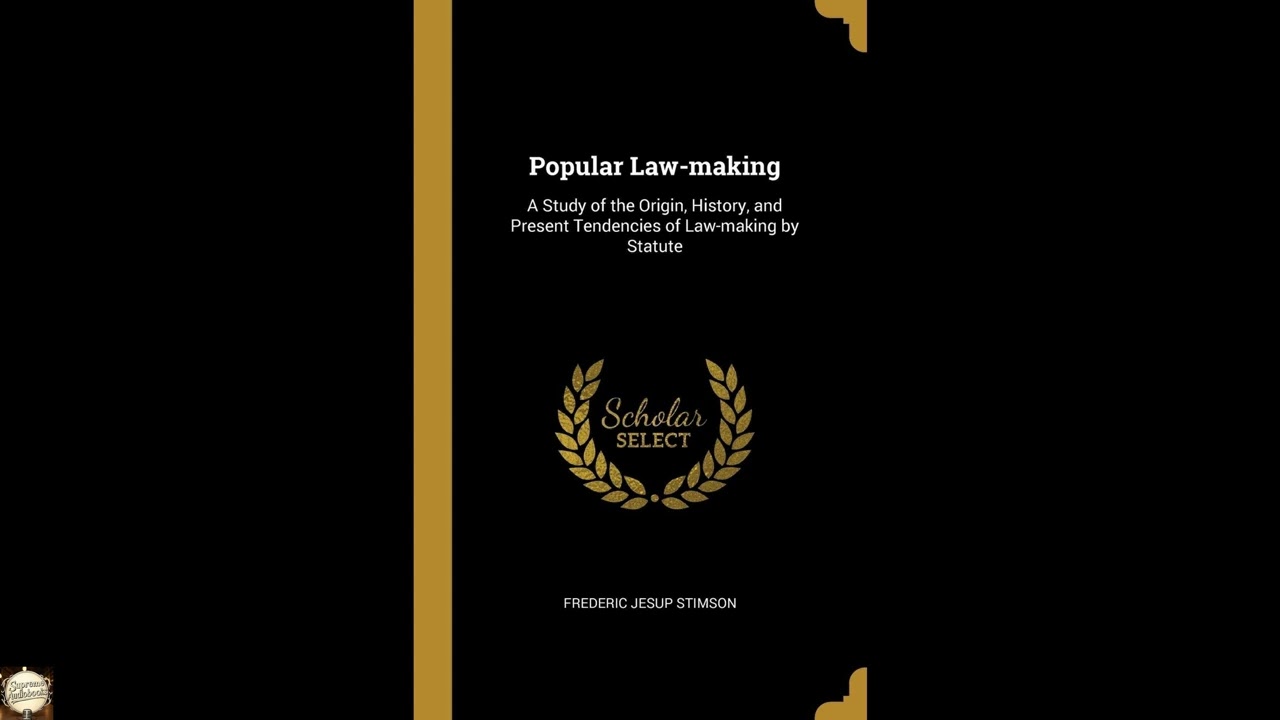
Popular Law-making: A Study of the Origin, History, and Present Tendencies of Law
Every society lives by a code, a complex web of rules and norms that govern behavior, resolve disputes, and shape our very understanding of justice. Yet, how often do we truly consider where these laws come from, how they’ve evolved over millennia, and the powerful, sometimes subtle, forces that continue to shape them? "Popular Law-making: A Study of the Origin, History, and Present Tendencies of Law" is a monumental examination that strips away the mystique from legal systems, revealing them not as immutable dictates handed down from on high, but as living, breathing constructs born from human ingenuity, conflict, and societal need. This profound work invites us to understand the dynamic relationship between a people and the principles by which they govern themselves, offering an indispensable lens through which to view not only ancient civilizations but also the most pressing legal debates of our own time. It is a foundational text for anyone seeking to grasp the fundamental architecture of human civilization and the ongoing saga of self-governance. The book unfurls its ambitious panorama by first taking us back to the earliest glimmerings of organized society, when law emerged from custom and tribal practice. We witness the gradual codification of unwritten traditions, the first attempts to set down universal principles that transcended individual whims. From these primordial beginnings, the study meticulously traces the development of legal thought and practice through various epochs. It navigates the profound impact of ancient empires, examining how formidable legal frameworks like those of Rome shaped vast territories and influenced subsequent civilizations for centuries. The narrative progresses through the intricacies of feudal systems, where law was often fragmented and localized, reflecting the decentralized power structures of the age. As the historical narrative advances, we observe the transformative period of the Enlightenment and its profound re-evaluation of human rights and governmental authority. Here, the concept of law-making begins its decisive shift from the sole prerogative of monarchs or religious institutions to a more broadly distributed, and eventually, popular, undertaking. The core intellectual challenge the text grapples with is the tension between law as an instrument of control—a top-down imposition—and law as an expression of a community’s collective will and aspirations. The arc of this historical study culminates in an insightful analysis of modern legal trends, particularly the increasing emphasis on democratic processes, public opinion, and the direct participation of citizens in the creation and amendment of their own laws. It carefully outlines how the "popular" element has grown in prominence, weighing its strengths against its potential vulnerabilities without revealing the ultimate conclusions. This scholarly work stands as a testament to diligent research and intellectual synthesis, drawing together a vast array of historical and philosophical strands to form a coherent, compelling argument. Though the specific hand that penned these words remains veiled by time, the sheer breadth and depth of the material suggest an author steeped in legal history, political theory, and the social sciences of their era. The very anonymity of the author, far from diminishing the work, elevates it, allowing the arguments and observations to stand on their own merit, untethered to personal biography or literary renown. This is a classic of legal scholarship, emerging from a period when scholars sought to systematize knowledge and understand the grand narratives of human institutional development. It is a work that has earned its place not through the celebrity of its creator, but through the enduring power and relevance of its ideas, serving as a cornerstone for subsequent studies in comparative law and political science. One of the central themes that resonates throughout the pages is the evolutionary nature of legal systems. The author consistently demonstrates that law is not static; it is a dynamic, adaptive response to changing social, economic, and political conditions. For instance, the text might illustrate how the simple customary laws of early agricultural communities gave way to more complex property laws as societies became more settled and wealth accumulation became a factor. Another significant idea conveyed is the ongoing struggle for popular sovereignty in law-making. The study meticulously details instances where the will of the people, however expressed—through petitions, rebellions, or electoral reforms—has incrementally challenged and ultimately reshaped the authority structures that create and enforce law. Consider how the book might contrast the absolute decrees of a pharaoh with the nuanced debates and legislative processes of a modern parliament, showing a clear, if sometimes circuitous, trajectory towards greater public input. A third prominent theme is the interplay between law and morality. The work frequently examines how societal values, ethical considerations, and evolving concepts of justice are codified, or sometimes contested, within legal frameworks. It might present the historical shift from retribution-focused justice to more rehabilitative ideals as an example of this dynamic. Finally, the study subtly highlights the universal impulse for order and predictability that underpins all legal systems, regardless of their specific manifestations. Whether it’s an ancient code outlining punishments for theft or a contemporary statute regulating international trade, the fundamental human need for established rules to facilitate interaction and prevent chaos is a constant thread woven throughout this comprehensive historical survey. These ideas are not merely presented; they are illuminated through historical examples, theoretical discussions, and logical progression, allowing the listener to grasp the profound implications of each concept. This monumental study likely emerged during a period of intense intellectual ferment, possibly in the late nineteenth or early twentieth century. This era witnessed a profound re-examination of institutions, driven by rapid industrialization, burgeoning democratic movements, and a burgeoning interest in scientific and historical methods applied to social phenomena. It was a time when scholars sought grand unified theories to explain human progress and the development of civilization. The Progressive Era, in particular, with its focus on social reform, legal changes, and the expansion of democratic participation, would have provided fertile ground for a work dedicated to understanding the "popular" dimension of law-making. Such a book would have spoken directly to contemporary concerns about the role of the state, the rights of the individual, and the mechanisms by which a modern, complex society could govern itself fairly and effectively. It sought to provide historical context and intellectual grounding for the sweeping changes then underway, making sense of a world in rapid transformation. To experience "Popular Law-making" as an audiobook on SupremeAudiobooks.com is to allow its carefully constructed arguments to unfold at your own pace, guided by a skilled narrator. The several hours of listening time offer ample opportunity to absorb the intricate historical details and complex philosophical insights. A clear, measured voice is crucial for a work of such intellectual weight, ensuring that each historical transition, each theoretical point, lands with precision and clarity. You'll want to pay close attention to the subtle shifts in tone as the author moves from historical exposition to theoretical analysis, listening for the careful articulation of complex ideas that demand thoughtful consideration. This format allows the listener to engage with challenging concepts without the visual fatigue of a printed text, making it ideal for reflection during commutes, walks, or quiet evenings. The sustained duration encourages a deep, immersive engagement, turning what might otherwise be a daunting academic endeavor into an accessible and enlightening listening experience.
Enjoyed Popular Law-making: A Study of the Origin, History, and Present Tendencies of Law? A few ways to support us
Audible & Amazon links are affiliate; we may earn a small commission at no extra cost.
About this production
Human narration by a volunteer reader from LibriVox.org, the public-domain audiobook project. LibriVox volunteers record literary works whose copyright has expired in the United States, releasing the resulting recordings into the public domain.
Popular Law-making: A Study of the Origin, History, and Present Tendencies of Law by Frederic Jesup Stimson. The underlying text is in the U.S. public domain. We do not republish any modern copyrighted edition, translation, or commentary.
The 4K cinematic visuals accompanying this audiobook are generated by an AI image model from prompts derived from the source text. No copyrighted photos, paintings, or stock footage are used. AI generation is disclosed on every video on our YouTube channel as required by YouTube's altered/synthetic content policy.
English subtitles are transcribed from the LibriVox recording with OpenAI Whisper. Translations into the 11 other supported languages are produced by Meta's NLLB-200 neural translation model. No human translator's copyrighted translation is used.
Questions about sourcing or rights? See our DMCA & Sourcing policy or contact us.
Enjoyed this audiobook?
If you'd like to own a copy of Popular Law-making: A Study of the Origin, History, and Present Tendencies of Law or hear a professionally produced edition, the links below help support free audiobook production at no extra cost to you.
As an Amazon Associate we earn from qualifying purchases. Audible / print links are affiliate.