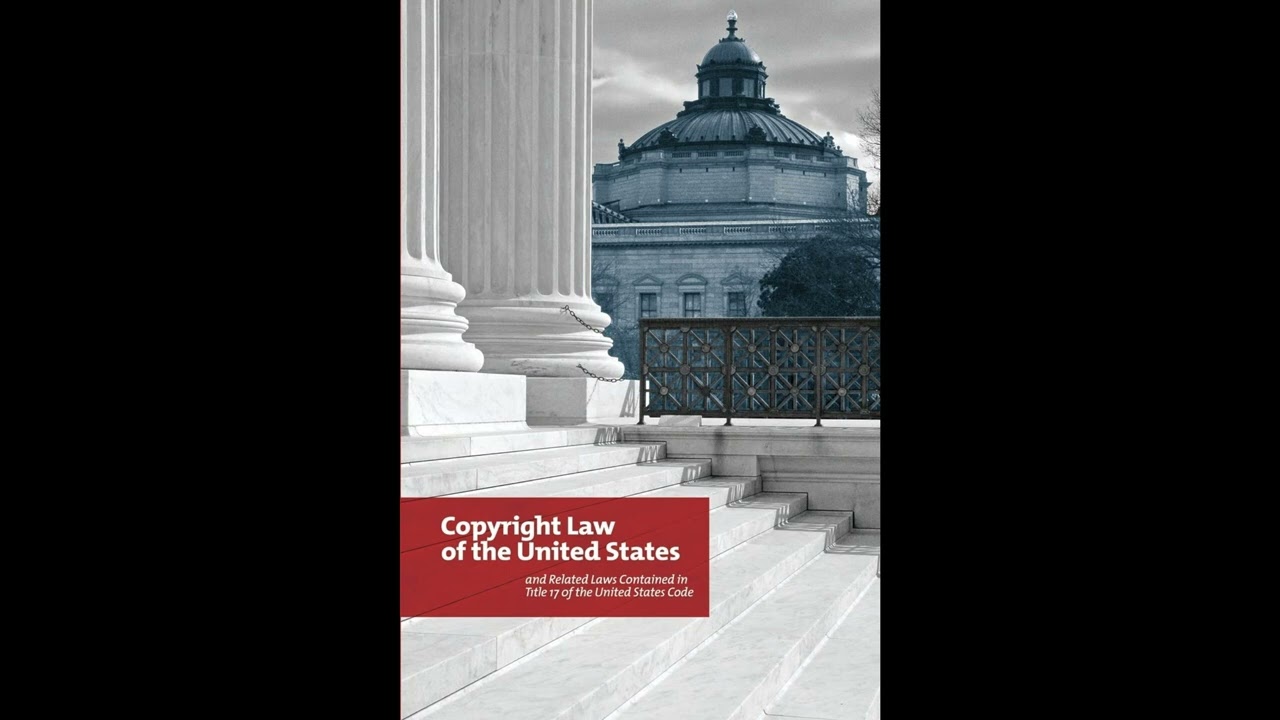
Copyright Law of the United States and Related Laws Contained in Title 17 of the Uni- Full Audiobook
What unseen threads weave together the boundless creativity of the human mind with the practicalities of commerce and ownership? How do we, as a society, foster innovation while ensuring artists and creators can earn a living from their work? The answer lies within the pages—or rather, the spoken words—of the foundational text known as Copyright Law of the United States and Related Laws Contained in Title 17 of the United States Code. Far from a mere dry legal document, this work represents the culmination of centuries of thought on intellectual property, acting as the invisible scaffolding that supports our modern cultural and technological landscape. Today, in an era defined by instantaneous digital sharing, streaming content, and user-generated media, understanding the principles articulated here is more crucial than ever for anyone who creates, consumes, or simply navigates the vast ocean of information and entertainment. This audiobook unveils the inherent drama within the legal framework governing original works of authorship. Its "setting" is the vast, often contentious arena where ideas are born, expressed, and then either celebrated, contested, or occasionally misappropriated. The "main characters" are not individuals in a traditional narrative sense, but rather archetypal roles: the diligent creator seeking just recompense, the innovative user building upon existing works, the aspiring entrepreneur navigating licensing, and the diligent public domain serving as a shared cultural commons. The central conflict within this overarching "story" is the perennial tension between the exclusive rights granted to creators—the incentive to produce—and the public’s need for access to knowledge and cultural heritage, which in turn fuels further creativity and progress. The arc of this "narrative" unfolds systematically, much like a well-constructed argument or a carefully plotted procedural drama. It begins by establishing the fundamental definitions: what precisely constitutes a "work of authorship" eligible for protection? When does copyright "attach" to a creation? From there, the text meticulously lays out the exclusive rights afforded to copyright holders—the right to reproduce, to distribute, to perform, to display, and to create derivative works. This progression builds a comprehensive picture of ownership. The "story" then shifts to the crucial boundaries of these rights, introducing concepts like "fair use," which acts as a vital counterpoint, allowing limited use of copyrighted material without permission for purposes such as criticism, commentary, news reporting, teaching, scholarship, or research. This intricate dance between rights and limitations forms the heart of the legal drama, guiding us through potential disputes and their resolutions without ever revealing a fixed, final twist, as the law itself is a living, evolving entity. As for the "author" of this monumental compilation, the attribution "Unknown" speaks to its very nature as a codification of collective legal and societal wisdom, rather than the product of a singular literary voice. This work is not authored by one person but by the American people through their elected representatives, evolving over two centuries. Its roots stretch back to Article I, Section 8, Clause 8 of the United States Constitution, which grants Congress the power "To promote the Progress of Science and useful Arts, by securing for limited Times to Authors and Inventors the exclusive Right to their respective Writings and Discoveries." The first federal copyright law was enacted in 1790, a mere year after the Constitution's ratification. Since then, Title 17 has undergone numerous significant revisions—most notably in 1909 and the comprehensive overhaul of 1976—each reflecting the technological and social shifts of its era, from the advent of photography and sound recordings to motion pictures, radio, television, and most recently, the internet and digital technologies. This constant adaptation means the "author" is, in a sense, the unfolding history of American innovation and jurisprudence itself, placing this body of law at the very core of how our nation supports and regulates intellectual creation. Despite its legal genre, Copyright Law of the United States enacts several profound themes usually associated with literary works, albeit in a prescriptive rather than descriptive manner. One central theme is the delicate balance between private incentive and public good. The law grants creators exclusive rights for a limited time, a direct incentive to produce new works, thereby enriching society. Yet, it simultaneously ensures that these creations eventually enter the public domain, fostering future innovation and cultural sharing. For instance, the provision for a finite copyright term, rather than perpetual ownership, exemplifies this tension, ensuring a legacy of shared knowledge. Another powerful theme is the very concept of intellectual property as a form of ownership. The statute defines how intangible ideas, once fixed in a tangible medium, transform into assets that can be bought, sold, licensed, inherited, and protected, illustrating a unique philosophical extension of property rights beyond the purely physical. This is concretely shown in the provisions detailing copyright assignment and licensing agreements, which legally formalize the transfer of these intangible rights. Further themes include innovation as a societal imperative and the pursuit of justice through legal remedy. The constitutional mandate to "promote the Progress of Science and useful Arts" is not merely rhetoric but the underlying purpose of the entire framework, making innovation a foundational theme. The law actively seeks to create an environment where creators feel secure enough to take risks and invest their efforts, knowing their work will be protected. This is evident in the inclusion of statutory damages and attorneys' fees, which provide robust enforcement mechanisms. The theme of justice is enacted through the detailed provisions for infringement—what constitutes a violation, how damages are calculated, and the various forms of legal recourse available to a wronged copyright holder. These sections provide a clear roadmap for resolving disputes, attempting to restore equity when rights are transgressed, thereby demonstrating the law’s commitment to fairness within the creative ecosystem. The emergence and ongoing evolution of U.S. copyright law are deeply intertwined with the historical context of a nation constantly striving to foster its own distinct cultural identity and technological prowess. In the late 18th century, post-Revolutionary America recognized the need for indigenous literature, music, and scientific advancement, moving away from reliance solely on European works. The Constitutional framers, influenced by Enlightenment thinkers like John Locke, understood that securing exclusive rights was a pragmatic way to encourage native genius. As the nation expanded and industrialized throughout the 19th and 20th centuries, new forms of expression—photography, phonographs, motion pictures, radio, television—continuously challenged the existing legal framework. Each major revision of Title 17, from the 1909 Act grappling with new media to the landmark 1976 Act and subsequent amendments addressing the digital age, represented a critical societal response. The law did not spring forth fully formed, but rather emerged as a dynamic response to the relentless march of technological progress and evolving societal values, reflecting the ongoing conversation about creativity, access, and economic incentives in a free society. Listening to Copyright Law of the United States and Related Laws Contained in Title 17 of the United States Code as an audiobook transforms what could be dense statutory text into an accessible and engaging educational experience. With a run length of several hours, this allows for a comprehensive understanding that can be absorbed during commutes, while exercising, or during focused study. A skilled narrator brings clarity and careful pacing to the often-complex legal language, making intricate definitions and nuanced distinctions easier to follow and absorb than when merely scanning text on a page. The listener can tune into the precise, deliberate phrasing that characterizes legal prose, appreciating how each word contributes to the overall structure and meaning. This auditory format highlights the logical flow of the arguments, from general principles to specific exceptions and remedies, allowing for a deeper grasp of the system's underlying coherence and the subtle atmosphere of careful deliberation that underpins the law.
Enjoyed Copyright Law of the United States and Related Laws Contained in Title 17 of the Uni- Full Audiobook? A few ways to support us
Audible & Amazon links are affiliate; we may earn a small commission at no extra cost.
About this production
Human narration by a volunteer reader from LibriVox.org, the public-domain audiobook project. LibriVox volunteers record literary works whose copyright has expired in the United States, releasing the resulting recordings into the public domain.
Copyright Law of the United States and Related Laws Contained in Title 17 of the Uni- Full Audiobook. The underlying text is in the U.S. public domain. We do not republish any modern copyrighted edition, translation, or commentary.
The 4K cinematic visuals accompanying this audiobook are generated by an AI image model from prompts derived from the source text. No copyrighted photos, paintings, or stock footage are used. AI generation is disclosed on every video on our YouTube channel as required by YouTube's altered/synthetic content policy.
English subtitles are transcribed from the LibriVox recording with OpenAI Whisper. Translations into the 11 other supported languages are produced by Meta's NLLB-200 neural translation model. No human translator's copyrighted translation is used.
Questions about sourcing or rights? See our DMCA & Sourcing policy or contact us.
Enjoyed this audiobook?
If you'd like to own a copy of Copyright Law of the United States and Related Laws Contained in Title 17 of the Uni- Full Audiobook or hear a professionally produced edition, the links below help support free audiobook production at no extra cost to you.
As an Amazon Associate we earn from qualifying purchases. Audible / print links are affiliate.
More by Unknown
Illustrated Catalogue Of The Collections Obtained From The Indians Of New Mexico An
A Treasury of War Poetry: British and American Poems of the World War, 1914-1917
Knitting, Crochet, and Netting, with Twelve Illustrations: Mastering Needlework Tec