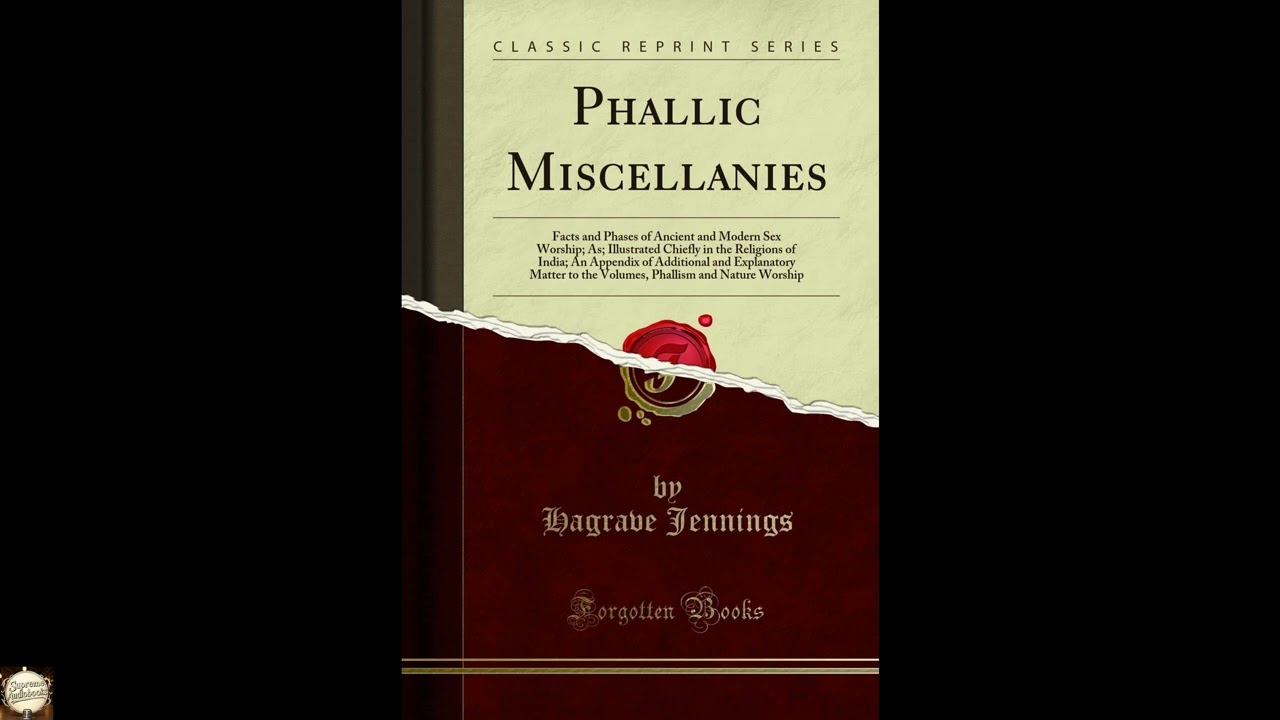
Phallic Miscellanies
For those intrigued by the hidden currents that flow beneath the surface of civilization, Hagrave Jennings’ Phallic Miscellanies presents a unique and profound inquiry into the symbolic life of humanity. This singular work, now brought to life as an audiobook, stands as a testament to the power of unconventional scholarship, inviting listeners to reconsider the very foundations of culture, myth, and societal structure. Far from a dry academic treatise, Jennings’ writing offers a series of deeply observational studies, presented with an often-startling wit and an unflinching eye, making it as relevant today for understanding the complexities of gender and power as it was upon its original appearance. It is a work that challenges ingrained assumptions, asking us to look anew at familiar objects, rituals, and narratives, revealing their often-overlooked deeper resonances. Phallic Miscellanies does not unfold with a conventional narrative arc featuring a single protagonist, but rather invites the listener into a grand intellectual survey, guided by Jennings’ distinctive authorial voice. The "setting" shifts dynamically, spanning countless epochs and diverse geographical locations—from the sun-baked stones of ancient Near Eastern temples to the veiled parlors of Victorian England, from the primal forests of pre-Christian Europe to the bustling markets of colonial empires. The "main characters" are less individuals and more archetypes and symbolic representations: the fertility idol, the mythic hero, the unyielding patriarch, the ritual dancer, the agricultural implement, even the geological formation that has inspired reverence across millennia. Jennings orchestrates these diverse elements into a coherent whole, demonstrating the persistent, often subconscious, influence of certain symbolic forms on human thought and behavior. The central conflict animating the work is the tension between the overt, often repressive, moral and social codes of various societies and the underlying, enduring human impulses they attempt to contain or redirect. Jennings masterfully illustrates how, even when explicitly forbidden or sublimated, these elemental forces manifest themselves in art, architecture, language, and custom. The story, then, is the unfolding revelation of these connections, tracing how what might seem like disparate cultural phenomena—a folk tale, a religious dogma, a fashion trend—are in fact deeply connected by shared symbolic roots. The arc of the piece progresses from the most ancient, primal expressions to their more subtle and often disguised appearances in modernity, creating a profound continuity across human history. Listeners witness how societies attempt to civilize, sanctify, or suppress these forces, and how, inevitably, they find new avenues of expression. Hagrave Jennings, a figure whose intellectual curiosity seemingly knew no bounds, emerged as a compelling voice in the late nineteenth and early twentieth centuries, a period of immense intellectual ferment and cultural re-evaluation. Born in the English countryside, he was educated at one of the esteemed universities, yet his particular brand of scholarship often placed him outside the mainstream academic currents of his time. Eschewing narrow specialization, Jennings cultivated a wide-ranging interest in anthropology, comparative mythology, folklore, and the lesser-known byways of history. His private means and independent spirit allowed him the freedom to pursue his sometimes-controversial lines of inquiry, often traveling to remote regions to gather firsthand observations and study ancient texts that many of his contemporaries overlooked. His other notable works include The Alchemical Bride, a fascinating study of esoteric symbols in early modern thought, and Rituals of the Unseen, a comparative examination of hidden ceremonies and secret societies across cultures. Jennings' approach was characterized by a meticulous gathering of evidence, paired with a willingness to draw bold, synthesising conclusions, often connecting seemingly disparate cultural practices through their underlying symbolic structures. He was a keen observer of human nature, always searching for the universal patterns that manifest in diverse cultural forms. His place in the literary canon is that of a pioneering cultural analyst, a precursor to later developments in psychoanalysis and structural anthropology, whose work, though sometimes idiosyncratic, offered genuinely innovative ways of seeing the world. Among the specific themes Phallic Miscellanies enacts, the enduring power of symbolism stands out prominently. Jennings argues that certain forms and images carry an almost primal resonance across cultures and centuries, shaping human understanding long after their original sacred meaning has faded from conscious memory. For instance, he details the pervasive reverence for upright stones and columns, showing how this respect appears in megalithic structures, ancient religious architecture, and even urban monuments, consistently linked to notions of permanence, power, and generation. Another vital theme is the subtle yet profound influence of societal repression and its often unexpected manifestations. Jennings demonstrates how attempts to suppress natural human impulses or symbolic expressions often lead to their re-emergence in sublimated or transformed ways. He points to the strict moral codes of certain historical periods, contrasted with the proliferation of coded language, clandestine rituals, or even popular superstitions that obliquely address the very forces society tries to deny. A third significant theme is the shifting nature of masculinity itself, revealing how cultural definitions of what it means to be a man evolve while certain core symbolic expressions persist. Jennings compares the heroic ideals depicted in ancient sagas, with their emphasis on physical prowess and procreative power, to the expectations placed upon men in the emerging industrial age, where virtues like economic productivity and stoic rationality gained prominence, yet the underlying symbolic weight remained. Finally, the work consistently highlights the interconnectedness of culture and biology, positing that fundamental human drives and biological realities underpin vast superstructures of myth, religion, and social organization. He illustrates this by examining fertility rites across wildly different civilizations, demonstrating a shared human impulse to understand and control generation, translated into unique but thematically resonant cultural practices. Phallic Miscellanies emerged from a pivotal moment in history, written during a period that saw the final vestiges of Victorian social conservatism giving way to new intellectual currents. The late nineteenth and early twentieth centuries were characterized by an increasing scientific curiosity about human origins, myth, and psychology, challenging long-held dogmas. Charles Darwin's theories had already reshaped understanding of humanity's place in the natural world, paving the way for more rigorous anthropological studies. Scholars like James Frazer were cataloging the myths and rituals of the world, revealing surprising cross-cultural commonalities, while early psychologists began to probe the subconscious mind. Jennings' work fits squarely into this intellectual landscape, reacting against the prevailing prudishness of the era by daring to openly discuss subjects considered taboo, but doing so with a scholarly rigor that demanded serious consideration. It was a time ripe for works that sought to uncover the hidden logic beneath human behavior, anticipating many of the insights of modern cultural theory. Listening to Phallic Miscellanies as an audiobook offers a particularly immersive and contemplative experience. The duration of several hours allows ample time for Jennings' nuanced arguments and detailed observations to unfurl, inviting listeners to engage with his often-provocative ideas at their own pace. A skilled narrator brings a vital clarity to Jennings’ occasionally dense yet always precise prose, ensuring that the intellectual thread remains unbroken. The pacing allows for thoughtful pauses, giving time for the listener to consider the profound implications of each historical anecdote or symbolic comparison. Listeners will appreciate the careful intonation that highlights the subtle humor and earnest conviction in Jennings’ voice, bringing a personal dimension to this expansive intellectual inquiry. The spoken word allows the atmosphere of each described scene—be it an ancient ceremony or a quiet rumination—to truly settle, transforming what could be a challenging read into a captivating exploration of the hidden dimensions of human existence.
Enjoyed Phallic Miscellanies? A few ways to support us
Audible & Amazon links are affiliate; we may earn a small commission at no extra cost.
About this production
Human narration by a volunteer reader from LibriVox.org, the public-domain audiobook project. LibriVox volunteers record literary works whose copyright has expired in the United States, releasing the resulting recordings into the public domain.
Phallic Miscellanies by Hagrave Jennings. The underlying text is in the U.S. public domain. We do not republish any modern copyrighted edition, translation, or commentary.
The 4K cinematic visuals accompanying this audiobook are generated by an AI image model from prompts derived from the source text. No copyrighted photos, paintings, or stock footage are used. AI generation is disclosed on every video on our YouTube channel as required by YouTube's altered/synthetic content policy.
English subtitles are transcribed from the LibriVox recording with OpenAI Whisper. Translations into the 11 other supported languages are produced by Meta's NLLB-200 neural translation model. No human translator's copyrighted translation is used.
Questions about sourcing or rights? See our DMCA & Sourcing policy or contact us.
Enjoyed this audiobook?
If you'd like to own a copy of Phallic Miscellanies or hear a professionally produced edition, the links below help support free audiobook production at no extra cost to you.
As an Amazon Associate we earn from qualifying purchases. Audible / print links are affiliate.