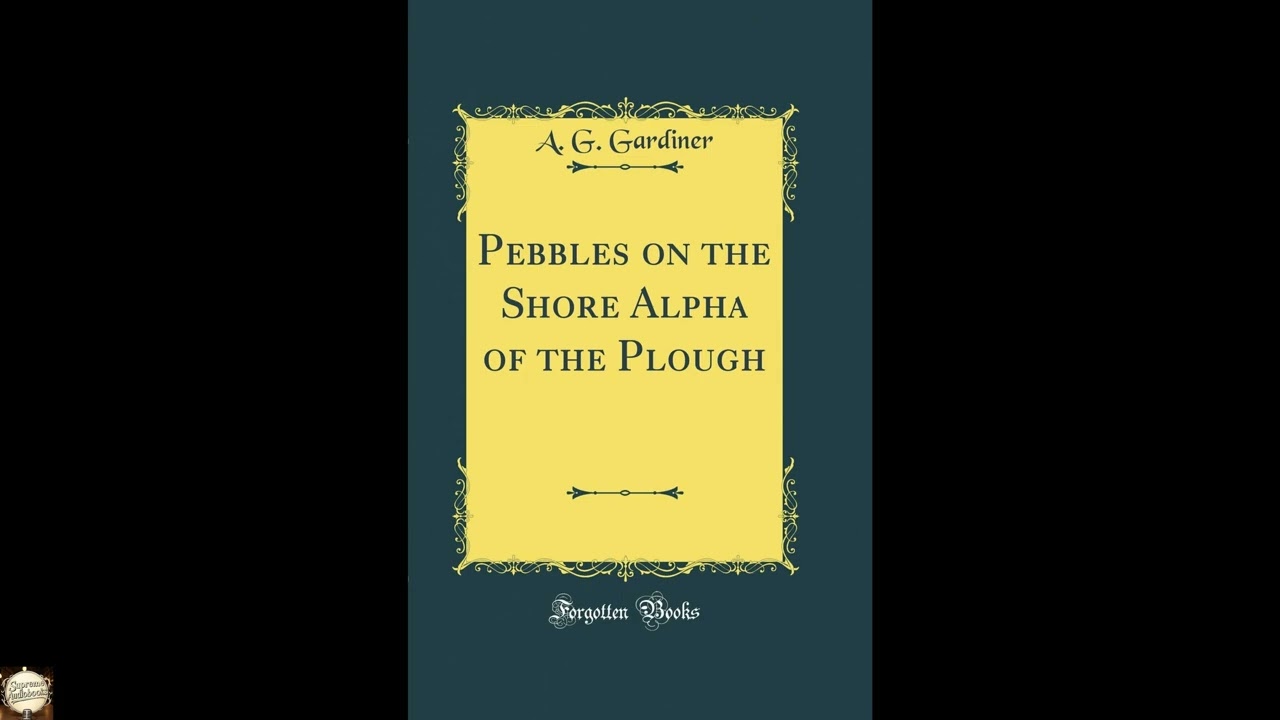
Pebbles on the Shore Alpha of the Plough
A. G. Gardiner’s collected essays, presented under the evocative banner of Pebbles on the Shore Alpha of the Plough, offer a rare invitation to step back into a world both familiar and distinctly bygone, revealing the universal truths of human experience that continue to resonate with striking clarity today. This literary offering is not merely a collection of observations; it is a gently persuasive call to embrace the quiet wisdom of everyday life, to find wonder in the mundane, and to consider the profound implications of seemingly trivial encounters. In an age of relentless acceleration and information overload, Gardiner’s prose provides a much-needed respite, a chance to slow down and rediscover the art of thoughtful reflection and the enduring power of keen, humane observation. It reminds us that true insight often lies not in grand pronouncements, but in the subtle textures of existence, polished smooth like pebbles by the ceaseless tides of time. This esteemed compilation draws listeners into a landscape painted with the meticulous detail of an Edwardian master, yet animated by a spirit that transcends its specific era. The "setting" for these reflections is largely the bustling urban and serene rural environments of early twentieth-century England—the crowded streets of London, the quiet charm of a village green, the contemplative solitude of a garden path. Rather than introducing a single overarching narrative, Gardiner crafts a dynamic "world" populated by an array of recurring archetypes: the harried commuter, the earnest politician, the thoughtful librarian, the boisterous child, and the stoic pedestrian. These figures, though nameless, become vivid characters through Gardiner's empathetic lens, their quirks and commonalities illuminating broader facets of human nature. The central "conflict" running through the pieces is not one of external drama, but an internal, gentle wrestling with the absurdities and beauties of life itself—the tension between individual aspirations and societal expectations, the fleeting nature of happiness, and the search for meaning in a rapidly changing world. The "arc of the story" within Pebbles on the Shore Alpha of the Plough is thus less a linear progression than a spiraling expansion of understanding. Each essay acts as a distinct but interconnected vignette, building cumulatively towards a comprehensive, though never didactic, portrait of humanity. We begin with lighthearted observations on topics as varied as street etiquette or the joy of a good book, gradually moving towards deeper contemplations on patriotism, poverty, and the quiet dignity of ordinary people. The author’s persona, often signing himself as "Alpha of the Plough," acts as our guide—a genial, intelligent, and subtly witty companion who observes the human pageant with a tolerant eye and an ever-present sense of humor. He engages with his subjects not with judgment, but with an almost philosophical curiosity, inviting the listener to join him in pondering the deeper currents beneath the surface of daily existence. The esteemed author behind these thoughtful musings was Alfred George Gardiner, born in Chelmsford, Essex, in 1865. His professional life began as a journalist, a path that led him to editorship of the Daily News in 1902, a position he held with distinction until 1919. Under his leadership, the paper became a significant voice of liberal thought, known for its progressive views and its staunch opposition to the First World War, a stance that required considerable moral courage at the time. Gardiner was a prolific writer, contributing regularly to various publications under his own name and several pseudonyms, most famously "Alpha of the Plough." His writing career spanned several decades, deeply influencing the discourse of his era. He was not only an essayist but also a biographer, penning notable works on figures like Sir George White, General Botha, and David Lloyd George. Gardiner’s particular place in the literary canon is as a quintessential English essayist of the early 20th century, standing alongside contemporaries like G. K. Chesterton and Hilaire Belloc, though with a distinct voice that often favored gentle introspection and social observation over polemic. He cultivated a style that was accessible yet refined, merging journalistic clarity with literary grace. His essays, often published in collections such as Leaves in the Wind, Many Furrows, and the beloved Pebbles on the Shore and Alpha of the Plough, earned him a wide readership and enduring affection. Gardiner’s output represents a particular flowering of the short, personal essay form, a tradition stretching back to Montaigne and Lamb, but adapted by Gardiner for the rapidly changing modern world. He passed away in 1946, leaving behind a substantial body of work that continues to charm and enlighten. Among the specific themes that Pebbles on the Shore Alpha of the Plough articulates with remarkable warmth and insight, one finds a profound appreciation for the beauty of the everyday. Gardiner possesses an uncanny ability to elevate common experiences to moments of quiet revelation. For instance, in an essay reflecting on the simple act of walking through a fog-laden street, he transforms the oppressive atmosphere into a canvas for poetic observation, noting the muffled sounds and the way familiar landmarks assume a new, mysterious significance. He finds grandeur not in mountains, but in the bustling choreography of a city crowd or the steadfast loyalty of a dog. Another prominent theme is the subtle yet pervasive presence of humor and satire throughout his observations. Whether he is gently mocking the peculiarities of English weather or the pomposity of public figures, Gardiner’s wit is always tempered by an underlying benevolence. He rarely employs biting sarcasm; instead, his humor arises from a keen understanding of human foibles, often inviting the listener to laugh with, rather than at, the subjects of his scrutiny. Further, the collection frequently engages with the theme of human nature and society, examining the intricate ways individuals interact and the unwritten rules that govern public life. Gardiner is a shrewd observer of social dynamics, often contrasting the idealized self with the practical realities of communal living. His reflections on courtesy, for example, move beyond mere etiquette to consider its role as a fundamental lubricant in the machinery of society, a small but vital act that upholds civility. Finally, the essays often return to the idea of individualism within a conformist world. While he appreciates order, Gardiner subtly champions the eccentric, the dreamer, and the quiet rebel. He celebrates the unique spark in each person, advocating for a gentle resistance to the pressures of uniformity, finding value in personal quirks and independent thought, often using his own mild idiosyncrasies as examples. These essays emerged during a fascinating juncture in British history, roughly spanning the late Edwardian period and the interwar years—a time of immense social and political upheaval. The grandeur of the Victorian era had given way to an increasingly industrialized and urbanized society, and the shadow of the First World War loomed large, eventually breaking and reshaping global consciousness. Culturally, there was a tension between traditional values and the burgeoning forces of modernity, reflected in movements from women's suffrage to the arts. Gardiner, as a journalist and public intellectual, was very much attuned to these currents. His essays can be seen as a thoughtful response to the rapid pace of change, offering a calm, reflective counterpoint to the anxieties of the age. They represent a literary tradition that sought to find solace and meaning in the human scale of existence amidst the vast, impersonal forces of progress and conflict, providing readers with a sense of continuity and shared humanity during a period of profound dislocation. Listening to Pebbles on the Shore Alpha of the Plough as an audiobook offers a particularly rewarding experience. The duration, several hours in length, allows for a prolonged immersion in Gardiner’s distinctive voice and perspective, providing ample opportunity to absorb the nuances of his observations. The pacing of the essays, designed for leisurely contemplation, lends itself perfectly to audio, allowing the listener to digest each piece without hurry. A skilled narrator can truly bring Gardiner’s genial persona to life, giving voice to his gentle humor and quiet wisdom. Listen for the subtle shifts in tone—the playful lightness when describing a trivial incident, the underlying earnestness in his social commentary, and the reflective pauses that punctuate his deeper thoughts. The spoken word adds an immediate intimacy to his conversational style, making it feel as if Gardiner himself is sharing his insights directly with you, turning mundane moments into delightful, thought-provoking encounters.
Enjoyed Pebbles on the Shore Alpha of the Plough? A few ways to support us
Audible & Amazon links are affiliate; we may earn a small commission at no extra cost.
About this production
Human narration by a volunteer reader from LibriVox.org, the public-domain audiobook project. LibriVox volunteers record literary works whose copyright has expired in the United States, releasing the resulting recordings into the public domain.
Pebbles on the Shore Alpha of the Plough by A. G. Gardiner. The underlying text is in the U.S. public domain. We do not republish any modern copyrighted edition, translation, or commentary.
The 4K cinematic visuals accompanying this audiobook are generated by an AI image model from prompts derived from the source text. No copyrighted photos, paintings, or stock footage are used. AI generation is disclosed on every video on our YouTube channel as required by YouTube's altered/synthetic content policy.
English subtitles are transcribed from the LibriVox recording with OpenAI Whisper. Translations into the 11 other supported languages are produced by Meta's NLLB-200 neural translation model. No human translator's copyrighted translation is used.
Questions about sourcing or rights? See our DMCA & Sourcing policy or contact us.
Enjoyed this audiobook?
If you'd like to own a copy of Pebbles on the Shore Alpha of the Plough or hear a professionally produced edition, the links below help support free audiobook production at no extra cost to you.
As an Amazon Associate we earn from qualifying purchases. Audible / print links are affiliate.