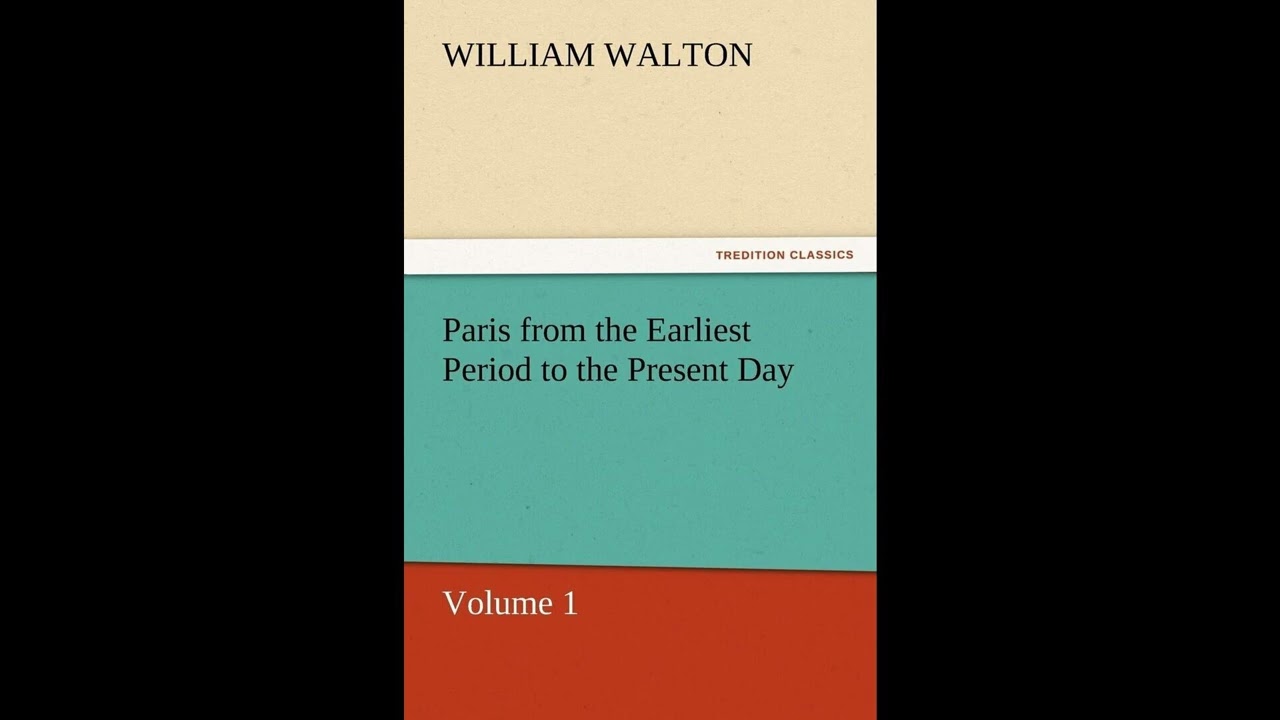
Paris from the Earliest Period to the Present Day, Volume 1
Few cities hold quite the mythical sway over the human imagination as Paris. It is a place synonymous with romance, revolution, art, and intellectual ferment—a city whose very name conjures images of grand boulevards, hidden cafes, and a history etched into every stone. But how did this legendary metropolis come to be? William Walton Sir’s multi-volume history, beginning with Paris from the Earliest Period to the Present Day, Volume 1, offers an unprecedented invitation to understand the deep currents that shaped one of the world’s most celebrated urban centers. This foundational account, presented in the author’s eloquent and thoroughly researched prose, peels back the layers of centuries to reveal not merely facts, but the very soul of Paris, making it essential listening for anyone who has ever fallen under its spell or wishes to comprehend the forces that create enduring cultural hubs. Volume 1 commences at the absolute dawn, introducing us to the humble origins of Paris as Lutetia, a settlement of the Parisii tribe on a modest island in the Seine. We witness the arrival of the Romans, the imposition of their infrastructure—baths, forums, and an arena—and the subsequent decline and transformation as the Roman Empire recedes. The narrative then follows the city through the murky twilight of the early medieval period, a time of barbarian incursions and the rise of monastic life, as the scattered populace slowly coalesces around the protective walls and spiritual authority of Sainte-Geneviève. We observe the gradual ascendance of the Capetian dynasty, establishing Paris as a royal seat rather than just a strategic outpost, a critical shift that sets the stage for its future grandeur. The story progresses through the intellectual and architectural blossoming of the High Middle Ages. Listeners encounter the monumental construction of Notre Dame Cathedral, a symbol of both spiritual devotion and civic ambition, rising majestically above the river. The burgeoning university on the Left Bank—the Sorbonne—begins to draw scholars from across Europe, cementing Paris’s reputation as a center of learning and debate, a place where ideas could take root and flourish. The arc of this initial volume focuses on the city’s struggle for identity and stability, its growth from a small, defensible island settlement to a sprawling, ambitious capital, facing down challenges from invading forces, internal strife, and the ever-present pressures of expansion and renewal. This is a story of continuous construction and reinvention, of a city steadily growing in stature and complexity, always balancing its ancient roots with aspirations for the future. The author, William Walton (1843-1915), was an American art critic, author, and editor whose literary career spanned the late nineteenth and early twentieth centuries. Born in Philadelphia, he became a notable figure in the American intellectual and artistic circles, particularly those with a strong European orientation. Walton spent considerable time in Paris, immersing himself in its culture and history, which profoundly informed his writing. His expertise was not limited to historical accounts; he also served as an editor for Scribner's Magazine and authored significant works on art and expositions, including the official catalogue for the World’s Columbian Exposition in Chicago in 1893. His background as an art critic lent a keen eye for architectural detail and a deep appreciation for the aesthetic dimensions of urban development to his historical prose. Walton's particular perspective positioned him as an eloquent interpreter of European culture for an American audience. His collected works, often published in lavish, multi-volume editions, reflected a contemporary fascination with detailed historical accounts and beautifully presented texts. He stood among a generation of American writers and scholars who looked to European capitals, especially Paris, as sources of inspiration and subjects of rigorous study, contributing significantly to the cultural dialogue between the continents. His place in the canon is marked by a dedication to comprehensive, accessible scholarship, presented with a literary flair that elevated his non-fiction beyond mere reportage. One central theme evident in Walton’s account is the relentless process of urban metamorphosis—the way a city is not a static entity but a constantly evolving organism. He illustrates this by detailing how Roman Lutetia’s structures were repurposed or subsumed by subsequent medieval developments; for instance, the arenas might become quarries for new buildings, or ancient thoroughfares would dictate the paths of future streets. This continuous cycle of destruction and rebirth, of building atop the ruins of the past, demonstrates the enduring human spirit to adapt and create. Another prominent theme is the interplay of power, religion, and daily life in shaping the urban landscape. The authority of kings, such as Philip Augustus and his defensive walls, or the influence of the Church, exemplified by the construction of Notre Dame, fundamentally dictated where people lived, how they moved, and what symbolic structures defined their collective identity. Walton skillfully brings to light how even seemingly mundane elements, like the city’s evolving sanitation systems or the changing demographics of its populace, reflect broader cultural shifts and societal priorities. He does not merely list events but connects them to the physical manifestation of the city, showing how each political upheaval, each religious fervor, each technological advance leaves its indelible mark on the urban fabric. The historical narrative subtly conveys the theme of memory—how the past literally underpins the present, with the vestiges of earlier eras continually influencing the character and direction of Paris, providing a palpable sense of continuity despite the ruptures of war and revolution. This multi-volume work emerged during a fascinating period, roughly at the turn of the twentieth century, an era often referred to as the Belle Époque for Paris itself. Culturally, there was a widespread fascination with history, an impulse to document and understand the grand narratives of nations and cities, often driven by newly available archaeological discoveries and historical methodologies. Politically, the world was entering an age of rapid modernization, global interconnectedness, and increasing urban populations. For Paris, specifically, this was a time of continued prestige, artistic innovation, and a growing tourism industry. Walton’s work spoke directly to an educated public—both American and European—who yearned for comprehensive, yet accessible, accounts of history, providing a sense of context for the marvels of the modern city they observed. It allowed readers to appreciate the deep roots of a city that was simultaneously embracing the future with unmatched enthusiasm. Listening to Paris from the Earliest Period to the Present Day, Volume 1 as an audiobook offers a unique opportunity to absorb this expansive history with an immersive quality. The author’s descriptive language, carefully structured to build a clear picture of an evolving city, unfolds naturally in an auditory format. The several hours of content allow for a sustained intellectual engagement, perfect for longer commutes, leisurely afternoons, or as an ongoing companion for those wishing to deepen their understanding of European history. Listeners can appreciate the deliberate pacing that allows historical periods to breathe, enabling a thorough grasp of the transformations Paris underwent. The narration brings Walton's articulate observations to life, creating an atmospheric experience that transports one to the banks of the ancient Seine, to the medieval street, and to the grand projects that laid the groundwork for the modern French capital.
Enjoyed Paris from the Earliest Period to the Present Day, Volume 1? A few ways to support us
Audible & Amazon links are affiliate; we may earn a small commission at no extra cost.
About this production
Human narration by a volunteer reader from LibriVox.org, the public-domain audiobook project. LibriVox volunteers record literary works whose copyright has expired in the United States, releasing the resulting recordings into the public domain.
Paris from the Earliest Period to the Present Day, Volume 1 by William Walton Sir. The underlying text is in the U.S. public domain. We do not republish any modern copyrighted edition, translation, or commentary.
The 4K cinematic visuals accompanying this audiobook are generated by an AI image model from prompts derived from the source text. No copyrighted photos, paintings, or stock footage are used. AI generation is disclosed on every video on our YouTube channel as required by YouTube's altered/synthetic content policy.
English subtitles are transcribed from the LibriVox recording with OpenAI Whisper. Translations into the 11 other supported languages are produced by Meta's NLLB-200 neural translation model. No human translator's copyrighted translation is used.
Questions about sourcing or rights? See our DMCA & Sourcing policy or contact us.
Enjoyed this audiobook?
If you'd like to own a copy of Paris from the Earliest Period to the Present Day, Volume 1 or hear a professionally produced edition, the links below help support free audiobook production at no extra cost to you.
As an Amazon Associate we earn from qualifying purchases. Audible / print links are affiliate.