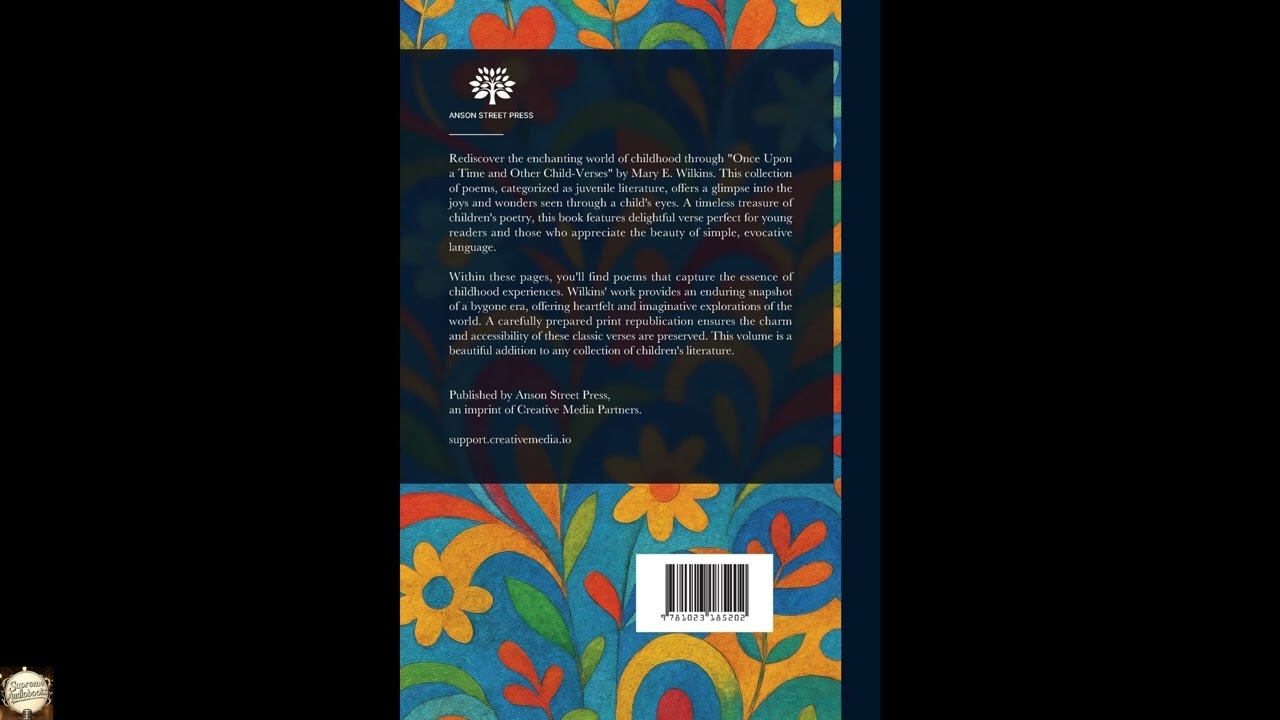
Once Upon a Time, and Other Child-Verses
Step into a world where childhood wonder never truly fades, where the rustle of leaves holds secrets and everyday moments sparkle with magic. "Once Upon a Time, and Other Child-Verses" offers a tender passage back to an era of gentle innocence, crafted by Mary Eleanor Wilkins Freeman, a writer celebrated for her keen observations of New England life. This collection of verses for children, brimming with imagination and charm, invites listeners to reconnect with the simple joys and profound insights of youth. It is a work that, despite its origins in a bygone age, speaks with remarkable clarity to the enduring spirit of childhood, offering a comforting presence and a delightful escape for listeners of all ages. This gathering of child-verses paints a picture of a world seen through untainted eyes, often set amidst the changing seasons and familiar domestic scenes of rural America. Each poem acts as a miniature narrative, introducing listeners to curious children, anthropomorphic animals, and personified objects that come alive with individual spirit. Imagine a child conversing with a mischievous squirrel, or a doll sharing secrets, or the sun and moon having their own quiet dialogue. The verses often depict children engaged in play—building snow forts, chasing butterflies, or listening to the tales of elders—each moment infused with a sense of discovery and quiet contemplation. There isn't a single overarching story in the traditional sense; rather, the collection builds an emotional arc from poem to poem, moving through the stages of childhood experience, from the first blush of spring to the cozy warmth of winter, from playful mischief to moments of thoughtful learning. The "central conflict," if one could call it that, resides in the everyday challenges and triumphs of growing up, seen through a lens of gentle humor and deep empathy. The poems celebrate the small wonders, the fleeting beauty of nature, and the comforting routines that shape a young life, all without pushing a heavy moralizing tone, but rather inviting reflection. Mary Eleanor Wilkins Freeman stands as a significant figure in American literature, particularly known for her regionalist fiction that meticulously detailed the lives of ordinary people in rural New England. Born in Randolph, Massachusetts, in 1852, she spent much of her life in the quiet villages of Massachusetts and Vermont, an upbringing that deeply informed her writing. Her early life was marked by her father’s financial struggles and the family’s relocation, experiences that undoubtedly sharpened her understanding of hardship and resilience. After her family's return to Randolph, she began writing to support herself, quickly gaining recognition for her distinctive voice. While much of her celebrated work focuses on the psychological complexities and often constrained lives of women in post-Civil War New England, stories like those in A New England Nun and Other Stories (1891) and novels such as Pembroke (1894) secured her place among the great realists of her time. Her focus on minute details, the nuances of dialect, and the internal lives of her characters set her apart. In 1902, she married Dr. Charles M. Freeman, taking his surname and adopting a somewhat more public life, though her focus remained firmly on her literary endeavors until her passing in 1930. Freeman's contribution to American letters is considerable; she captured a particular time and place with unparalleled precision, earning her a reputation as a master of the short story and a key figure in the rise of American literary realism. Her work is often characterized by its spare, unadorned prose, which allowed the quiet dramas of her characters to resonate with profound emotional weight. While "Once Upon a Time, and Other Child-Verses" might seem a departure from her more somber, adult-oriented fiction, it reveals another facet of her talent—her ability to observe and articulate the human condition across the spectrum of age, from the burdened adult to the dreaming child. This collection showcases her versatility and her deep understanding of the human spirit, even when rendered in the simpler, more hopeful language of children's poetry. The verses in this collection enact several key themes, chief among them being childhood imagination and wonder. Freeman consistently portrays children not just as small adults, but as beings with a unique capacity to transform the mundane into the magical. For instance, a common garden path might become a grand avenue for adventure, or a toy an eloquent companion, illustrating how a child’s inner world enriches their surroundings. This is not merely fanciful; it underscores a profound truth about how early perceptions shape understanding. Another prevalent theme is the interconnection with nature and the changing seasons. Many poems gently highlight the beauty of the natural world and the rhythms of the year, often personifying elements like the wind or the flowers. A verse might describe children observing a bird building its nest, or playing in the falling leaves, offering quiet lessons about life cycles and the delicate balance of the environment. This constant engagement with nature helps to ground the fantastical elements of childhood within a tangible, sensory reality. Furthermore, the collection often touches upon the gentle lessons of character and conduct, without resorting to overt preaching. These lessons are often embedded in the narrative of a child's interaction with others or with a dilemma, subtly suggesting kindness, honesty, or perseverance. A poem about sharing a treat or overcoming a small fear provides a concrete example of how moral frameworks are introduced and absorbed in youth. Finally, the theme of domestic comfort and security quietly permeates many of the verses. There are images of children safe within their homes, surrounded by family, engaged in simple, comforting routines. These moments emphasize the importance of a nurturing environment for a child's development, providing a backdrop of warmth and stability against which their imaginations can freely roam and their personalities can form. These themes, woven throughout the verses, create a comforting and thought-provoking experience, demonstrating Freeman's astute observation of the human condition, even in its most nascent stages. The period in which "Once Upon a Time, and Other Child-Verses" emerged—the late nineteenth and early twentieth centuries—was a fascinating time for American letters and culture. Following the upheaval of the Civil War and during an era of rapid industrialization and urbanization, there was a parallel movement in literature, often termed Regionalism or Local Color, which sought to preserve and depict the unique customs, dialects, and landscapes of specific areas before they were lost to modernization. Mary Eleanor Wilkins Freeman was a prominent voice in this movement, meticulously documenting the lives of New Englanders. Simultaneously, this was a burgeoning era for children's literature, with a growing recognition of childhood as a distinct phase of life deserving of its own specific forms of storytelling and poetry, moving beyond purely didactic texts to works that celebrated imagination and enjoyment. Authors like Louisa May Alcott and Mark Twain had already laid groundwork for truly American children's narratives, and collections of verses like Freeman's contributed to this expanding genre, offering works that nurtured imagination and sensitivity. The work naturally arose from this confluence, combining a regionalist sensibility for detail and setting with an increasing literary focus on the child's perspective, providing an enduring window into both a literary moment and a cultural understanding of youth. Listening to "Once Upon a Time, and Other Child-Verses" as an audiobook offers a singular opportunity to fully appreciate the rhythm and cadence of Freeman's poetry. The several hours of narration allow for a measured, unhurried appreciation of each verse, letting the gentle rhymes and evocative imagery settle in the mind. A skilled narrator's voice becomes a vital instrument, breathing life into the playful characters and tender scenes, guiding listeners through the shift from verse to verse with appropriate pacing. The spoken word can highlight the musicality inherent in children's poetry, making the observations about nature, the innocent conversations, and the small adventures feel even more immediate and intimate. This auditory experience invites listeners to slow down, to engage their imaginations in the way a child does, and to find quiet pleasure in the language itself, making it an ideal companion for moments of relaxation or for sharing with younger listeners.
Enjoyed Once Upon a Time, and Other Child-Verses? A few ways to support us
Audible & Amazon links are affiliate; we may earn a small commission at no extra cost.
About this production
Human narration by a volunteer reader from LibriVox.org, the public-domain audiobook project. LibriVox volunteers record literary works whose copyright has expired in the United States, releasing the resulting recordings into the public domain.
Once Upon a Time, and Other Child-Verses by Mary Eleanor Wilkins Freeman. The underlying text is in the U.S. public domain. We do not republish any modern copyrighted edition, translation, or commentary.
The 4K cinematic visuals accompanying this audiobook are generated by an AI image model from prompts derived from the source text. No copyrighted photos, paintings, or stock footage are used. AI generation is disclosed on every video on our YouTube channel as required by YouTube's altered/synthetic content policy.
English subtitles are transcribed from the LibriVox recording with OpenAI Whisper. Translations into the 11 other supported languages are produced by Meta's NLLB-200 neural translation model. No human translator's copyrighted translation is used.
Questions about sourcing or rights? See our DMCA & Sourcing policy or contact us.
Enjoyed this audiobook?
If you'd like to own a copy of Once Upon a Time, and Other Child-Verses or hear a professionally produced edition, the links below help support free audiobook production at no extra cost to you.
As an Amazon Associate we earn from qualifying purchases. Audible / print links are affiliate.
![Children's Classics in Dramatic Form, Book Two. [1909] by Augusta Stevenson — free full audiobook](https://img.youtube.com/vi/h4bTKUeuO7U/maxresdefault.jpg)