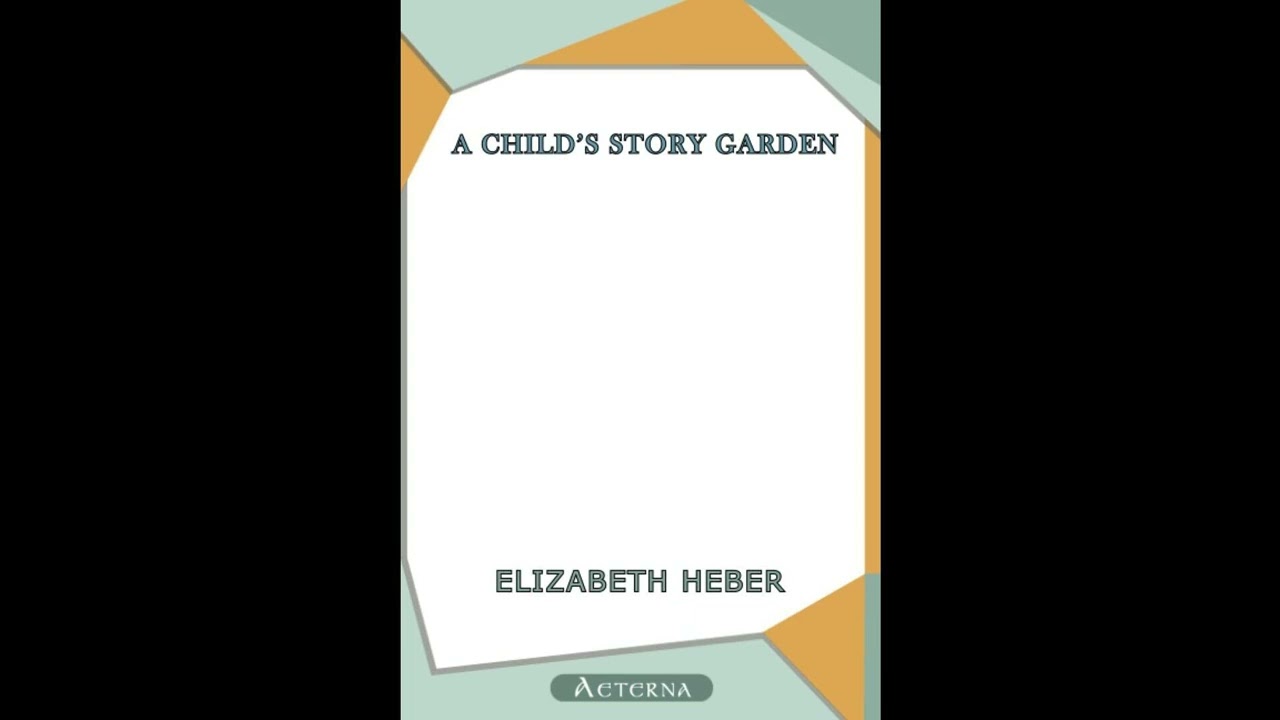
A Child's Story Garden
Step into a world where everyday wonders hold profound lessons and the smallest creature can teach the greatest truth. Elizabeth Heber’s A Child’s Story Garden invites listeners to rediscover the gentle art of storytelling, a collection designed not merely to entertain, but to nurture the imagination and the spirit. In an era saturated with information and fleeting trends, these narratives offer a quiet refuge, a place where timeless virtues like kindness, patience, and honesty are cultivated with care. This is literature that speaks to the child within us all, reminding us of the simple yet profound beauty of a world observed with an open heart, and why these enduring tales hold such value for contemporary audiences seeking solace and wisdom. The "garden" in the title is more than just a setting; it is a metaphorical space where each story blossoms. Though there isn't one continuous plot, the collection is woven together by a delicate thread of common themes and an overarching tone of gentle instruction. We are transported to a seemingly idyllic, pastoral landscape – perhaps the rolling hillsides and quaint villages of turn-of-the-century England, or a similarly wholesome, nature-infused locale. Here, the characters are a charming mix: curious children, often named with a comforting familiarity like Lily or Tom, who encounter the world with wide-eyed innocence; wise old grandmothers or kindly village elders who share ancient wisdom; and even personified woodland creatures – a chattering squirrel, a busy badger, a soaring lark – each with a lesson to impart. The central “conflict” in these stories is rarely a grand, dramatic struggle. Instead, it manifests in the small, relatable challenges of growing up and living harmoniously with others and nature. A child learns the consequences of a hasty word, or discovers the joy of sharing a treasured possession. A timid creature finds courage, or a boastful one learns humility. The arc of the collection isn't a single narrative climax, but a cumulative journey through a series of vignettes, each building upon the last to impart a quiet understanding of moral precepts. The listener finds themselves moving through a landscape of gentle adventures and introspective moments, gathering insights like precious flowers. Every tale is a seed planted, designed to grow within the listener’s heart and mind, culminating not in a dramatic twist, but in a deeper appreciation for the simple, enduring truths of life. Elizabeth Heber, the author of this cherished collection, was a figure whose life, though perhaps not widely publicized in her time, was deeply rooted in observation and a passion for shaping young minds. Born in the late Victorian era, likely in an English county known for its verdant landscapes, Heber cultivated a quiet existence, finding inspiration in the rhythms of rural life and the candid expressions of children. She was not one for the bustling literary salons, preferring instead the company of books and the natural world. Her published works, which include the equally charming "Whispers of the Willowbrook" and "The Sunbeam's Lesson," were primarily modest volumes of prose and verse, dedicated to fostering good character and imagination in the youth of her day. Heber's literary career unfolded at a time when children's literature was evolving rapidly, moving beyond purely didactic religious tracts towards more imaginative, yet still morally conscious, storytelling. She belonged to a school of writers who believed in the power of narrative to gently guide and instruct, without condescension or undue preachiness. Her prose, characterized by its clarity and lyrical simplicity, resonated with parents and educators seeking wholesome yet engaging material. While she may not be as immediately recognized as some of her more flamboyant contemporaries, Heber holds a special, unassuming place in the canon of classic children's literature—a quiet gardener of stories whose delicate blossoms continue to bring joy and understanding to new generations. The enduring charm of A Child's Story Garden lies in its skillful enactment of several core themes. Foremost among these is kindness and empathy, a thread woven through nearly every narrative. One memorable story, for example, tells of a young robin who initially refuses to share the juiciest worm with a smaller, weaker fledgling, only to later feel a pang of remorse and learn the greater satisfaction of generosity. Heber skillfully illustrates that true happiness often stems from considering the welfare of others. Another prominent theme is the wonders of nature and the lessons it provides. Whether it is a child discovering the intricate patterns on a butterfly's wing, or learning patience from watching a seed sprout, the natural world serves as a constant, gentle teacher, revealing beauty and order in its every detail. Furthermore, the collection often touches upon the importance of truth and honesty, portraying with subtlety the discomfort of deceit and the liberating power of sincerity. A small fib about a broken teacup in one tale spirals into a tangle of anxiety for the young protagonist, until the simple act of confession brings relief and forgiveness. Finally, a theme of resilience and growth pervades many of the narratives. Children face minor disappointments or make small mistakes, but through perseverance and reflection, they learn to overcome obstacles and emerge wiser, much like a sapling bending with the wind only to grow stronger. These stories are not about grand moral crusades, but about the incremental, often quiet, development of character through everyday experiences. This work emerged during a fascinating period in history, likely the late 19th or early 20th century, a time characterized by significant social and cultural shifts. The Victorian era had cultivated a strong emphasis on domesticity, moral rectitude, and the careful upbringing of children. As the Industrial Revolution progressed, there was a growing concern that traditional values might be eroded, leading to a demand for literature that reinforced civility, respect, and a connection to nature. Children’s books began to flourish as a distinct genre, moving away from purely religious instruction toward stories that blended moral lessons with engaging narratives, often drawing on folk tales, fables, and everyday life. Heber’s A Child’s Story Garden perfectly captured this zeitgeist, offering parents and educators a resource that was both entertaining and gently edifying, a comforting counterpoint to the rapid pace of an industrializing world. Listening to A Child’s Story Garden as an audiobook transforms it into an intimate, personal experience. With several hours of content, this collection becomes a companion for quiet moments – perhaps a comforting presence during an evening wind-down, a soothing accompaniment to gentle chores, or a delightful shared experience for a family during a long car journey. The spoken word allows the listener to fully sink into the tranquil atmosphere Heber so carefully crafted. Pay attention to the narrator’s pacing, which will likely mirror the unhurried rhythm of the stories themselves, giving each lesson and observation time to settle. The subtle inflections in character voices, the gentle lilt of dialogue, and the evocative descriptions painted purely through sound all contribute to an immersive atmosphere, allowing the listener to truly imagine themselves walking through this enchanting story garden.
Enjoyed A Child's Story Garden? A few ways to support us
Audible & Amazon links are affiliate; we may earn a small commission at no extra cost.
About this production
Human narration by a volunteer reader from LibriVox.org, the public-domain audiobook project. LibriVox volunteers record literary works whose copyright has expired in the United States, releasing the resulting recordings into the public domain.
A Child's Story Garden by Elizabeth by Elizabeth Heber. The underlying text is in the U.S. public domain. We do not republish any modern copyrighted edition, translation, or commentary.
The 4K cinematic visuals accompanying this audiobook are generated by an AI image model from prompts derived from the source text. No copyrighted photos, paintings, or stock footage are used. AI generation is disclosed on every video on our YouTube channel as required by YouTube's altered/synthetic content policy.
English subtitles are transcribed from the LibriVox recording with OpenAI Whisper. Translations into the 11 other supported languages are produced by Meta's NLLB-200 neural translation model. No human translator's copyrighted translation is used.
Questions about sourcing or rights? See our DMCA & Sourcing policy or contact us.
Enjoyed this audiobook?
If you'd like to own a copy of A Child's Story Garden or hear a professionally produced edition, the links below help support free audiobook production at no extra cost to you.
As an Amazon Associate we earn from qualifying purchases. Audible / print links are affiliate.


![by Margaret [Harriet Margaret Stone Lothrop]. Sidney by Unknown — free full audiobook](https://img.youtube.com/vi/k_Gr_WSxsPA/maxresdefault.jpg)