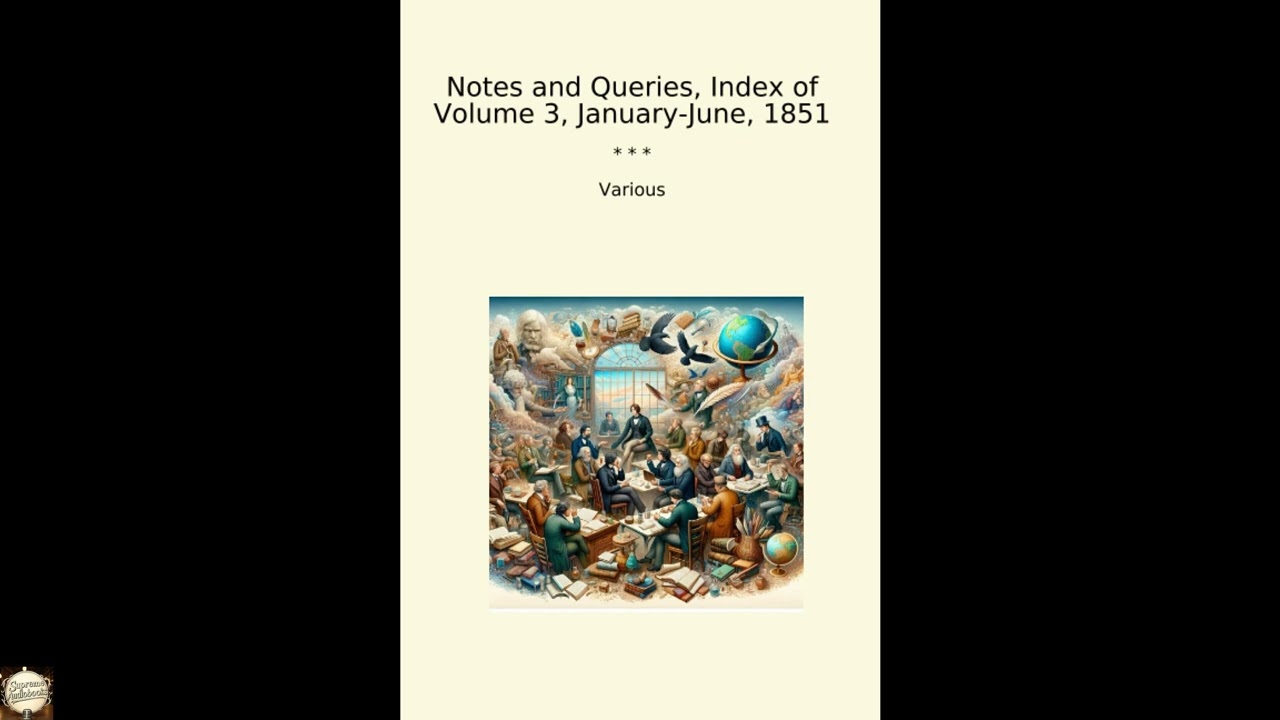
Notes and Queries, Index of Volume 3, January-June, 1851 (Classic Books)
Step back into the bustling intellectual landscape of mid-Victorian England, a period of rapid change and profound curiosity. Imagine a time when the internet was a distant dream, yet the human desire to ask, to answer, and to record lingered as strongly as it does today. Notes and Queries, Index of Volume 3, January-June, 1851 offers a remarkable, unconventional doorway into this bygone era. Far from a mere list of terms, this volume acts as a meticulously curated skeleton key to the collective consciousness of early 1850s Britain, cataloging the obscure facts, forgotten histories, and pressing questions that occupied the scholars, antiquarians, and general enthusiasts of the day. It is not a story with a traditional protagonist, but rather a compelling record of human curiosity, a snapshot of an entire culture's intellectual preoccupations distilled into a single, navigable document. Rather than following a singular narrative thread, this volume presents a panoramic view of intellectual life, a dynamic forum where the pressing, peculiar, and often profound questions of the age were posed and answered. Notes and Queries itself was founded in 1849 as a weekly periodical dedicated to the exchange of information, a kind of proto-Wikipedia and social media hybrid for the Victorian intelligentsia. Its pages brimmed with inquiries about forgotten customs, etymological puzzles, historical minutiae, and literary obscurities. The 'story' here unfolds not through a hero's quest, but through the hundreds of anonymized entries that reveal the shared intellectual pursuits of a community. One might encounter a query about the origin of a folk saying in Devon, followed by a scholarly note on an obscure passage in Shakespeare, or a debate over the precise date of a historical event. The main 'characters' are therefore the countless anonymous voices—the 'Querists' who posed the riddles, and the 'Noters' who offered their accumulated wisdom, all contributing to a growing reservoir of shared knowledge. The central 'conflict,' if one could call it that, is the universal human desire to understand, to clarify, and to preserve. It is the communal effort to push back against the tide of forgetting, to rescue anecdotes and facts from the dustbin of history. Imagine an antiquarian in Surrey seeking confirmation of a local legend, or a literary scholar in London striving to decipher a cryptic allusion in a nearly forgotten play. Their questions, and the subsequent responses they garnered from fellow readers, form the ongoing dialogue documented within this index. It is a story told in fragments, each entry a small window into a specific intellectual problem being grappled with, a tiny victory against ignorance or inaccuracy. The 'arc' of this unique 'narrative' is the progression of collective enlightenment. As one scrolls through the entries, organized alphabetically by subject matter and contributor, a mosaic of Victorian concerns emerges. From 'Anachronisms' to 'Zoology,' the index categorizes the full spectrum of academic and amateur interests. It details the precise locations where specific questions were asked, the names (or pseudonyms) of those who provided answers, and the subjects debated—be they botanical terms, heraldic devices, or the precise nature of spectral phenomena. This meticulous cataloging allows a reader to trace the intellectual currents of the time, to see which topics generated the most discussion, and where the collective knowledge of the era was focused. With the author listed as 'Unknown,' it becomes clear that this work is not the singular creation of one mind, but rather a reflection of a collaborative intellectual enterprise. The true 'authorship' of Notes and Queries belongs to the collective readership and contributors who, week after week, fueled its pages with their inquiries and expertise. The journal itself was founded by William John Thoms in 1849. Thoms, an eminent antiquarian, librarian, and early folklore enthusiast, conceived of Notes and Queries as a public repository for knowledge, a place where researchers, collectors, and curious minds could exchange information that might otherwise be lost to time or remain isolated in private study. Thoms's vision was to create a clearinghouse for 'literary intercommunication'—a space for those engaged in various scholarly pursuits to pose questions that stumped them and to offer answers to others' dilemmas. He famously coined the term 'folklore' in 1846, publishing it in a letter to The Athenaeum, and his subsequent endeavor with Notes and Queries was a direct extension of his commitment to preserving popular antiquities and local traditions. The periodical quickly garnered a dedicated following among academics, clergy, legal professionals, and educated laypeople across the British Isles and beyond. Its success underscored a widespread desire for a formal yet accessible platform for the exchange of recondite knowledge. The 'author' of this index, then, is less an individual and more a systemic necessity—the careful hands that compiled and organized the vast amount of information generated by this thriving intellectual community. It represents the crucial work of making accessible the diverse discussions contained within the third volume, turning a disparate collection of weekly notes and queries into a usable, searchable archive. Without such an index, the wealth of information contained within the original periodical would be buried, its insights difficult to retrieve, thereby diminishing the very purpose Thoms had intended for his publication. Several resonant themes emerge from an examination of this volume's index, even in its highly organized format. Foremost among them is the unrelenting pursuit of knowledge. Every entry, whether it points to a question about a forgotten historical figure or an answer regarding an obscure botanical term, signifies a desire to understand and to clarify. For instance, entries under 'Shakespeare' or 'Milton' don't just list appearances of the names; they often point to discussions about specific textual interpretations, contested dates, or biographical ambiguities. This isn't passive information reception, but active engagement with the known and the unknown. Another powerful theme is the concept of collective scholarship. Notes and Queries was inherently a collaborative venture, democratizing the act of scholarly research. It offered a platform for anyone with a pertinent question or a valuable piece of information, regardless of their institutional affiliation, to contribute to the greater intellectual good. You might find entries referencing contributions from eminent professors alongside those from 'A Country Parson' or 'An Enquirer from Exeter.' This index highlights the wide array of voices, revealing how seemingly disparate fields of inquiry—from the nuances of ecclesiastical architecture to the precise lineage of a peerage—were woven together by the common thread of shared investigation. It underscores the belief that knowledge is built incrementally, through the combined efforts of many minds. The preservation of ephemeral information—like local legends, dialect words, or passing observations—also forms a significant undercurrent, saving snippets of culture that might otherwise vanish into silence. The year 1851 stands as a landmark in British history, perfectly encapsulating the spirit of the early Victorian age—a period marked by burgeoning scientific discovery, rapid industrialization, and profound social change. It was the year of the Great Exhibition, housed in the Crystal Palace, an event that proudly showcased Britain's technological prowess and global reach. This was a society grappling with the implications of progress, yet also deeply rooted in its past, eager to understand its traditions and origins amidst the whirlwind of modernity. The proliferation of print culture was central to this era; newspapers, magazines, and specialized journals flourished, catering to an increasingly literate public hungry for information and intellectual engagement. Notes and Queries emerged precisely from this fertile ground. In a world before easily accessible encyclopedias and digital databases, such a publication filled a vital void. It served as an essential tool for scholars navigating an ever-expanding universe of information, providing a centralized, published forum for questions and answers that might otherwise have required extensive, time-consuming correspondence or specialized library visits. The detailed indexing of Volume 3, covering the first half of 1851, therefore offers more than just a list of contents; it provides a direct glimpse into the very questions that occupied the educated mind during a transformative moment, reflecting the era's blend of forward-looking ambition and reverence for historical detail. Listening to Notes and Queries, Index of Volume 3, January-June, 1851 as an audiobook offers a unique and surprisingly immersive experience. Imagine settling in to hear the systematic cadence of entries read aloud, each item a small, self-contained piece of information. The narration transforms what might appear as a dry list into a rhythmic unfolding of facts and curiosities. You'll hear the precise phrasing of Victorian inquiries, the names of prominent contributors, and the often-quaint terminology used to categorize knowledge in that specific time. It is less about following a conventional plot and more about appreciating the sonic texture of an era's intellectual landscape. The steady pace of the reading allows for contemplation, inviting you to ponder the significance of each subject, to consider the minds behind the queries, and to appreciate the meticulous dedication required to build such an extraordinary repository of shared human knowledge.
Enjoyed Notes and Queries, Index of Volume 3, January-June, 1851 (Classic Books)? A few ways to support us
Audible & Amazon links are affiliate; we may earn a small commission at no extra cost.
About this production
Human narration by a volunteer reader from LibriVox.org, the public-domain audiobook project. LibriVox volunteers record literary works whose copyright has expired in the United States, releasing the resulting recordings into the public domain.
Notes and Queries, Index of Volume 3, January-June, 1851 (Classic Books). The underlying text is in the U.S. public domain. We do not republish any modern copyrighted edition, translation, or commentary.
The 4K cinematic visuals accompanying this audiobook are generated by an AI image model from prompts derived from the source text. No copyrighted photos, paintings, or stock footage are used. AI generation is disclosed on every video on our YouTube channel as required by YouTube's altered/synthetic content policy.
English subtitles are transcribed from the LibriVox recording with OpenAI Whisper. Translations into the 11 other supported languages are produced by Meta's NLLB-200 neural translation model. No human translator's copyrighted translation is used.
Questions about sourcing or rights? See our DMCA & Sourcing policy or contact us.
Enjoyed this audiobook?
If you'd like to own a copy of Notes and Queries, Index of Volume 3, January-June, 1851 (Classic Books) or hear a professionally produced edition, the links below help support free audiobook production at no extra cost to you.
As an Amazon Associate we earn from qualifying purchases. Audible / print links are affiliate.
More by Unknown
Abraham Lincoln: Was He a Christian?: "I am not a Christian."—Lincoln- Full Audiobook
New York At The Louisiana Purchase Exposition, St. Louis, 1904: Report Of The New Y
Brown Wolf and Other Jack London Stories - Chosen and Edited By Franklin K. Mathiews- Full Audiobook