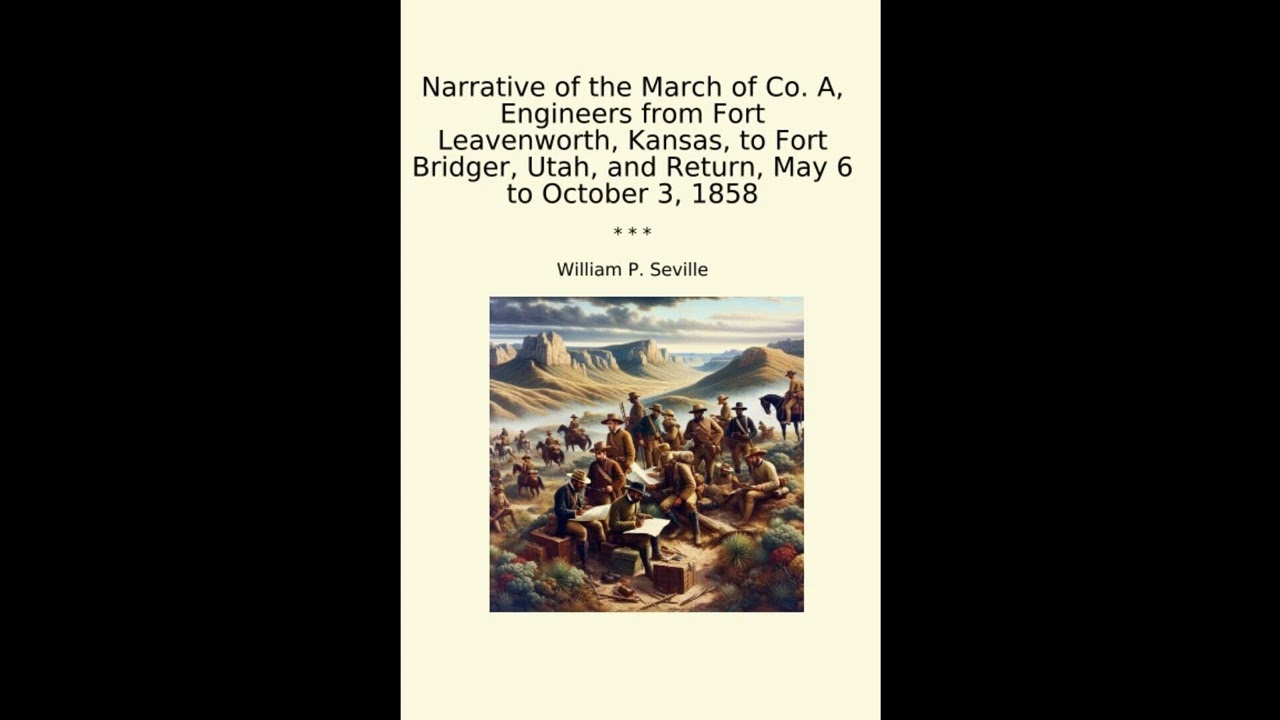
Narrative of the March of Co. A, Engineers from Fort Leavenworth, Kansas, to Fort Br- Full Audiobook
The roar of the modern world often drowns out the quiet, resolute footsteps of history. Yet, some accounts possess a unique power to transport us directly into another time, another struggle, another way of life. The Narrative of the March of Co. A, Engineers from Fort Leavenworth, Kansas, to Fort Br- offers precisely such an opportunity. This rare, unvarnished account pulls back the curtain on the daily realities of military life on the American frontier, chronicling a particular expedition with an almost scientific precision. It is more than just a military record; it is a human document, a testament to endurance, and a window into the arduous process of shaping a nation, making it profoundly relevant for anyone seeking a genuine connection to the past, unmediated by later interpretation. This historical record places us squarely in the mid-19th century, among the men of Company A, Engineers, as they prepare to set out from Fort Leavenworth, Kansas. This post, already a vital hub for westward expansion and military operations, served as the genesis point for countless expeditions into the untamed territories. The narrative begins with the logistical challenges inherent in such an undertaking: the provisioning of supplies, the organization of equipment, and the sheer human effort required to move an entire company across vast, often unmapped lands. The central concern is the physical and mental test posed by the march itself—a prolonged movement over challenging terrain towards a frontier outpost, referred to in the text as "Fort Br-". The "plot," as it were, unfolds through the rhythm of daily life on the trail: the breaking of camp at dawn, the long hours of marching under varying conditions, the establishment of bivouacs at dusk. The reader becomes an unseen member of the company, witnessing the meticulous details that comprised existence on the frontier. The narrator, a keen observer, records not just distances covered and routes taken, but also observations of the natural world, the state of the men's morale, and the constant vigilance required in an uncertain environment. There is no grand antagonist beyond the relentless demands of the landscape and the weather; the primary struggle is against fatigue, the elements, and the inherent challenges of military discipline in motion. The story details the company's progression day by day, charting their physical course and implicitly, their collective perseverance. This account does not promise high drama or earth-shattering revelations, but instead delivers the compelling, often overlooked, power of lived experience and the steady, determined drive towards a distant objective. With an author noted simply as "Unknown" and a publication year of "0," the Narrative of the March of Co. A, Engineers stands as a unique kind of literary artifact. Instead of attributing the text to a named individual, we recognize it as part of a significant tradition: the firsthand military report or personal journal from an era when such documents were crucial for both official record-keeping and for understanding the vast, dynamic changes occurring across the continent. These kinds of accounts often originated from officers or enlisted men tasked with documenting their unit's movements, observations, and encountered conditions. They might have been official reports intended for commanders, or private journals kept for personal reflection or later sharing with family. The anonymity of the author, far from diminishing the narrative's value, actually enhances its status as a direct, unmediated primary source. It suggests a focus on the events themselves, rather than the personality of the chronicler. This text falls within the broader category of frontier narratives and military histories that proliferated in the 19th century, documenting the expansion of the United States. Such writings range from official government surveys to personal memoirs, and collectively they form an invaluable repository of information about a period of immense change. The very existence of this detailed account underscores the importance placed on recording and understanding the logistical and human elements of military deployment in the American West. Several significant themes emerge from the precise, unadorned prose of the narrative. Foremost among them is human endurance and resilience. The text consistently documents the physical toll of marching long distances day after day, whether under a relentless sun or through inclement weather. We witness the men’s unwavering continuation of their duties, their ability to adapt to discomfort, and the collective push required to achieve their goal. For instance, the descriptions of making camp after a particularly arduous day, the simple acts of eating and resting, underscore the fundamental human capacity to persevere against constant physical strain. Another key theme is the experience of the American frontier. The narrative paints a vivid picture of the landscape itself—its vastness, its challenges, and its often unforgiving nature. The company's progress through plains, over rivers, and across varying terrains illustrates not only the physical geography but also the sheer scale of the task of simply traversing the continent. The Engineers, by their very nature, were tasked with understanding and often shaping this frontier. A third important theme is military life and discipline. Far from a romanticized view, the narrative presents the gritty reality of a soldier's existence: the daily routines, the hierarchical structure, the reliance on orders, and the collective action that defined unit cohesion. Details about camp organization, the management of supplies, and the execution of specific tasks, such as building temporary crossings or surveying routes, showcase the systematic nature of military operations. Finally, the act of observation and documentation itself functions as a profound theme. The narrator's commitment to recording distances, topography, weather conditions, and the general state of the company highlights the human impulse to make sense of experience, to create a record, and to contribute to a larger understanding. The narrative’s careful cataloging of events and details reflects a practical, reportorial mindset, aimed at capturing a precise slice of history. This narrative likely emerged from a distinct period in American history, specifically the mid-19th century, when the concept of "Manifest Destiny" dominated national discourse. The United States was actively expanding westward, solidifying its claims, and establishing a presence across the vast territories acquired through purchase and conflict. Fort Leavenworth, established in 1827, served as a crucial logistical and staging area for military expeditions, scientific surveys, and emigrant trains moving into the unorganized territories. The Engineers, as a branch of the military, were particularly vital during this era, responsible for mapping, building fortifications, surveying routes for roads and railroads, and generally facilitating the movement and settlement of the frontier. The demand for accurate records of these movements, both for strategic planning and historical purposes, would have been high, making such detailed accounts invaluable. Listening to Narrative of the March of Co. A, Engineers as an audiobook offers a uniquely immersive and powerful experience. The very nature of this account—a day-by-day record of sustained physical movement—lends itself perfectly to auditory consumption. As the narrator’s voice recounts the measured progress of the company, listeners can almost march alongside them, the rhythm of the words echoing the cadence of footsteps across the plains. The several hours of run length allow for a deep, sustained engagement with the material, ideal for long commutes, thoughtful walks, or quiet evenings when one wishes to step away from the present. Pay close attention to the deliberate pacing of the narration, which mirrors the slow, methodical advancement of the company. The straightforward, often understated voice of the narrator brings an authenticity to the period, allowing the events to speak for themselves, without undue dramatic embellishment. This creates an atmosphere that is both historically vivid and deeply personal, connecting the listener directly to the grit and determination of those who charted the course of the American West.
Enjoyed Narrative of the March of Co. A, Engineers from Fort Leavenworth, Kansas, to Fort Br- Full Audiobook? A few ways to support us
Audible & Amazon links are affiliate; we may earn a small commission at no extra cost.
About this production
Human narration by a volunteer reader from LibriVox.org, the public-domain audiobook project. LibriVox volunteers record literary works whose copyright has expired in the United States, releasing the resulting recordings into the public domain.
Narrative of the March of Co. A, Engineers from Fort Leavenworth, Kansas, to Fort Br- Full Audiobook. The underlying text is in the U.S. public domain. We do not republish any modern copyrighted edition, translation, or commentary.
The 4K cinematic visuals accompanying this audiobook are generated by an AI image model from prompts derived from the source text. No copyrighted photos, paintings, or stock footage are used. AI generation is disclosed on every video on our YouTube channel as required by YouTube's altered/synthetic content policy.
English subtitles are transcribed from the LibriVox recording with OpenAI Whisper. Translations into the 11 other supported languages are produced by Meta's NLLB-200 neural translation model. No human translator's copyrighted translation is used.
Questions about sourcing or rights? See our DMCA & Sourcing policy or contact us.
Enjoyed this audiobook?
If you'd like to own a copy of Narrative of the March of Co. A, Engineers from Fort Leavenworth, Kansas, to Fort Br- Full Audiobook or hear a professionally produced edition, the links below help support free audiobook production at no extra cost to you.
As an Amazon Associate we earn from qualifying purchases. Audible / print links are affiliate.
More by Unknown
Graining And Marbling: A Series Of Practical Treatises On Material, Tools And Applia- Full Audiobook

The Press-Gang Afloat and Ashore

A Narrative of the Siege of Delhi. With an Account of the Mutiny at Ferozepore