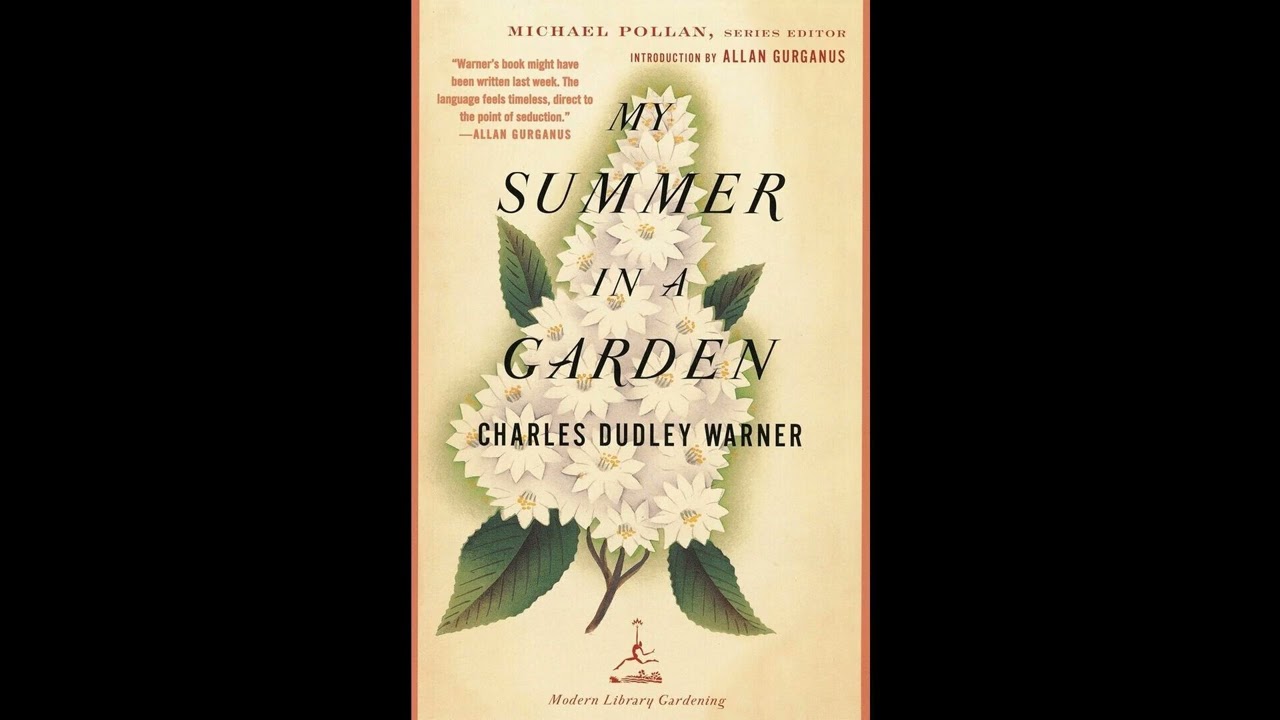
My Summer in a Garden
Step into a world where the most formidable adversaries are not villains or monsters, but rather weeds, bugs, and the relentless, often inscrutable will of nature itself. Charles Dudley Warner's My Summer in a Garden offers a delightful escape into the everyday struggles and profound satisfactions of a novice gardener. This classic work, first published in 1871, remains astonishingly fresh and relevant today, a gentle reminder that our attempts to impose order on the natural world, and indeed on life, are often met with humorous resistance. It is a balm for the overstimulated mind, a charming discourse on patience, observation, and the enduring human quest for a patch of green—a quest that speaks to our modern longing for simplicity and connection amidst an ever-complexifying world. The story unfolds as our unnamed narrator, an enthusiastic but decidedly inexperienced gentleman, resolves to cultivate a garden around his newly acquired home. He approaches this endeavor with an almost military zeal, mapping out his prospective vegetable plots and flowerbeds with meticulous care, brimming with grand visions of verdant bounty and horticultural triumph. However, the soil, the seeds, and the very elements conspire to challenge his lofty ideals. From the moment he attempts to sow his first crops, he finds himself locked in an epic, yet entirely domestic, battle. The setting is his own backyard, an ordinary plot of land in a quiet, perhaps suburban, locale, which quickly transforms into a testing ground for his patience and an arena for constant, often comical, skirmishes. The central conflict, such as it is, arises from the clash between the narrator’s idealistic expectations and the stubbornly independent spirit of his garden. He yearns for neat rows and predictable growth, but is instead confronted by the rampant anarchy of weeds, the mysterious disappearances of his seedlings, and the peculiar, almost sentient, insistence of potatoes to sprout wherever they please. His long-suffering wife, often referred to simply as "the Woman," offers practical advice and occasional, gentle admonishment, serving as a grounding force against his more outlandish horticultural theories. The arc of the summer sees the narrator's initial fervent optimism slowly yield to a more measured, though no less passionate, understanding of his green dominion. He learns, through trial and error and no small amount of exasperation, that a garden has a mind of its own, and that true success lies not in absolute control, but in a humorous, observant surrender to its rhythms. The author behind this charming horticultural memoir was Charles Dudley Warner, born in Plainfield, Massachusetts, in 1829. A prominent figure in American letters during the latter half of the nineteenth century, Warner’s early career took him from studying law to working as a surveyor in Missouri, before he found his true calling in journalism and literary pursuits. He joined the Hartford Evening Press, eventually becoming its editor, and later served as an associate editor for the Hartford Courant. Warner was more than just an editor; he was a prolific essayist, travel writer, and novelist, known for his keen observations, gentle wit, and reflective prose. Perhaps his most famous collaboration, and a significant moment in American literary history, was his co-authorship with his close friend and neighbor, Mark Twain, on The Gilded Age: A Tale of Today, published in 1873. This satirical novel coined the term that would forever define an era of American history. Beyond this, Warner penned numerous collections of essays, such as Backlog Studies and Being a Boy, and travel sketches like Baddeck, and That Sort of Thing, all showcasing his distinctive blend of humor, philosophy, and detailed description. He occupied a respected place in the American literary landscape, known for his refined style and intellectual curiosity, contributing significantly to the essay tradition that flourished in his time. He passed away in Hartford, Connecticut, in 1900, leaving behind a body of work that continues to provide both amusement and insight. My Summer in a Garden enacts several significant themes, perhaps most notably the enduring struggle between humanity and the wildness of nature. Warner’s narrator constantly attempts to impose his will on his garden, drawing precise lines and planning specific yields, only to find nature pushing back with a mischievous indifference. We witness his frustration as the potato, a plant he deems particularly willful, spreads beyond its designated patch, asserting its own territorial rights. This conflict becomes a poignant, often hilarious, commentary on the illusion of human control in the face of the natural world’s vast, untamed power. Another key theme is the power of humor and self-deprecation as a coping mechanism. The narrator’s endless battles with weeds, which he personifies with distinct personalities, or his lamentations over the apparent conspiracy of slugs against his prized vegetables, are always infused with a wry, self-aware humor. He laughs at his own earnest efforts, at the disproportionate scale of his struggles, and at the sheer absurdity of trying to reason with a radish. This constant vein of gentle comedy makes the book not just a record of a summer's gardening, but a delightful study of human foibles and the joy found in embracing imperfection. The book first appeared in 1871, a time in America often referred to as the post-Civil War era or the nascent years of the Gilded Age. This was a period of immense change: rapid industrialization, burgeoning cities, and the westward expansion. While many Americans were moving towards urban centers and embracing the promise of modern life, there was also a growing cultural appreciation for nature and a nostalgic yearning for simpler, agrarian existences. Books like Warner’s provided a gentle counter-narrative, a quiet contemplation of life’s smaller rhythms amidst the clamor of progress. It emerged when essay writing and humorous sketches were popular forms of literary expression, appealing to a burgeoning middle class that might now have the leisure, and indeed the small plot of land, to consider the joys and frustrations of a summer garden. Listening to My Summer in a Garden as an audiobook offers a unique pleasure. The conversational, often whimsical nature of Warner’s prose lends itself perfectly to the spoken word. A skilled narrator can truly bring out the subtle shifts in the author’s tone—from the initial burst of hopeful enthusiasm to the later, more resigned but still utterly charmed acceptance of his garden’s anarchic spirit. The run length is perfectly suited for savoring in short bursts during a commute, while tending your own patch of green, or as a soothing backdrop to a quiet afternoon. Pay attention to the narrator’s pacing, which should mirror the slow, seasonal progression of the summer, and the nuanced delivery of Warner’s delightful observations. The subtle humor, the direct address to the "reader" (now listener), and the evocative descriptions of birdsong, rustling leaves, and the persistent hum of insects, all combine to create an atmospheric and deeply satisfying auditory experience that connects you directly to Warner’s delightful summer world.
Enjoyed My Summer in a Garden? A few ways to support us
Audible & Amazon links are affiliate; we may earn a small commission at no extra cost.
About this production
Human narration by a volunteer reader from LibriVox.org, the public-domain audiobook project. LibriVox volunteers record literary works whose copyright has expired in the United States, releasing the resulting recordings into the public domain.
My Summer in a Garden by Charles Dudley Warner. The underlying text is in the U.S. public domain. We do not republish any modern copyrighted edition, translation, or commentary.
The 4K cinematic visuals accompanying this audiobook are generated by an AI image model from prompts derived from the source text. No copyrighted photos, paintings, or stock footage are used. AI generation is disclosed on every video on our YouTube channel as required by YouTube's altered/synthetic content policy.
English subtitles are transcribed from the LibriVox recording with OpenAI Whisper. Translations into the 11 other supported languages are produced by Meta's NLLB-200 neural translation model. No human translator's copyrighted translation is used.
Questions about sourcing or rights? See our DMCA & Sourcing policy or contact us.
Enjoyed this audiobook?
If you'd like to own a copy of My Summer in a Garden or hear a professionally produced edition, the links below help support free audiobook production at no extra cost to you.
As an Amazon Associate we earn from qualifying purchases. Audible / print links are affiliate.