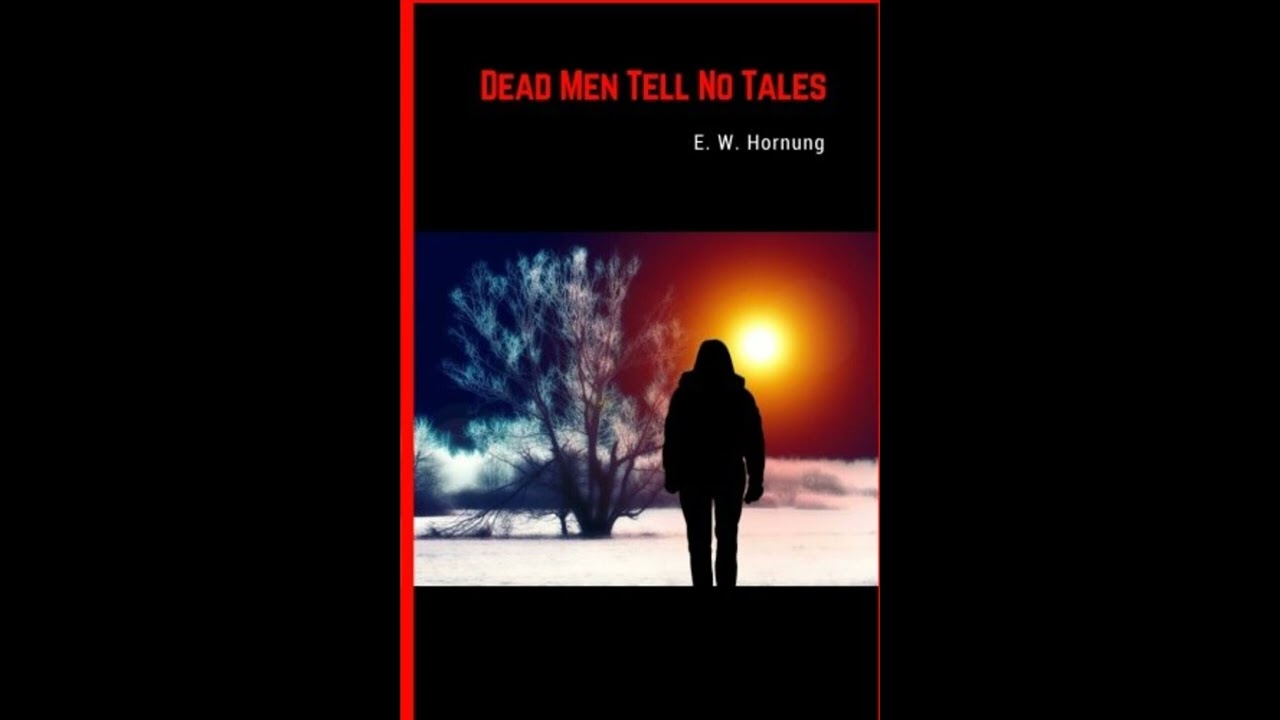
Dead Men Tell No Tales
Enter a world where the sea guards secrets and the past refuses to stay buried, a realm of deception, pursuit, and the chilling truth that some lies are best left undisturbed. E. W. Hornung’s Dead Men Tell No Tales is a forgotten jewel of early twentieth-century suspense, a novel that plunges its characters — and its listeners — into a gripping narrative of mistaken identity, calculated revenge, and the relentless grip of fate. Published at the dawn of a new century, this story stands as a testament to the enduring power of classic adventure literature, its themes of justice, moral ambiguity, and the quest for truth resonating with an intensity that transcends its original era. If you appreciate a finely wrought mystery steeped in atmosphere and character, Hornung offers a compelling tale that feels both familiar in its classic structure and fresh in its execution. The story opens on the remote, sun-drenched coast of Australia, a land that serves as both a refuge and a prison for its inhabitants. Here, Philip Weld, a man haunted by a shadow in his own past, has sought a new beginning, finding a semblance of peace in the quiet life of a lighthouse keeper. His solitude is brutally shattered by a dramatic and gruesome discovery: a derelict yacht adrift, its single occupant a figure seemingly returned from the dead. This spectral encounter — with a man whose face, though disfigured, bears an uncanny resemblance to someone long thought lost beneath the waves — pulls Philip into a complex web of events he can neither comprehend nor escape. As Philip tries to unravel the mystery surrounding the man's survival and his true intentions, he finds himself increasingly entangled with a cast of characters who seem to orbit the enigma: a beautiful woman with her own hidden grief, a cunning and dangerous adversary, and the lingering presence of a crime committed years before. The narrative quickly transforms into a tense game of cat and mouse, with Philip caught between the desire for answers and the immediate threat to his life. He must navigate treacherous waters, both literal and metaphorical, as he pieces together the fragments of a conspiracy, all while confronting his own vulnerability and the potential for a devastating personal cost. The story builds with a steady, mounting dread, drawing the listener deeper into a world where trust is a luxury and danger lurks just beneath the surface of everyday life. Ernest William Hornung, born in 1866 in Middlesbrough, England, was a writer whose life and career intersected with some of the most prominent literary figures of his time. He spent a significant period in Australia during his younger years, a experience that profoundly influenced his writing, particularly his vivid descriptions of the continent's landscape and its distinct colonial atmosphere. This firsthand knowledge of Australia provided a unique backdrop for many of his adventure stories, including Dead Men Tell No Tales. Hornung eventually returned to England, where he established himself as a successful author of fiction, often focusing on tales of crime, suspense, and adventure. His most famous creation remains A. J. Raffles, the "amateur cracksman" — a gentleman thief who navigated London society with charm and criminal ingenuity. Raffles was, in many ways, an inverted reflection of Sherlock Holmes, a character created by Hornung’s brother-in-law, Arthur Conan Doyle. The literary relationship between the two authors was a friendly rivalry, with Hornung dedicating his first Raffles book to Doyle, acknowledging the inspiration. Hornung’s works, including Dead Men Tell No Tales published in 1901, positioned him as a significant voice in the late Victorian and Edwardian periods, contributing to the burgeoning popularity of detective and adventure fiction that captivated a wide readership. He passed away in 1921, leaving behind a body of work that continues to attract readers interested in the genesis of modern crime narratives. At its core, Dead Men Tell No Tales engages with profound themes, most notably that of identity and deception. Characters in this story are rarely who they seem; names are assumed, pasts are fabricated, and appearances are meticulously maintained to conceal darker truths. For instance, the very premise hinges on a man’s apparent return from death, forcing the protagonist, Philip Weld, to question the reliability of his own perception and the identities of those around him. This theme manifests in every crucial encounter, whether it is the eerie reappearance of a long-lost figure or the careful misdirection employed by those seeking to protect or exploit secrets. Another significant theme is the enduring reach of justice and revenge. The narrative is propelled by the consequences of past actions, as a long-dormant injustice demands retribution, casting a long shadow over the present. We see characters driven by a fierce desire to right old wrongs or to escape the consequences of their own misdeeds. This plays out in the relentless pursuit that defines much of the book’s tension, as individuals are forced to confront the ramifications of choices made years ago, demonstrating how the past, no matter how carefully buried, invariably surfaces to dictate the future. The story also touches on the concept of moral ambiguity, where the lines between hero and villain, right and wrong, become increasingly blurred, challenging the listener to consider the motivations behind each character's actions. Dead Men Tell No Tales emerged at a fascinating juncture in literary and cultural history, the turn of the twentieth century. This was an era marked by the continued expansion of the British Empire, and with it, a widespread public fascination with distant lands and exotic adventures. Stories of colonial exploits, mysteries set in far-flung locales, and tales of daring individuals facing down unknown dangers were immensely popular. Hornung's use of the Australian coast as a setting tapped into this appetite for the remote and the untamed, offering a vivid backdrop that felt both familiar in its British connection and distinctly unique in its rugged beauty. The period also saw the solidification of popular fiction as a dominant literary form, particularly in the genres of crime and adventure. Following the immense success of Arthur Conan Doyle's Sherlock Holmes stories, there was a keen public demand for narratives that offered puzzles, suspense, and a strong sense of danger. Hornung, with his Raffles stories and novels like Dead Men Tell No Tales, contributed significantly to this wave, crafting narratives that blended intricate plots with compelling character studies. His work reflected the Edwardian sensibilities of the time, where social order and individual morality were often tested against the backdrop of thrilling personal struggles and complex interpersonal dramas, capturing the anxieties and excitements of a society on the cusp of significant change. Listening to Dead Men Tell No Tales as an audiobook transforms Hornung's prose into an immersive, immediate experience. The narrator's voice becomes the conduit for the rising tension and the shifting loyalties that define the story. Hear how the performance subtly emphasizes the desolate beauty of the Australian setting, allowing the listener to visualize the sun-baked cliffs and the restless ocean that frames Philip Weld's ordeal. Pay close attention to the distinct vocalizations that bring each character to life – the protagonist's quiet desperation, the chilling composure of the antagonist, and the nuanced expressions of those caught in the unfolding drama. The pacing of the narration is crucial here, as it allows the intricate plot to unfold with clarity, giving ample space for the suspense to build and for the listener to absorb the clues and misdirections that punctuate the narrative. This auditory rendition brings an additional layer of atmosphere to a story already rich in mystery and intrigue.
Enjoyed Dead Men Tell No Tales? A few ways to support us
Audible & Amazon links are affiliate; we may earn a small commission at no extra cost.
About this production
Human narration by a volunteer reader from LibriVox.org, the public-domain audiobook project. LibriVox volunteers record literary works whose copyright has expired in the United States, releasing the resulting recordings into the public domain.
Dead Men Tell No Tales by E. W. Hornung. The underlying text is in the U.S. public domain. We do not republish any modern copyrighted edition, translation, or commentary.
The 4K cinematic visuals accompanying this audiobook are generated by an AI image model from prompts derived from the source text. No copyrighted photos, paintings, or stock footage are used. AI generation is disclosed on every video on our YouTube channel as required by YouTube's altered/synthetic content policy.
English subtitles are transcribed from the LibriVox recording with OpenAI Whisper. Translations into the 11 other supported languages are produced by Meta's NLLB-200 neural translation model. No human translator's copyrighted translation is used.
Questions about sourcing or rights? See our DMCA & Sourcing policy or contact us.
Enjoyed this audiobook?
If you'd like to own a copy of Dead Men Tell No Tales or hear a professionally produced edition, the links below help support free audiobook production at no extra cost to you.
As an Amazon Associate we earn from qualifying purchases. Audible / print links are affiliate.