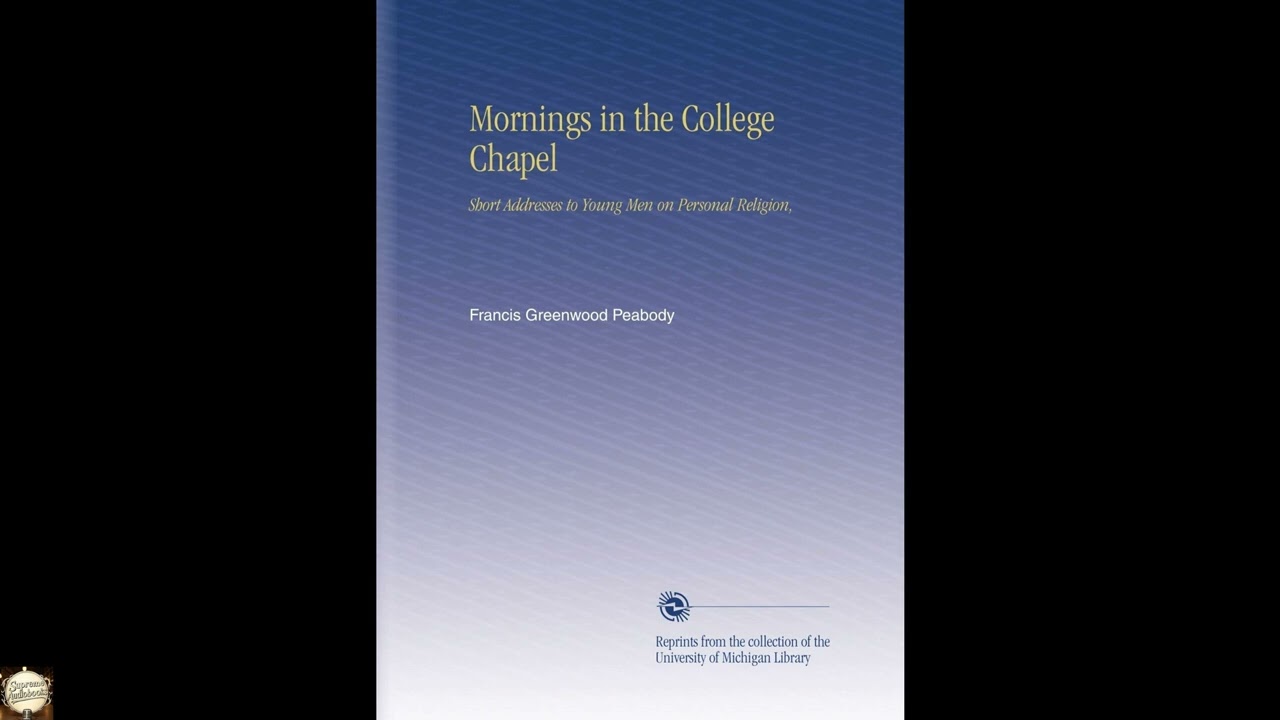
Mornings in the College Chapel: Short Addresses to Young Men on Personal Religion
Standing at the threshold of adulthood, young men often face a unique set of challenges: the weight of new responsibilities, the allure of differing philosophies, and the quiet, persistent questions of personal identity and purpose. "Mornings in the College Chapel: Short Addresses to Young Men on Personal Religion" steps into this critical juncture, offering a series of thoughtful meditations designed to guide and inspire. This collection, likely born from a tradition of moral and spiritual instruction within esteemed educational institutions, speaks directly to the enduring human need for grounding principles. Even today, in a world that often feels fractured and uncertain, these addresses offer a quiet space for reflection, encouraging listeners to consider the foundations of their character, the scope of their convictions, and the path of a life lived with intention and integrity. It is a voice of gentle wisdom, urging self-examination and the cultivation of an inner life that can withstand the tests of time and circumstance. The addresses within this collection unfold not as a linear narrative but as a structured discourse, each piece building upon the previous in a progression of spiritual and ethical development. Imagine a quiet morning in a college chapel, the first rays of light streaming through stained glass, as a respected mentor addresses a gathering of students. The speaker, though unnamed, emerges as a figure of experience and deep conviction, offering counsel not with dogmatic decree, but with an invitational tone, prompting the young men to engage with profound questions. The central focus rests on the concept of "personal religion"—not merely outward observance, but the intimate, internal relationship between an individual and their faith, shaping their decisions, their conscience, and their very being. The implied "plot" of "Mornings in the College Chapel" is the intellectual and spiritual maturation of its audience. The "conflict" is the internal struggle faced by young men grappling with newfound intellectual freedoms, moral ambiguities, and the pressures of societal expectation alongside their personal ideals. Each address tackles a facet of this internal landscape—from the nature of prayer and the importance of honesty, to the demands of duty and the pursuit of truth. The collection serves as a steady hand, gently navigating these complex waters, proposing that a robust personal faith can be a compass in navigating life's inevitable storms, fostering resilience, compassion, and a clear sense of moral direction. Given that the author of "Mornings in the College Chapel" remains uncredited, this collection stands as a testament to a venerable tradition rather than the singular vision of an individual. Such anonymity often points to a desire for the message itself to transcend personal attribution, becoming instead a voice of collective wisdom, representing the shared values and spiritual guidance offered by an institution. These addresses likely originated from the late nineteenth or early twentieth century, a period when chapel services were a cornerstone of academic life in many universities, particularly those founded on religious principles. The practice of a dean, a headmaster, or a chaplain offering short, reflective sermons to students was a common and cherished part of the educational experience. This tradition was not merely about religious indoctrination, but about holistic character formation. Universities of the era saw it as their duty not only to educate the mind but also to cultivate the moral and spiritual dimensions of their students, preparing them not just for careers, but for lives of purpose and principled leadership. "Mornings in the College Chapel" therefore embodies this ethos, serving as a pastoral expression of an institution's commitment to the spiritual welfare and ethical development of the young men entrusted to its care. It reflects a belief that intellectual rigor and spiritual depth were not separate pursuits but intrinsically linked, each enriching and informing the other, to produce well-rounded individuals ready to contribute meaningfully to society. At its heart, "Mornings in the College Chapel" addresses several enduring themes, chief among them personal piety and inner life. The addresses consistently advocate for a robust inner world, a space of spiritual discipline and self-reflection that serves as a wellspring for outward conduct. For instance, one might find an address discussing the quiet practice of prayer, not as a ritual, but as an intimate conversation, a cultivation of spiritual awareness that grounds one’s actions and thoughts. Another crucial theme is moral courage and integrity. The addresses challenge young men to stand firm in their convictions, even when facing peer pressure or difficult choices. A vivid example might be an address that encourages honesty in academic pursuits, drawing a clear line between the temporary advantage of deceit and the lasting dignity of truthfulness, illustrating how integrity is not merely a rule, but a foundational strength of character. A third significant theme woven throughout is intellectual honesty and faith. The addresses gently assert that genuine faith is not afraid of questioning or reasoned inquiry; instead, it is strengthened by rigorous thought. This might manifest in a segment discussing the harmony between scientific discovery and spiritual understanding, reassuring young minds that intellectual pursuit and religious conviction need not be antagonistic but can, in fact, complement one another. Finally, the addresses implicitly champion service and social responsibility. While focused on personal religion, the ultimate aim is often to equip these young men for lives of positive contribution to their communities and the wider world, suggesting that true spiritual growth naturally leads to a compassionate engagement with others and a commitment to justice, perhaps through references to using one's gifts for the common good. The period from which "Mornings in the College Chapel" likely emerged—the late nineteenth or early twentieth century—was a fascinating crucible of change. Culturally, Western society was grappling with the implications of industrialization, rapid urbanization, and a burgeoning scientific worldview that, for some, seemed to challenge traditional religious doctrines. Politically, nations were often engaged in imperial expansion and domestic reform, demanding a new generation of leaders with strong moral compasses. In the literary world, authors like Matthew Arnold debated the role of culture and religion, while thinkers like John Henry Newman championed the integration of faith and reason within education. This was a time when institutions of higher learning, particularly those with a religious heritage, felt a profound responsibility to provide not just academic instruction but also ethical and spiritual guidance. "Mornings in the College Chapel" can be understood as a direct response to this need—a series of spiritual compass points offered to young men poised to navigate a world of unprecedented complexity and opportunity, reminding them of the enduring values that transcend fleeting trends. Listening to "Mornings in the College Chapel" as an audiobook allows for a deeply immersive and reflective experience. The spoken word brings these addresses to life in a way that reading on a page often cannot, allowing the listener to truly inhabit the atmosphere of a quiet chapel service. A skilled narrator's thoughtful, measured pacing, and a voice that conveys both reverence and intellectual depth, can transform these printed words into living counsel. The "several hours" run length makes it ideal for daily segments of reflection, perhaps during a commute, a morning walk, or as a calming prelude to the day. Listen for the subtle shifts in tone—moments of gentle admonition giving way to soaring inspiration—and how the narrator's voice underscores the wisdom and earnestness of the speaker. This format invites a personal engagement, creating an intimate space where these timeless questions of character, faith, and purpose can resonate anew.
Enjoyed Mornings in the College Chapel: Short Addresses to Young Men on Personal Religion? A few ways to support us
Audible & Amazon links are affiliate; we may earn a small commission at no extra cost.
About this production
Human narration by a volunteer reader from LibriVox.org, the public-domain audiobook project. LibriVox volunteers record literary works whose copyright has expired in the United States, releasing the resulting recordings into the public domain.
Mornings in the College Chapel: Short Addresses to Young Men on Personal Religion by Francis Greenwood Peabody. The underlying text is in the U.S. public domain. We do not republish any modern copyrighted edition, translation, or commentary.
The 4K cinematic visuals accompanying this audiobook are generated by an AI image model from prompts derived from the source text. No copyrighted photos, paintings, or stock footage are used. AI generation is disclosed on every video on our YouTube channel as required by YouTube's altered/synthetic content policy.
English subtitles are transcribed from the LibriVox recording with OpenAI Whisper. Translations into the 11 other supported languages are produced by Meta's NLLB-200 neural translation model. No human translator's copyrighted translation is used.
Questions about sourcing or rights? See our DMCA & Sourcing policy or contact us.
Enjoyed this audiobook?
If you'd like to own a copy of Mornings in the College Chapel: Short Addresses to Young Men on Personal Religion or hear a professionally produced edition, the links below help support free audiobook production at no extra cost to you.
As an Amazon Associate we earn from qualifying purchases. Audible / print links are affiliate.