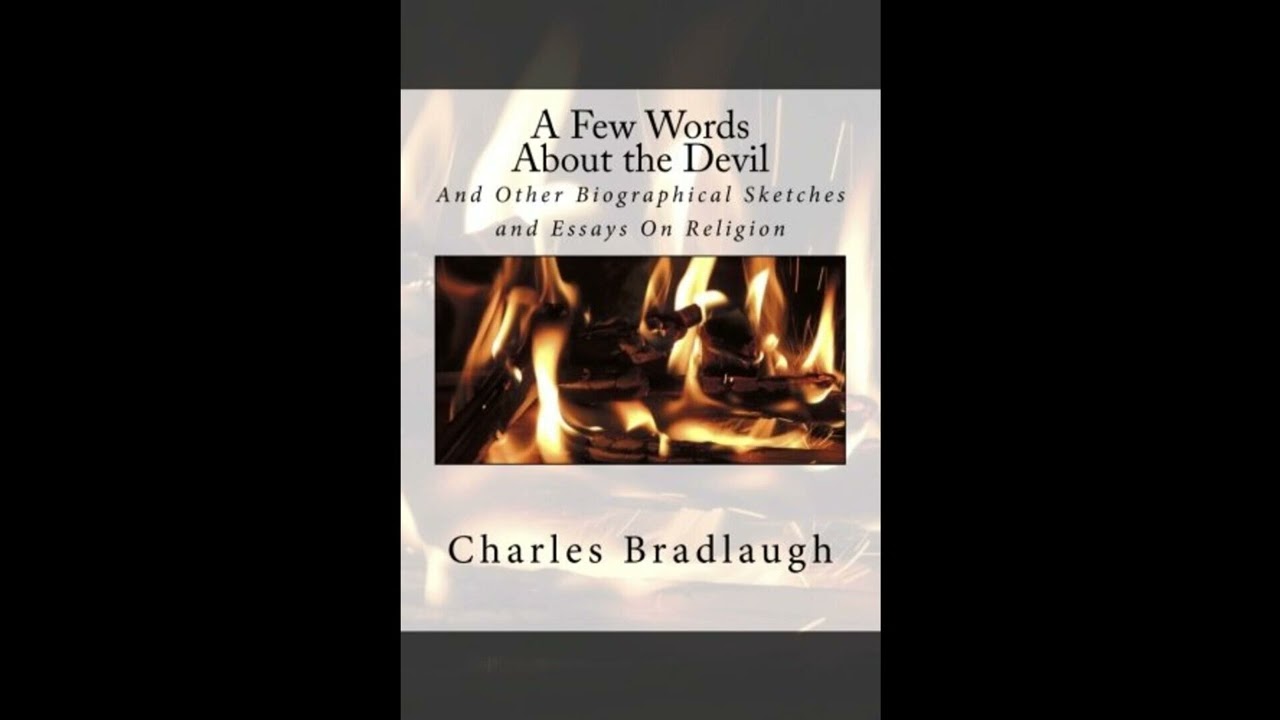
A Few Words About the Devil: And Other Biographical Sketches and Essays On Religion
In an age where certainty often feels elusive and ancient questions continually resurface, "A Few Words About the Devil: And Other Biographical Sketches and Essays On Religion" offers a singular opportunity for reflection. This collection of profound and often provocative writings, presented here as an audiobook, stands as a testament to humanity’s enduring fascination with the sacred and the profane, with the origins of belief and the nature of doubt. It is not merely a historical artifact; it is an active conversation, inviting listeners to engage with intellectual inquiries that shaped civilizations and continue to inform our modern understanding of ethics, morality, and the human condition. Why should one care today? Because the fundamental questions these essays pose—about good and evil, faith and reason, the lives of spiritual figures, and the interpretations of sacred narratives—are as vital and unresolved now as they ever were, urging us to examine our own perspectives with renewed rigor. The collection itself defies a traditional narrative structure, instead presenting an intellectual landscape painted with varying shades of inquiry. It opens, famously, with "A Few Words About the Devil," a concentrated examination of one of Western civilization's most potent and enigmatic symbols. This initial section does not preach; rather, it methodically unpacks the theological, mythological, and psychological dimensions of the Devil, tracing his evolution from ancient adversarial figures to the embodiment of evil in monotheistic traditions. It scrutinizes the concept's function within belief systems, its influence on human behavior, and the myriad interpretations it has spawned across centuries. From this intense focus on a singular, powerful concept, the collection expands its purview. The subsequent "Biographical Sketches" shift focus to the human agents of religious history—saints, reformers, heretics, and philosophers whose lives became crucibles for faith or doubt. These sketches are not hagiographies, but rather incisive portrayals, seeking to understand the motivations, struggles, and legacies of individuals who profoundly impacted religious thought and practice. Each profile serves as a micro-narrative, revealing how personal conviction intersects with broader spiritual movements and societal forces. Finally, the "Essays On Religion" broaden the scope further, addressing foundational questions of belief, ritual, scripture, and the institutional aspects of faith. These pieces serve as a comprehensive intellectual forum, challenging assumptions and offering diverse perspectives on the human encounter with the divine, culminating in a panoramic view of religious experience and thought. The author of this compelling collection remains unknown, a circumstance not uncommon for works that emerged from periods of intense intellectual or theological discourse. This anonymity, far from diminishing its impact, imbues the text with a particular resonance, allowing the arguments and insights to stand unimpeded by an individual author's renown or biography. Instead, the focus rests entirely on the ideas themselves, on the strength of the reasoning, and on the historical weight of the subjects discussed. Such works often arise from a collective intellectual current, representing a synthesis of scholarship or a particular school of thought prevalent during their creation. They can also represent a strategic choice, where the gravity of the subject matter or the desire to avoid personal controversy led to a deliberate concealment of authorship, ensuring the message transcended any single voice. The enduring presence of such anonymous contributions in the canon of classic literature reminds us that intellectual movements are often larger than their individual proponents. At its core, this work grapples with several profound themes that resonate across cultures and centuries. One central theme is The Nature of Evil, exemplified by the lead essay itself. The text does not simply accept evil as a given, but dissects its conceptual origins, showing how ideas of malevolence evolve with theological shifts and societal anxieties—from a simple adversary to a complex, multi-faceted entity embodying temptation, rebellion, and cosmic disorder. Another prominent theme is The Interplay of Faith and Reason. Throughout the biographical sketches, listeners witness figures torn between revelation and empirical observation, between dogmatic adherence and intellectual skepticism. One sketch might highlight a saint whose miracles test the limits of credulity, while another might portray a philosopher whose logical arguments challenge established doctrines, forcing us to consider the uneasy alliance and frequent conflict between these two modes of understanding. A third significant theme is The Evolution of Religious Thought and Practice. The collection implicitly traces how religious ideas are not static, but develop, adapt, and are reinterpreted across generations. The biographical sketches, for instance, demonstrate how the meaning of "piety" or "heresy" can shift dramatically depending on the historical moment and cultural context. These essays illuminate how core tenets can be re-examined, how rituals can gain new significance, or how certain figures rise to prominence as symbols of shifting spiritual priorities. Collectively, these examinations offer not just historical details but also a lens through which to observe the very process of intellectual and spiritual transformation within human societies. This collection likely emerged during a period of profound intellectual re-evaluation, perhaps in the eighteenth or nineteenth century, when the Western world grappled with the implications of the Enlightenment and the rise of scientific inquiry. It was a time when historical criticism began to be applied to religious texts, when biographies of religious figures sought to understand them as complex human beings rather than solely as divine agents, and when the very foundations of faith were subjected to rigorous philosophical scrutiny. Politically, the era saw the rise of more secular states and the questioning of traditional religious authority, fostering an environment where anonymous or critical essays on religion could find an audience outside of strictly ecclesiastical circles. Such a work would have served as a vital contribution to these broader cultural and intellectual currents, reflecting a growing desire to understand religious phenomena not just as matters of belief, but as subjects worthy of historical, psychological, and philosophical analysis. Listening to "A Few Words About the Devil: And Other Biographical Sketches and Essays On Religion" as an audiobook provides an exceptional means of engaging with its substantial content. Spanning several hours, the spoken word allows the intricate arguments and nuanced historical details to unfold at a contemplative pace, transforming what could be dense prose into an accessible intellectual experience. A skilled narrator will imbue the biographical sketches with distinct vocal textures, perhaps offering a more reflective tone for a mystic, or a crisper, more analytical delivery for a philosopher, enhancing the individuality of each figure. The cadence and emphasis of the narrator's voice can illuminate the subtle distinctions between theological positions and draw attention to key rhetorical moves within the essays. It creates an atmosphere conducive to deep listening, inviting the mind to wander through the landscape of ideas, allowing one to absorb challenging concepts and appreciate the historical weight of these enduring religious debates without the visual strain of reading.
Enjoyed A Few Words About the Devil: And Other Biographical Sketches and Essays On Religion? A few ways to support us
Audible & Amazon links are affiliate; we may earn a small commission at no extra cost.
About this production
Human narration by a volunteer reader from LibriVox.org, the public-domain audiobook project. LibriVox volunteers record literary works whose copyright has expired in the United States, releasing the resulting recordings into the public domain.
A Few Words About the Devil: And Other Biographical Sketches and Essays On Religion by Charles Bradlaugh. The underlying text is in the U.S. public domain. We do not republish any modern copyrighted edition, translation, or commentary.
The 4K cinematic visuals accompanying this audiobook are generated by an AI image model from prompts derived from the source text. No copyrighted photos, paintings, or stock footage are used. AI generation is disclosed on every video on our YouTube channel as required by YouTube's altered/synthetic content policy.
English subtitles are transcribed from the LibriVox recording with OpenAI Whisper. Translations into the 11 other supported languages are produced by Meta's NLLB-200 neural translation model. No human translator's copyrighted translation is used.
Questions about sourcing or rights? See our DMCA & Sourcing policy or contact us.
Enjoyed this audiobook?
If you'd like to own a copy of A Few Words About the Devil: And Other Biographical Sketches and Essays On Religion or hear a professionally produced edition, the links below help support free audiobook production at no extra cost to you.
As an Amazon Associate we earn from qualifying purchases. Audible / print links are affiliate.