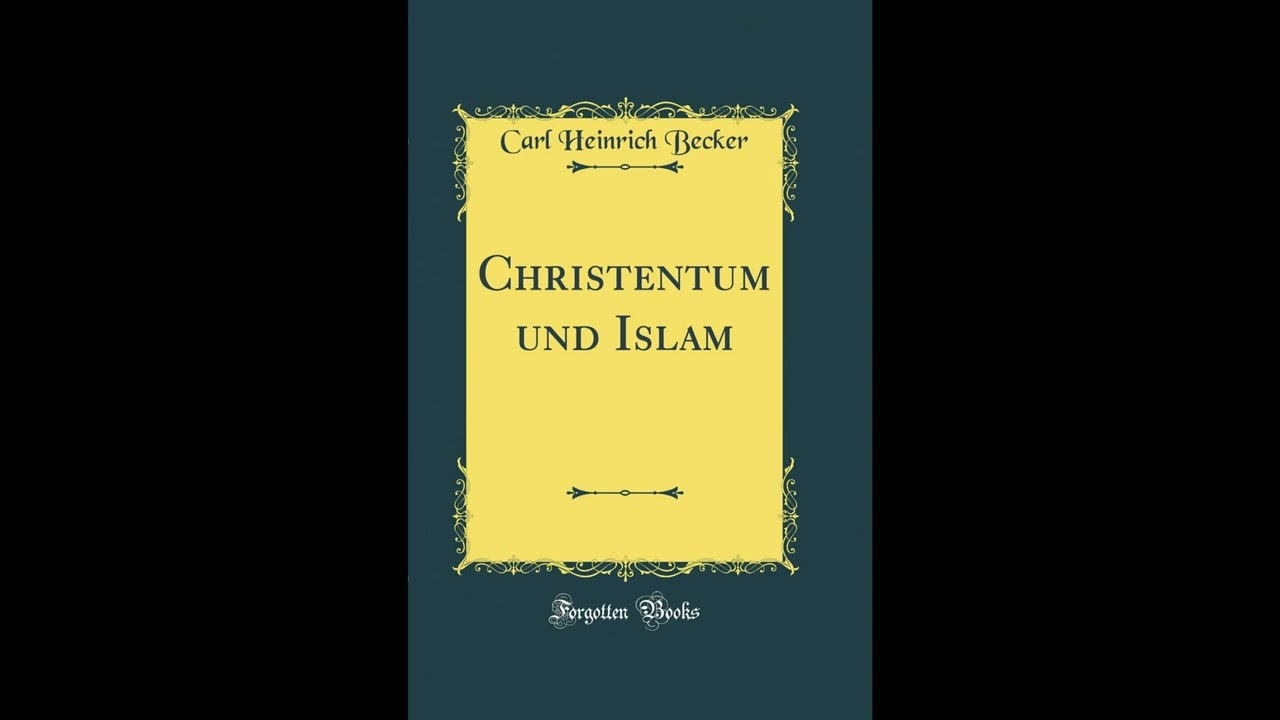
Christentum und Islam
Carl Heinrich Becker’s Christentum und Islam stands as a pivotal intellectual achievement, a book that arrived at the cusp of the twentieth century and immediately reshaped how scholars and the wider public understood the intricate historical relationship between two of the world’s most significant religions. More than a mere comparative study, this work represents a profound shift in academic methodology, challenging prevailing Eurocentric biases and advocating for a historically rigorous, empathetic approach to the study of Islam. Its enduring relevance today is undeniable, as conversations about interfaith dialogue, cultural exchange, and the shared roots of diverse traditions continue to shape global discourse. In an era marked by both conflict and calls for greater understanding, Becker’s foundational arguments offer a vital perspective, reminding us that the narratives we construct about religious others are as much a reflection of our own intellectual frameworks as they are a portrayal of history itself. This is a book that encourages deep thought, questioning assumptions, and recognizing the profound interconnectedness of human civilization. Becker’s central thesis in Christentum und Islam unfolds not as a chronological chronicle but as a carefully constructed argument, designed to dismantle common misperceptions. The setting for this intellectual endeavor is broad, encompassing the expansive historical trajectories of both Christianity, particularly its late antique and Byzantine manifestations, and the nascent and flourishing periods of Islamic civilization. Rather than presenting these traditions as isolated entities, Becker positions them as dynamic forces constantly interacting, influencing, and reacting to one another across vast geographical and temporal landscapes, from the Eastern Roman Empire to the burgeoning caliphates of the Middle East and North Africa. The main "characters" are, in a sense, the intellectual currents and historical figures that shaped these religions—early Christian theologians, the Prophet Muhammad, the founders of Islamic legal schools, and the philosophers who bridged Hellenistic thought with Arabic scholarship. The central conflict Becker addresses is the deeply ingrained Western tendency to view Islam as an alien, often hostile, and fundamentally derivative religion, separate from the Abrahamic lineage and European intellectual heritage. He confronts this prejudice head-on by meticulously demonstrating shared origins, mutual influences, and parallel developments. The arc of his argument begins by establishing a common ancient Near Eastern substratum, tracing how both religions inherited and transformed elements from late antiquity. He then systematically examines specific points of contact—philosophical ideas, scientific advancements, and even administrative practices—showing how Islam, far from being a mere imitator, developed its unique theological and cultural expressions while engaging with and often advancing the intellectual traditions it encountered. This narrative of reciprocal shaping, rather than one of clear-cut superiority or isolation, forms the compelling backbone of the book, inviting listeners to reconsider long-held historical dogmas without revealing Becker’s ultimate synthesis of these complex interactions. Carl Heinrich Becker, born in Speyer, Germany, in 1876, was a scholar whose life and work left an indelible mark on both academia and public life. His early education focused on Oriental languages, history, and theology, which laid the groundwork for his lifelong commitment to understanding the Islamic world. After completing his habilitation in 1902, he quickly rose through the academic ranks, holding professorships at the Colonial Institute in Hamburg and later at the University of Bonn. Becker’s academic pursuits were deeply rooted in the German tradition of rigorous historical and philological scholarship, but he applied these methods with a pioneering spirit, determined to move beyond theological polemics and towards an objective, academic discipline of Islamic studies—Islamwissenschaft—that treated Islam as a subject worthy of serious, critical investigation on its own terms. Beyond his scholarly achievements, Becker also distinguished himself as a statesman during the tumultuous Weimar Republic. He served twice as the Prussian Minister of Culture, from 1921 to 1925 and again from 1925 to 1930. In this capacity, he championed educational reform, promoted scientific research, and advocated for international cultural exchange, often drawing on his profound understanding of different civilizations. His administrative tenure reflected his academic conviction that knowledge and open dialogue were essential for societal progress. Becker's other notable works, such as his influential Islamstudien, further solidified his reputation as a groundbreaking scholar, establishing him as a crucial figure in the emergence of modern Islamic studies and placing him firmly within the canon of intellectual history for his efforts to bridge cultural divides through informed scholarship. He passed away in Berlin in 1933, leaving behind a legacy that continues to influence contemporary scholarship. Among the several crucial themes Becker addresses, the notion of historical interconnectedness stands out. He meticulously demonstrates how Christianity and Islam are not disparate, self-contained belief systems but rather branches from a shared Abrahamic root, continually influencing one another through philosophy, science, and even daily custom. For instance, he details how early Islamic scholarship directly engaged with and preserved Hellenistic philosophical and scientific texts, which were themselves part of the broader intellectual heritage of the Eastern Christian world. This careful tracing of intellectual genealogies challenges any simplistic narrative of religious isolation. Another prominent theme is the critique of Orientalism, long before Edward Said coined the term. Becker implicitly, yet powerfully, exposes the biases inherent in much of Western scholarship on Islam, particularly the tendency to define Islam in opposition to or as an inferior version of Christianity. He achieves this by presenting Islam's internal logic and historical development with scholarly rigor, allowing the tradition to speak for itself through its primary sources and historical context rather than through the lens of Western presuppositions. Furthermore, Becker champions religious pluralism as a methodological imperative, advocating for the study of each religion from its own historical and theological standpoint, recognizing its unique integrity and historical evolution. He avoids anachronistic judgments, instead striving to understand the conditions and motivations that shaped both Christian and Islamic thought at different junctures. This approach fosters a deeper understanding of both traditions, moving past simplistic comparisons to reveal a nuanced interplay of theological development and cultural adaptation. Finally, the book indirectly grapples with the tension between modernity and tradition. Written at a time when Europe was grappling with its own changing identity, Becker’s work implicitly suggests that understanding historical interactions between religions is vital for navigating contemporary challenges, encouraging a forward-looking perspective grounded in a clear-eyed assessment of the past. He highlights how both traditions have continuously reinterpreted their foundational texts and practices in response to evolving social and intellectual environments, demonstrating the dynamic nature of religious experience. When Christentum und Islam was first published in 1907, Germany and the wider European intellectual landscape were in a state of considerable ferment. The academic world was moving towards greater specialization and scientific rigor, particularly in the humanities, seeking to apply critical historical methods to subjects traditionally reserved for theology. This was the era after the peak of European colonialism, with Western powers having extensive political and cultural engagement, often through dominance, in regions with large Muslim populations. Such interactions frequently fueled both exoticism and prejudice in public discourse. Becker's work emerged as a direct intellectual challenge to these prevailing attitudes, positioning itself against the often-biased, apologetic, or polemical approaches to Islam that had dominated Western thought for centuries. He wrote at a time when the academic discipline of comparative religion was solidifying, and his contribution was crucial in establishing a truly objective and historically informed approach to Islamic studies, moving it away from purely theological departments into broader faculties of history and Oriental languages. His scholarship reflected a broader intellectual trend in German academia, which valued meticulous philological analysis and a deep engagement with primary sources, seeking to reconstruct historical realities with precision and nuance. Listening to Christentum und Islam as an audiobook offers a unique opportunity to engage with Becker’s nuanced arguments through the power of narration. The sustained intellectual output of several hours allows the listener to fully immerse themselves in his meticulously constructed thesis, following the logical progression of his ideas at a contemplative pace. A skilled narrator brings clarity and authority to Becker’s scholarly prose, translating complex historical and theological points into an accessible, yet intellectually stimulating, experience. Listen for the precision in the voice as it articulates Becker’s subtle distinctions between religious concepts and historical events, making his critique of past methodologies and his vision for a new understanding truly palpable. The auditory presentation of such a foundational text encourages a deeper absorption of its themes, allowing the listener to reflect on the interwoven histories of Christianity and Islam and their enduring relevance to our world, creating an atmosphere of thoughtful engagement without the interruptions of visual cues.
Enjoyed Christentum und Islam? A few ways to support us
Audible & Amazon links are affiliate; we may earn a small commission at no extra cost.
About this production
Human narration by a volunteer reader from LibriVox.org, the public-domain audiobook project. LibriVox volunteers record literary works whose copyright has expired in the United States, releasing the resulting recordings into the public domain.
Christentum und Islam by Carl Heinrich Becker. The underlying text is in the U.S. public domain. We do not republish any modern copyrighted edition, translation, or commentary.
The 4K cinematic visuals accompanying this audiobook are generated by an AI image model from prompts derived from the source text. No copyrighted photos, paintings, or stock footage are used. AI generation is disclosed on every video on our YouTube channel as required by YouTube's altered/synthetic content policy.
English subtitles are transcribed from the LibriVox recording with OpenAI Whisper. Translations into the 11 other supported languages are produced by Meta's NLLB-200 neural translation model. No human translator's copyrighted translation is used.
Questions about sourcing or rights? See our DMCA & Sourcing policy or contact us.
View 10 famous quotes from this book →
Enjoyed this audiobook?
If you'd like to own a copy of Christentum und Islam or hear a professionally produced edition, the links below help support free audiobook production at no extra cost to you.
As an Amazon Associate we earn from qualifying purchases. Audible / print links are affiliate.