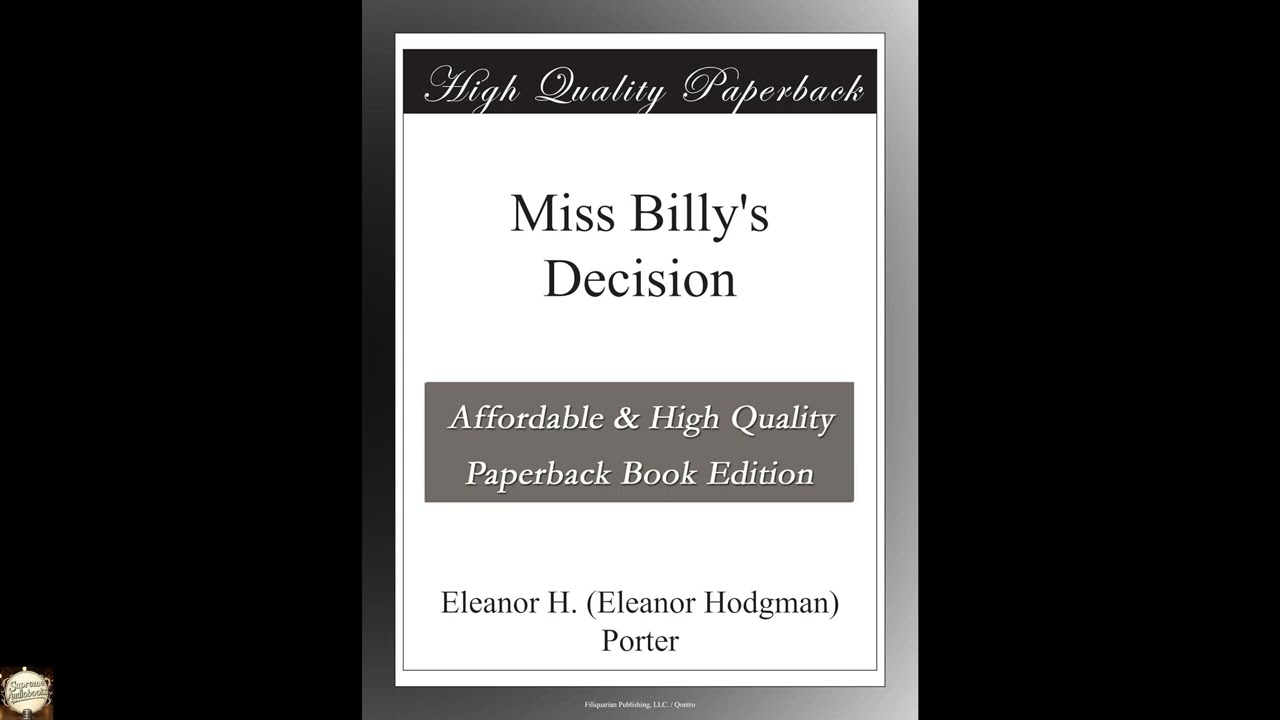
Miss Billy's Decision
What does it mean to make a truly significant choice, one that shapes not only your future but also the happiness of those you hold dear? Eleanor H. Porter’s Miss Billy’s Decision invites listeners into the heart of just such a dilemma, presenting a young woman at a crossroads where affection, duty, and self-discovery collide. This novel, part of Porter’s beloved "Miss Billy" trilogy, offers a refreshing perspective on the complexities of love and identity in an era of societal change. It’s a story that resonates strongly even today, reminding us that the deepest personal decisions often require the greatest courage and clarity of spirit, and that true happiness often hinges on being authentic to oneself. The narrative introduces us to Billy, whose full name, Wilhelmina, hints at the spirited and unconventional nature she often displays. Having found a comfortable place within the household of the kind but often bewildered Mr. and Mrs. Carew, Billy has carved out a life for herself filled with warmth, friendship, and the quiet joys of a New England town. Her days are brightened by the company of her friends, especially the two brothers, Cyril and Allen, who have both grown to care for her deeply. Their companionship provides a sense of stability and affection, but also begins to set the stage for the pivotal choice that gives the novel its title. As the story unfolds, Billy finds herself increasingly aware of the unspoken expectations and competing affections that surround her. The pleasant, almost idyllic atmosphere of her life starts to become tinged with the weight of responsibility, particularly as the romantic intentions of one of the brothers become more explicit, while the quiet devotion of the other also presses upon her heart. She must contend with her own feelings, the potential heartbreak of those she cares for, and the societal pressures that suggest certain paths are more fitting for a young woman of her position. The arc of the story follows Billy as she grapples with these competing forces, seeking not just a resolution to her romantic quandaries but also a deeper understanding of her own desires and convictions. Eleanor Hodgman Porter, born in Littleton, New Hampshire, in 1868, left an indelible mark on American literature before her passing in 1920. Initially trained as a singer at the New England Conservatory of Music, Porter eventually turned her considerable talents to writing, finding a voice that would enchant millions. She began publishing her stories and novels in the early years of the twentieth century, quickly gaining a reputation for her heartwarming and morally uplifting narratives. While Porter is perhaps most widely known for her enduring sensation, Pollyanna, published in 1913, and its subsequent influence on popular culture through the "glad game," her earlier works, such as the "Miss Billy" series, established her as a formidable presence in popular fiction. She specialized in creating characters who faced adversity with an indomitable spirit and a positive outlook, often set against the backdrop of quaint American towns. Her distinctive style, characterized by clear prose, engaging dialogue, and a profound understanding of human nature, secured her a place as one of the most beloved authors of her time, offering comfort and inspiration to readers across the nation. At its core, Miss Billy's Decision examines several enduring themes relevant to personal growth and societal interaction. One prominent theme is the idea of personal agency and decision-making. Billy is not a passive recipient of fate; she actively weighs her options, seeks counsel, and confronts her own feelings. For instance, in moments of quiet reflection or conversation with trusted friends, Billy articulates her struggle to reconcile her affections with what she perceives as her obligations, demonstrating the profound internal work required when confronting a life-altering choice. Another significant theme is the nature of love and companionship. The novel portrays different forms of affection—familial, platonic, and romantic—and how they intertwine and sometimes conflict. Billy’s relationships with the Carews, and especially with Cyril and Allen, are central to this examination. Her internal debate about who she truly loves, and what kind of partner she needs, reflects a deeper inquiry into the foundations of lasting happiness. The book also quietly asserts the theme of authenticity, showing how Billy ultimately strives to honor her true self, even when faced with external pressures or the desire to please others. When Eleanor H. Porter penned Miss Billy's Decision in the early 1910s, America was navigating a period of rapid transformation. The Progressive Era was in full swing, characterized by social reform movements, increasing urbanization, and significant shifts in the roles and expectations for women. While the suffrage movement gained momentum, and women slowly began to enter professions beyond traditional domestic spheres, many young women like Billy still found themselves balancing personal desires with societal conventions regarding marriage, family, and duty. Porter's novels, with their focus on resilient heroines making their way in the world, spoke directly to these evolving sensibilities, providing both reflection and aspiration for her readership. Her stories offered a comforting yet forward-looking perspective on how individuals could maintain optimism and moral fortitude amidst a changing social landscape. Hearing Miss Billy's Decision brought to life as an audiobook offers a uniquely intimate experience of Eleanor H. Porter’s charming storytelling. The several hours of narration allow listeners to become fully immersed in Billy’s world, hearing her internal monologues and the nuanced cadences of dialogue that reveal the true affections and intentions of those around her. A skilled narrator can beautifully convey the subtle shifts in Billy’s emotions—her moments of joyful contentment, her periods of pensive doubt, and her eventual resolve—lending depth to her character. The pacing often reflects the gentle rhythm of small-town life, providing ample space to absorb Porter's witty observations and the quietly building tension of Billy’s personal dilemma, allowing the listener to truly settle into the engaging atmosphere of this beloved classic.
Enjoyed Miss Billy's Decision? A few ways to support us
Audible & Amazon links are affiliate; we may earn a small commission at no extra cost.
About this production
Human narration by a volunteer reader from LibriVox.org, the public-domain audiobook project. LibriVox volunteers record literary works whose copyright has expired in the United States, releasing the resulting recordings into the public domain.
Miss Billy's Decision by Eleanor H. (Eleanor Hodgman) Porter. The underlying text is in the U.S. public domain. We do not republish any modern copyrighted edition, translation, or commentary.
The 4K cinematic visuals accompanying this audiobook are generated by an AI image model from prompts derived from the source text. No copyrighted photos, paintings, or stock footage are used. AI generation is disclosed on every video on our YouTube channel as required by YouTube's altered/synthetic content policy.
English subtitles are transcribed from the LibriVox recording with OpenAI Whisper. Translations into the 11 other supported languages are produced by Meta's NLLB-200 neural translation model. No human translator's copyrighted translation is used.
Questions about sourcing or rights? See our DMCA & Sourcing policy or contact us.
Enjoyed this audiobook?
If you'd like to own a copy of Miss Billy's Decision or hear a professionally produced edition, the links below help support free audiobook production at no extra cost to you.
As an Amazon Associate we earn from qualifying purchases. Audible / print links are affiliate.